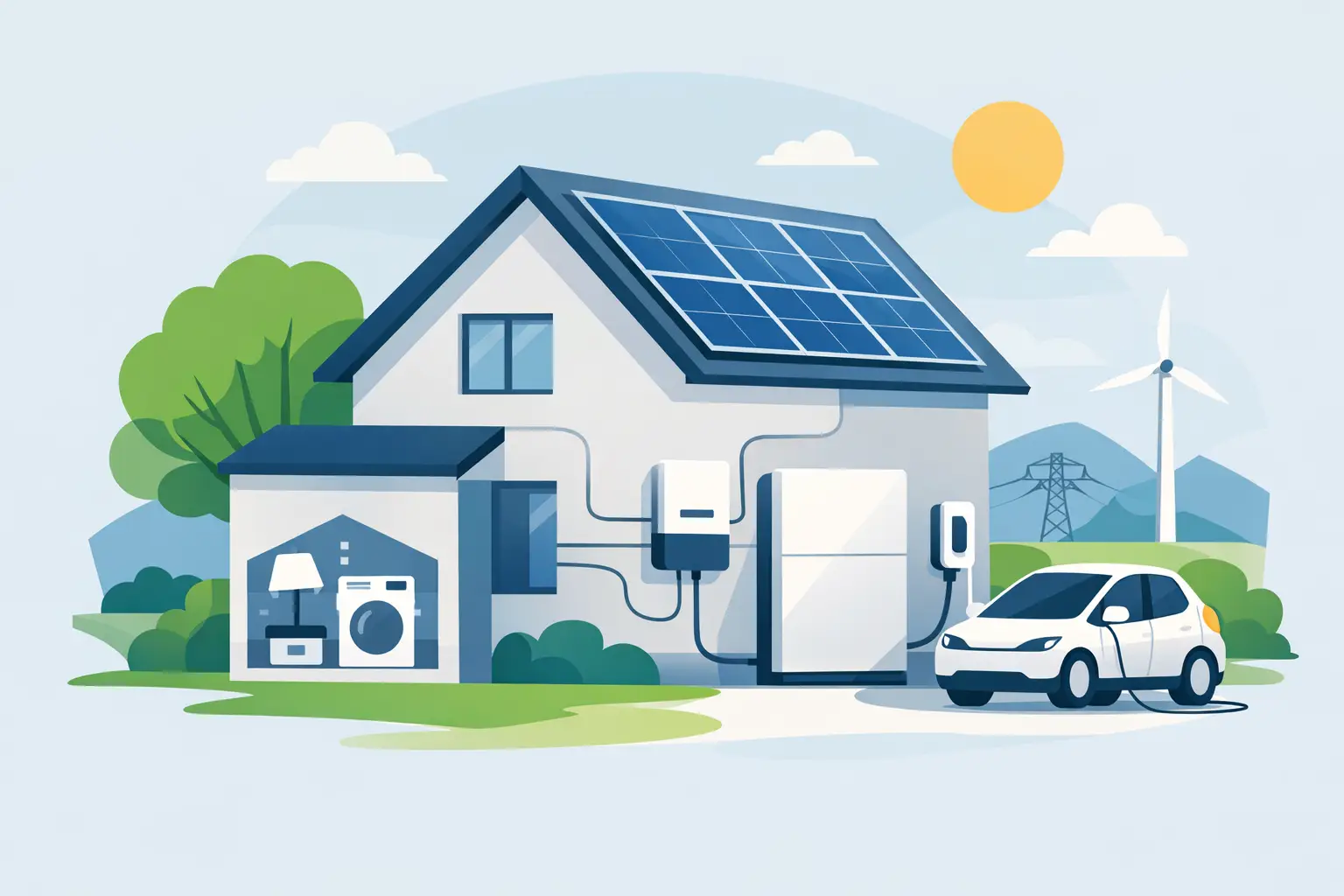
You normally notice battery storage when the sun has gone down and the house is still running on power you generated earlier. That is the point of a good domestic battery storage guide – not clever marketing, but helping you work out whether a battery will genuinely lower bills, improve self-use of solar energy and suit the way your household actually lives.
For many homeowners, the question is not whether batteries are interesting. It is whether they make financial and practical sense now. The answer depends on your electricity use, whether you already have solar panels, the tariff you are on, and what you expect the battery to do. Some households want to store daytime solar for evening use. Others want a degree of backup during outages. Those are not quite the same job, and the right system for one home can be the wrong fit for another.
At its simplest, a domestic battery stores electricity so you can use it later instead of importing it from the grid at full price. In most homes, that stored electricity comes either from solar panels during the day or from cheaper off-peak grid electricity if you are on a suitable tariff.
That sounds straightforward, but the value of a battery depends on timing. If your home is empty all day and most of your electricity use happens in the evening, storage can be very useful because it shifts cheaper or self-generated power into the hours when you need it most. If you use most of your electricity during the daytime already, the gain may be smaller.
This is also where honest advice matters. Batteries are not a cure-all. They do not create electricity, and they do not remove your reliance on the grid altogether unless you are planning a far more complex system. What they do well is improve how efficiently you use the electricity available to you.
Battery storage is often a strong fit for homes with solar PV. Without a battery, surplus daytime generation is usually exported once the home is not using it. With a battery, more of that generation can be kept on site for later use. That usually improves self-consumption and can reduce evening imports.
It can also suit households without solar, particularly where electricity tariffs offer cheaper overnight rates. In that case, the battery can charge when electricity is less expensive and discharge later when rates are higher. Whether that stacks up financially depends on the tariff gap, battery efficiency and your daily usage pattern.
There is also the question of resilience. Some battery systems can provide backup power in a power cut, but not all do. Even among those that do, the level of backup varies. Some systems may support only selected circuits, while others are designed for a broader backup function. This needs careful design from the outset rather than being treated as a simple add-on.
One of the most common mistakes is assuming bigger always means better. In practice, battery sizing should be based on your home’s typical generation and consumption profile.
If a battery is too small, it may fill up quickly and offer limited benefit through the evening. If it is too large, you may pay for capacity you rarely use, especially in winter when solar generation is lower. For many households, the right size sits somewhere in the middle – enough to capture meaningful surplus and cover useful evening demand, without overcommitting budget to storage that spends much of the year underused.
Your installer should look at how much electricity you use across the day, not just your annual total. A home that uses 4,000 kWh a year in a steady pattern is different from one with the same annual use but a sharp evening peak, an EV charging load or electric heating. Good system design starts with those details.
It is worth keeping expectations realistic in winter. Battery storage does not remove the fact that UK solar production drops during darker months. A battery can only store what is available to it, whether from solar or the grid. In summer, a battery may charge and discharge predictably most days. In winter, it may play a smaller role unless paired with off-peak charging strategies.
That does not make it poor value, but it does mean payback and performance should be judged over the whole year, not based on a few bright weeks in July.
The question most people ask first is sensible enough: will it save money? Usually, yes – but the level of saving varies.
A battery can reduce imported electricity, increase the value of your solar by using more of it at home, and potentially make better use of time-of-use tariffs. The strongest savings tend to come where the household has a good match between storage capacity, solar output and evening demand.
Payback is harder to generalise because equipment cost, energy prices and tariff structures all change. Installation quality and system design matter as well. A cheaper battery is not always better value if it is undersized, poorly integrated or supported by weak aftercare.
When reviewing quotes, it helps to look beyond the headline figure. Ask about usable capacity, expected cycle life, warranty terms, round-trip efficiency and whether monitoring is included. These factors affect long-term value more than the sticker price alone.
A proper domestic battery storage guide should also explain that batteries are not all the same. Chemistry, control systems, expandability and compatibility all matter.
Most modern domestic systems use lithium-based technology because it offers good efficiency and compact design. But even within that category, there are differences in how systems are configured and how they work with inverters and solar arrays.
If you already have solar panels, the installer will need to assess whether a battery can be added to the existing setup neatly or whether changes to the inverter arrangement are needed. Some systems are designed from the outset for battery integration, while others need more adaptation. This is one reason site assessment is so important.
You do not need to become an engineer, but you should expect clear answers to a few practical questions. Ask how much of your usual evening use the battery is expected to cover. Ask whether the system includes backup capability and, if so, what that actually powers. Ask where the equipment will be installed, what noise to expect, and what monitoring you will have once the system is running.
A good installer should also explain certification, documentation and any operational limits in plain English. If a proposal sounds too neat, too fast or too certain without a proper survey, that is usually a warning sign.
Battery storage is electrical infrastructure in your home, not a gadget. The quality of installation affects safety, reliability and long-term performance.
That means the conversation should cover cable routes, isolation, ventilation where required, equipment location, commissioning and handover. It should also cover the finish of the work. Homeowners rightly care about whether an installer turns up on time, protects the property, works tidily and leaves clear paperwork behind. Those details are part of a professional job, not extras.
For homeowners in Kent, working with a local specialist such as Baird And Brown LTD can make a real difference here. Direct access to experienced installers, proper site assessment and straightforward advice tend to produce better outcomes than a generic package sold at distance.
The strongest battery installations are usually the ones built around realistic goals. If your aim is to use more of your own solar energy and reduce evening grid use, battery storage can be an excellent addition. If your aim is full energy independence at the lowest possible cost, expectations may need adjusting.
There are trade-offs. A larger battery gives more storage but raises capital cost. Backup capability adds resilience but can add complexity. Charging from off-peak tariffs can improve savings, but only if your tariff and daily use make that worthwhile. None of this is a reason to avoid batteries. It simply means the best system is the one that matches your home, your budget and your habits.
The most useful starting point is not a product brochure. It is a proper conversation about how your home uses electricity now, how that might change in future, and what level of saving or resilience you actually want. Get that part right, and the technology tends to follow sensibly.
