

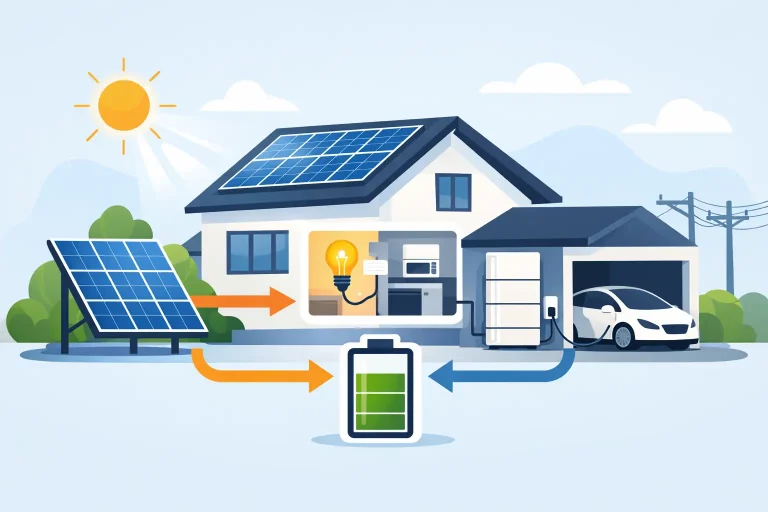
If you have ever looked at your solar generation in the middle of a bright afternoon and thought, we are out all day, so where is that electricity actually going, you are asking the right question. For most homeowners, how do solar batteries work becomes much easier to understand once you stop thinking of them as a separate gadget and start seeing them as part of one system that manages when your home uses power.
A solar battery does not create electricity. Your solar panels do that. The battery stores surplus electricity that your panels have already produced, so you can use it later when the sun has gone down or when your household demand is higher than your panels can cover at that moment. In simple terms, it shifts energy from one time of day to another.
That sounds straightforward, but there are a few parts working together in the background. Once you understand those, it becomes much clearer why battery storage can work very well in one property and be less useful in another.
How do solar batteries work in a domestic system?
In a typical home solar PV setup, the panels generate electricity during daylight hours. Your home will always use the solar power first if there is demand for it. So if the washing machine is on, someone is cooking, or an EV is charging, the solar generation feeds those loads before anything else.
When the panels are generating more than the house needs, that excess has to go somewhere. Without a battery, it is usually exported to the grid. With a battery installed, the system can divert that spare electricity into storage instead.
Later in the day, when solar production drops or stops, the battery discharges and supplies the house. That reduces the amount of electricity you need to import from the grid. The basic job of the battery is not to make more energy, but to help you use more of your own generation.
Whether that happens efficiently depends on the battery size, your usage patterns, the inverter setup, and the control system that decides when to charge and discharge.
The main parts that make battery storage work
Most homeowners do not need a deep lesson in electrical engineering, but it helps to know the key components.
The solar panels generate direct current electricity. In many domestic systems, an inverter converts that into alternating current for use in the home. The battery itself stores electricity chemically, usually using lithium iron phosphate or a similar lithium-based chemistry in modern home systems.
There is then a battery inverter or hybrid inverter that manages the flow of energy between the panels, the battery, your consumer unit and the grid. Alongside that, monitoring and control software tracks generation, household demand, battery charge level and import or export.
Good system design matters here. A battery is only as useful as the way it is integrated. That is one reason many homeowners prefer a proper site assessment and tailored design rather than a one-size-fits-all package.
What happens during the day and at night?
On a sunny morning, your panels begin producing electricity as daylight increases. The house uses what it needs first. If your demand is low and your panels are generating well, the battery starts charging.
By midday, if the battery still has room and solar production remains strong, more of that surplus continues to flow into storage. Once the battery is full, any further excess electricity is normally exported to the grid.
In the evening, when solar output falls away, the battery begins to discharge to support the home. It may run lighting, appliances, internet equipment, refrigeration and other usual household loads depending on the size of the battery and how much energy you use.
Overnight, if the battery empties before morning, the property then imports from the grid as normal. Some systems can also be set to charge from cheaper off-peak tariffs overnight, which can make financial sense in the right circumstances. That is not the same as solar storage in the pure sense, but it is often part of a sensible whole-home energy strategy.
How the battery knows when to charge or discharge
This is where the system intelligence comes in. A properly configured battery system measures power flowing to and from the property. If your home is importing electricity while the battery has usable charge available, the controls can tell the battery to discharge and reduce that import.
If the panels are producing more than the home is using, the controls can direct the excess into the battery. If the battery is full, the extra is exported. It is all based on real-time measurement.
Some systems are simple and mainly react to current conditions. Others are smarter and can be programmed around tariff times, backup reserve levels or expected household demand. For example, a homeowner with an electric vehicle may want the battery to keep a reserve for the evening rather than discharging too early in the day.
This is why there is no universal best setting for every household. A retired couple at home during the day may use solar very differently from a family who are out until 6pm.
How efficient are solar batteries?
Batteries are not perfect storage devices. Every time electricity is stored and then used again, there are small losses. This is known as round-trip efficiency. Many modern domestic batteries perform well, but no system returns 100 per cent of what went in.
In practice, that means a little of the energy is lost during charging, storage and discharge. For most homeowners, that does not cancel out the benefit. It simply means battery storage works best when the system is sized and configured properly.
There is also the question of usable capacity. A battery might be advertised at a certain size, but not all of that may be available for everyday use. Manufacturers often hold back a small portion to protect battery health and prolong lifespan.
Can a solar battery power the whole house?
Sometimes yes, but usually not indefinitely, and not always every circuit.
This is one of the most common misunderstandings. A home battery can support household loads, but the extent depends on its capacity, the inverter output and whether the system has been designed for backup operation. Running lights and sockets is very different from running an electric shower, immersion heater or heat pump at full load.
If there is a power cut, not every battery system automatically keeps the home running. Many standard installations shut down with the grid unless they include backup functionality and the correct changeover arrangements. If backup power matters to you, that should be discussed from the outset rather than assumed.
For some households, backup for a few essential circuits is enough. For others, whole-home backup may be the aim, but that usually needs more careful design and a larger budget.
What affects whether a battery is worth it?
The answer depends on how and when you use electricity.
If your home is empty most of the day and your solar panels are producing energy when nobody is there to use it, battery storage can make a lot of sense. It lets you keep more of that generation for the evening. If you are already at home during the day and use most of your solar power as it is produced, the battery may have less work to do.
Your tariff also matters. The value of avoiding peak-rate electricity can improve the case for storage. The same applies if you have an EV and want to manage charging more efficiently.
Then there is system size. A small battery paired with a large array may fill quickly and still export plenty. A very large battery on a modest solar system may take longer to charge fully, especially in winter. Balance is important.
In Kent, where many homeowners are looking for practical ways to reduce bills without overcomplicating the system, the best results usually come from matching battery size to real household habits rather than chasing the biggest unit available.
How long do solar batteries last?
Most modern home batteries are designed for years of regular use, but they do not last forever. Battery life is affected by cycle count, operating temperatures, charging behaviour and manufacturer design.
A good quality battery should offer solid long-term performance, but capacity will gradually reduce over time. That does not mean failure. It simply means the battery may store a little less energy after years of use than it did when new.
This is another area where product quality and installation standards matter. The battery itself is important, but so is where it is installed, how it is protected and how well the whole system has been commissioned.
Why installation quality matters as much as the battery
A battery is not just a box fixed to the wall. It is part of your home electrical system, and it needs to be designed around your property, your energy use and the equipment already in place.
Poorly planned installations can leave homeowners with disappointing performance, awkward app controls or a system that does not behave as expected. A proper installer should explain how the battery will operate through the year, what savings are realistic, whether backup is included, and what trade-offs come with different battery sizes.
That straightforward approach is often more valuable than headline claims. Companies such as Baird And Brown LTD focus on that practical side of the job because homeowners need clear advice, tidy installation work and a system that performs properly after the installers have left.
A simple way to think about it
If you want the shortest answer to how do solar batteries work, it is this: they store spare solar electricity so your home can use it later instead of buying as much from the grid.
The more useful answer is that battery storage works well when it is matched to the property, the tariff and the people living there. A well-designed system can make your solar investment work harder, but the right setup is not always the biggest or most expensive one. Usually, it is the one that fits the way your home actually runs.
