

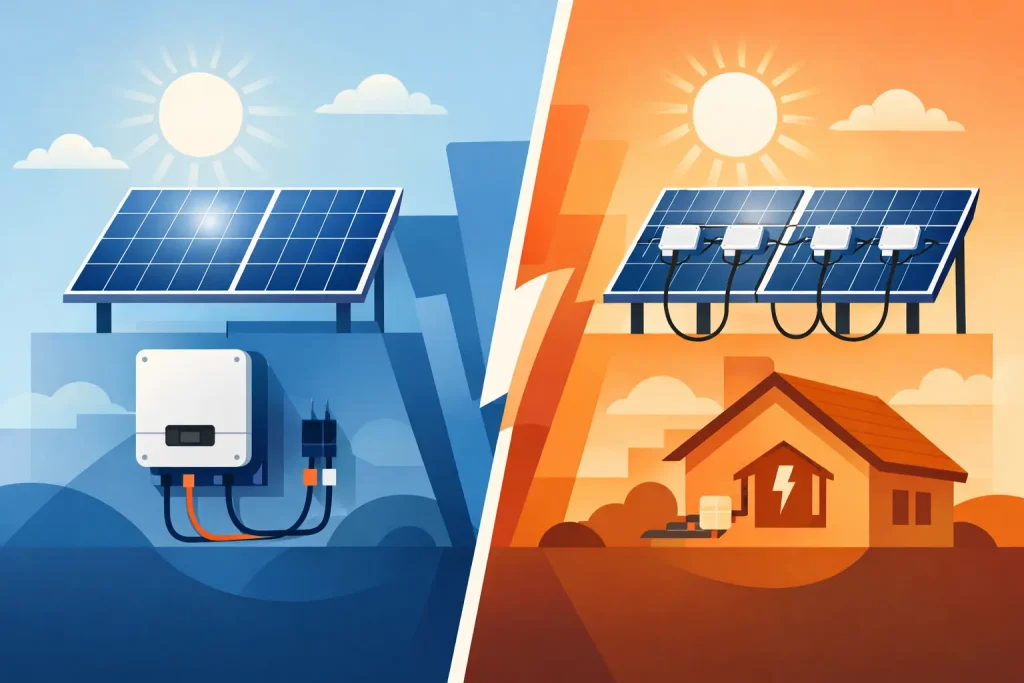
If you are comparing solar inverter vs microinverter options, you are already asking one of the most worthwhile questions in a solar project. The panels often get the attention, but the inverter setup has a big effect on performance, fault finding, future expansion and overall value. For homeowners in Kent, where roof shapes, chimney shading and budget all vary from property to property, the right answer is rarely one-size-fits-all.
A lot of online advice makes this sound simpler than it is. In practice, both systems can be excellent when they are matched properly to the property. The key is understanding how each one works and where the trade-offs sit.
Solar inverter vs microinverter: what is the difference?
A standard solar inverter, often called a string inverter, takes the direct current generated by a group of panels and converts it into usable alternating current for the home. In most domestic systems, several panels are wired together into one or more strings, and those strings feed into a single inverter.
A microinverter works differently. Instead of one central inverter handling a group of panels, each panel has its own small inverter fitted beneath it. That means every panel converts electricity individually.
On paper, that sounds like microinverters are automatically better. They are not always. They solve certain problems very well, but they also change the cost, complexity and maintenance considerations of the system.
When a string inverter makes more sense
For many homes, a string inverter remains a very sensible choice. If the roof has a simple layout, with panels facing the same direction and very little shading, a string inverter can deliver strong performance at a lower upfront cost.
This is often the most economical route for households who want solid returns without paying extra for features they may not actually need. A good quality string inverter, installed properly and matched to the array, can provide dependable generation for years.
There is also a practical point here. Fewer electronic components on the roof can mean a simpler installation. That does not automatically make it better, but on straightforward properties it can be a neat and efficient solution.
Some systems also use power optimisers alongside a string inverter. That sits somewhere between a basic string system and a full microinverter setup. It can help where there is some shading or panel mismatch, without moving fully to panel-level inversion.
Where microinverters come into their own
Microinverters tend to shine when the roof is more complicated. If one side of the array catches shade from a chimney, a nearby tree or a neighbouring property, panel-level conversion can reduce the impact on the rest of the system.
With a traditional string setup, the performance of one weaker panel can affect the output of others in the same string. With microinverters, each panel works more independently. So if one panel is underperforming because of shade or dirt, the rest can continue producing more effectively.
They can also be a good fit where panels are split across different roof faces, such as east and west, or where a future extension to the system is likely. That extra flexibility is useful on homes where roof space is broken up rather than being one clean rectangle.
For some homeowners, the panel-level monitoring is another advantage. It can make it easier to see whether one panel is not performing as it should, which helps with diagnostics over time.
Performance in real-world conditions
This is the point many homeowners care about most. Which one generates more electricity?
The honest answer is it depends on the roof. On an open, unshaded roof with panels all facing the same direction, the difference in annual generation may be modest. In that case, paying more for microinverters may not produce enough extra yield to justify the additional cost.
On a roof with regular shading or mixed orientations, microinverters can offer a more noticeable gain. Not because they are magic, but because they allow each panel to operate on its own terms rather than being dragged down by the weakest part of a string.
That is why site assessment matters. The best system on paper is not necessarily the best system for your house. Chimneys, dormers, satellite dishes and nearby trees all change the picture.
Cost and long-term value
In a straight comparison of solar inverter vs microinverter systems, string inverters are usually cheaper to install. There is typically one main inverter unit, fewer individual components and often a lower overall equipment cost.
Microinverters generally come with a higher upfront price because there is one unit per panel. For some households, that extra spend is worthwhile because of the shading benefits, design flexibility or panel-level monitoring. For others, it simply stretches the budget without adding enough practical benefit.
Long-term value is not only about purchase price. It is about what the system produces over time, how easy it is to maintain, and whether it suits the way the property may change in future. If a lower-cost string system performs very well on your roof, that can be the better investment. If a cheaper system loses output because of avoidable shading issues, it may be a false economy.
Reliability and maintenance
Reliability is often discussed in very black-and-white terms, but it is more nuanced than that.
With a string inverter, there is usually one main unit to monitor and, if needed, replace. If that inverter fails, the system output can stop altogether until the issue is resolved. The upside is that the equipment is accessible and fault tracing can be relatively straightforward.
With microinverters, there are more individual electronic components on the roof. That means no single central point of failure in the same way, but it also means more units overall. If one microinverter develops a fault, the rest of the system can continue working, although access for replacement may be more involved because the unit sits beneath the panel.
Neither option is inherently problem-free. What matters is the quality of the equipment, the design of the system and the standard of installation. Good workmanship, correct cable management and proper commissioning make a real difference whichever route you choose.
Battery storage compatibility
If you are planning to add battery storage, or think you might in future, inverter choice should be considered as part of the wider system rather than in isolation.
Some battery setups integrate more naturally with certain inverter arrangements than others. That does not mean either string inverters or microinverters rule out a battery, but the design needs to be thought through from the start. Retrofitting later is possible, yet it is usually easier and cleaner when future plans are part of the original conversation.
This is especially relevant for homeowners looking at solar as part of a broader upgrade that may also include an EV charger or more electric heating. The best advice takes the whole property into account, not just the panel layout.
Which option is better for most homes?
There is no single winner in the solar inverter vs microinverter question. The better choice depends on your roof, your budget and how much flexibility you need.
If your roof is simple, largely unshaded and all panels will sit on the same aspect, a string inverter is often the sensible and cost-effective answer. It can provide excellent results without adding unnecessary complexity.
If your roof has partial shading, multiple orientations or awkward sections, microinverters may well justify the extra investment. They are also worth considering if detailed panel-level monitoring matters to you or if you expect to expand the array later.
For many households, the right choice becomes clear once someone has looked properly at the property rather than relying on generic online comparisons. That is usually where honest, installer-led advice adds the most value. A good assessment should explain not just what is possible, but why one setup is more suitable than another.
Questions worth asking before you decide
Before choosing either option, ask how much shading affects the roof across the day and across the year. Ask whether all panels will face the same direction. Ask how future battery storage would fit in, and whether there is any realistic plan to expand the system later.
It is also worth asking what monitoring you will actually use. Some homeowners like panel-by-panel visibility. Others simply want the system to work well and show total generation clearly. There is no right preference, but it should be part of the decision.
Most of all, ask for a recommendation based on your property rather than a stock answer. At Baird And Brown LTD, that is the kind of conversation we believe homeowners should expect – clear, practical and based on what will work best on site.
The right solar system should feel sensible from day one and still make sense years later, when energy prices, household usage and future upgrades have moved on.




