

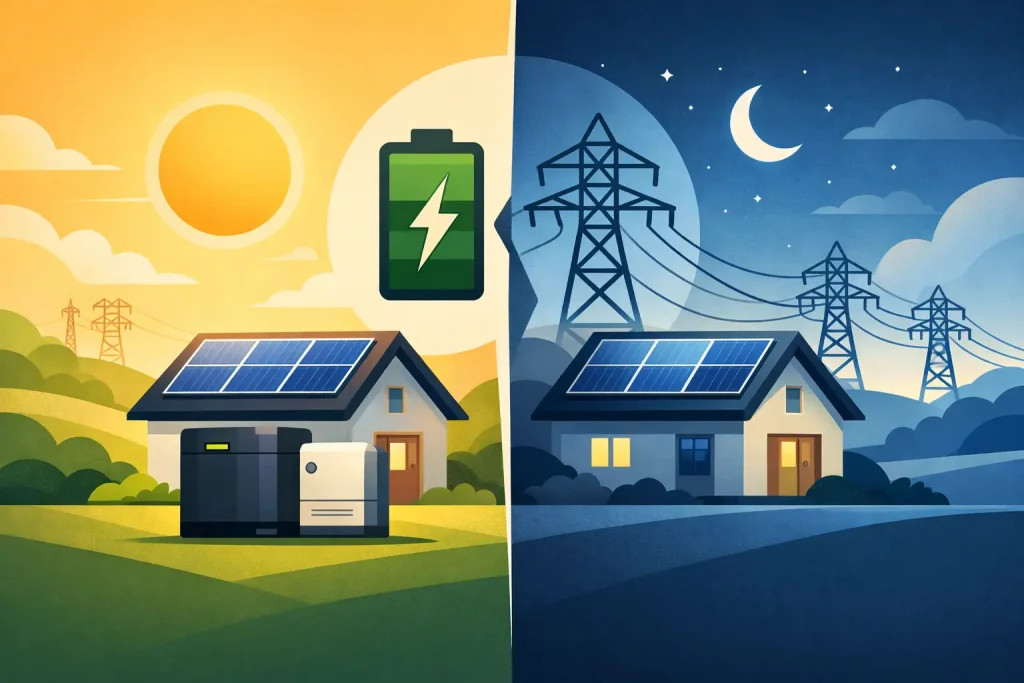
If you are planning solar for your home, one of the first decisions is solar battery vs no battery. It sounds like a simple either-or, but in practice it comes down to how your household uses electricity, when you are at home, and what you want from the system over the next 10 to 15 years.
For some homes, adding battery storage is a sensible upgrade that improves self-use and gives more control over energy costs. For others, it can add cost without enough benefit to justify it. The right answer is rarely the one with the biggest specification on paper. It is the one that suits the property and the people living in it.
Solar battery vs no battery: what changes?
A standard solar PV system without a battery generates electricity during daylight hours. Your home uses that power first, and any surplus is exported back to the grid. That setup is straightforward, reliable and often the lowest-cost way to start reducing electricity bills.
When you add a battery, some of that spare daytime generation can be stored and used later, usually in the evening when the panels are no longer producing. In some cases, batteries can also charge from the grid at cheaper off-peak rates, depending on the tariff and the system design.
So the main difference is not whether solar works without a battery – it does. The difference is how much of your own generated electricity you can keep and use yourself.
When no battery makes good sense
A lot of homeowners assume a battery is essential. It is not. Plenty of well-designed solar systems perform very well without one.
If someone is at home during the day, perhaps working from home, retired, or running appliances in daylight hours, a battery may be less important. The household is already using a good portion of the solar generation as it happens. In that case, the panels themselves may deliver most of the value.
No-battery systems also suit homeowners who want to keep the initial investment lower. Solar alone usually means a shorter payback period because there is less equipment to buy and install. You still reduce the amount of electricity you need to import from the grid, and you can still receive payment for exported power where eligible under your tariff.
There is also less complexity. Fewer components means fewer variables in the system design and a lower upfront cost. For many households, especially where roof space and budget are the main priorities, solar without battery storage is a perfectly sensible first step.
When a battery is worth serious consideration
Battery storage becomes much more attractive when your daytime usage is low and your evening usage is high. That is common in households where everyone is out during working hours, then returns home and uses most of their electricity later in the day for cooking, lighting, washing and entertainment.
Without a battery, much of the daytime solar may be exported for a modest return, while you still buy electricity back from the grid in the evening at a higher rate. With a battery, more of your own generation can be shifted into those higher-use hours.
A battery can also appeal to homeowners who want more control and predictability. Rising energy prices have made many people look beyond basic bill savings. They want to rely less on imported electricity and make better use of what their roof is generating.
If you own an electric vehicle, a battery may also fit better into the wider setup, though not always. It depends on when the car is home, how much charging it needs, and whether overnight tariffs already make grid charging economical.
The cost question homeowners really care about
Most decisions come back to value rather than technology. A battery nearly always increases the total system cost, so the question is whether the extra savings justify that additional spend.
That depends on several factors: your annual electricity use, the size of the solar array, how much energy you use in the evening, your export tariff, and whether you can benefit from time-of-use rates. There is no honest one-size-fits-all answer.
In some homes, a battery improves the economics clearly. In others, the financial return is slower, and the reason for choosing one is more about energy independence and flexibility than pure payback.
This is where good system design matters. Oversizing a battery sounds appealing, but if it is rarely filled and used properly, you are paying for storage capacity that brings little benefit. Equally, a battery that is too small may limit the advantage. The best system is usually sized around real usage patterns rather than guesswork.
Solar battery vs no battery for different household patterns
A retired couple who are home most days may find a no-battery system performs better than expected, simply because they can use washing machines, dishwashers and other appliances during daylight hours. Their solar generation is being consumed directly, which is always efficient.
A family that leaves the house empty from 8am to 6pm may see the opposite. The home generates well during the day but uses most electricity after sunset. In that situation, battery storage often has a stronger case.
New-build homes can be slightly different again. If the property already includes efficient heating, modern insulation and future-ready electrical planning, it often makes sense to consider battery storage from the outset, particularly if EV charging is part of the plan.
The key point is that two homes in the same street can need different answers. Similar roofs do not mean similar electricity habits.
What a battery does not do
It is worth clearing up a common misunderstanding. A battery does not automatically mean full backup power during a power cut. Some systems can provide backup capability, but many standard domestic battery installations do not operate that way unless they are specifically designed and configured for it.
It is also wrong to assume that a battery makes every solar installation dramatically more profitable. In some cases it helps a great deal. In others it improves self-consumption but only gradually pays back over time.
That is why straightforward advice matters. A battery should be recommended because it suits the home, not because it makes the quotation look more impressive.
Thinking beyond today
There is also a timing question. Some homeowners install solar panels first and add a battery later. That can be a sensible route if you want to start generating now but spread the cost. It is not always the cheapest option long term, depending on the equipment chosen, but it can be the most practical.
Others prefer to install a complete system from day one so everything is designed to work together from the start. That often gives a neater, more integrated result and avoids revisiting the installation later.
For households planning an EV, a heat pump, or increased electricity demand in the next few years, battery storage can make more sense now than it would have done in the past. Your energy profile may not stay the same.
Why a proper survey matters more than a quick quote
The best answer to solar battery vs no battery usually comes from a site visit and an honest conversation. Roof orientation, shading, consumer unit setup, available installation space and actual household usage all matter. So does your budget and your preference for lower upfront cost versus longer-term flexibility.
This is where a local installer should add value. Rather than pushing a standard package, they should assess how the property works in real life and explain the trade-offs clearly. At Baird and Brown Ltd, that practical approach matters because the decision should be based on how the system will perform on your home, not how well a generic package sells online.
Which option is right for you?
If your goal is to start saving with the lowest sensible upfront cost, and you use a fair amount of electricity during the day, solar without a battery may be the better fit. It is simpler, effective and often offers strong value.
If your home is empty in daylight hours, your evening usage is high, or you want more control over how and when electricity is used, a battery deserves proper consideration. The same applies if you are planning for an EV or want a system that is better aligned with future energy use.
The useful question is not whether batteries are good or bad. It is whether one earns its place in your particular system. A well-designed solar installation should fit the way you live, and that usually starts with honest numbers, sensible expectations and advice that does not try to force one answer on every home.




