

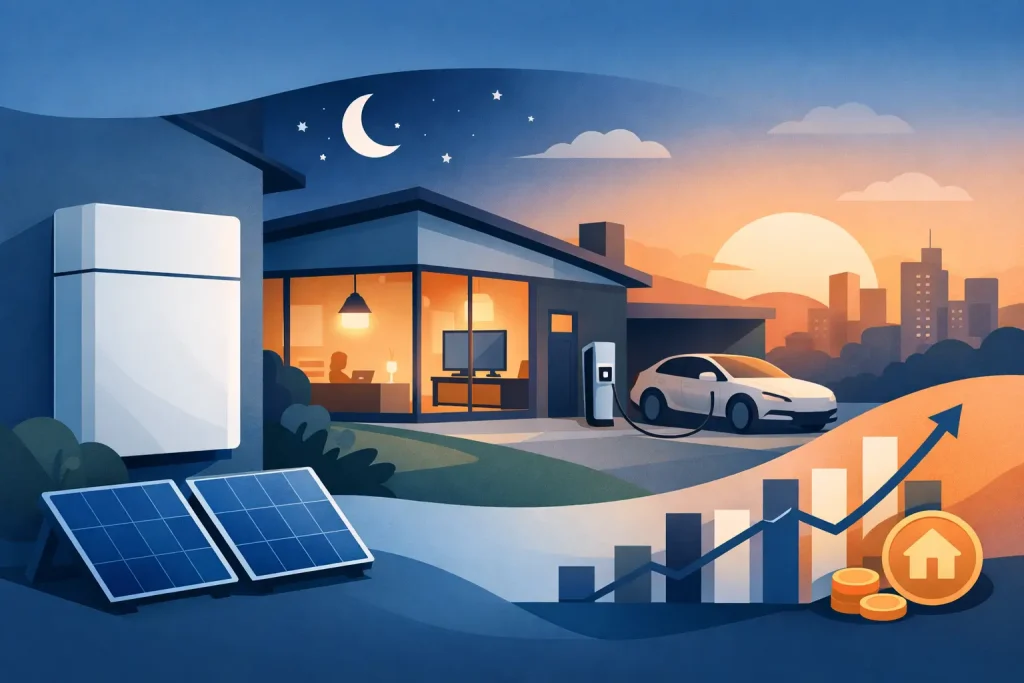
The expensive part of many household energy bills often arrives after work. Lights come on, the oven goes on, children are home, and an electric vehicle may be charging on the drive. Yet this is also the time when solar generation is falling away. So, can battery storage cut evening bills? For many Kent households, it can – but the size of the saving depends on how the system is designed, how your home uses electricity and the tariff you choose.
A home battery does not generate electricity. It stores electricity when it is cheapest or most available, then supplies it later when buying power from the grid would cost more. Used well, it can make a solar PV system more useful after sunset and give households greater control over when they import electricity.
Can battery storage cut evening bills with solar?
Yes. The most straightforward example is a solar-equipped home that produces more electricity than it needs around midday. Without a battery, much of that surplus is exported to the grid. You receive an export payment, but it is often lower than the cost of buying electricity back during the evening.
With battery storage, surplus solar can be held back for later. Instead of exporting every spare kilowatt-hour at lunchtime and importing power at 6pm, the battery can cover some or all of the evening demand. This is known as increasing solar self-consumption.
Imagine a bright spring day. Your panels may generate well while the house is quiet, with only background appliances running. By early evening, solar output has reduced, but cooking, washing, entertainment and heating controls are all using power. A correctly sized battery can bridge that gap.
It is not a guarantee that you will avoid grid electricity every evening. In winter, daylight is shorter and solar production can be modest for several days at a time. A battery helps you use the energy available more effectively; it cannot store electricity that has not been generated.
Off-peak tariffs can change the calculation
Solar is only one way to charge a battery. Many modern electricity tariffs offer cheaper overnight rates, particularly for households that can shift demand away from peak periods. A battery can charge when electricity is less expensive and discharge when rates are higher.
This can be valuable in winter, when there may be limited excess solar to store. Rather than relying solely on daytime generation, the battery can be programmed to take advantage of a lower overnight unit rate and reduce daytime or evening imports.
However, tariff charging needs sensible settings. If you are paid a good rate to export solar, it may sometimes be better to export surplus generation and charge from a cheaper off-peak period. On other tariffs, storing your own solar may provide the better return. The right approach is based on the actual import rate, export rate, battery losses and your household pattern, not a one-size-fits-all rule.
Battery losses matter
A battery is efficient, but it is not lossless. Some energy is used during charging and discharging, and a small amount may be used to keep the system operating. That means it rarely makes financial sense to charge a battery from the grid at a rate that is only slightly cheaper than the rate you would otherwise pay in the evening.
The gap between the off-peak and peak price needs to be large enough to cover those losses and still leave a worthwhile saving. This is why reviewing available tariffs should form part of the design conversation.
The right battery size is more useful than the biggest one
Battery capacity is usually measured in kilowatt-hours, or kWh. A larger battery can store more energy, but that does not automatically make it the best investment. If a household only has a small amount of surplus solar most days, a very large battery may spend much of the year underused.
Equally, a battery that is too small may fill early in the day and leave you exporting solar that could have been used later. It may also run out before the main evening demand begins. The useful size is linked to your typical solar surplus, your evening electricity use, your tariff and whether major loads such as an EV are involved.
Power rating matters too. Capacity tells you how much energy the battery can hold. Power tells you how quickly it can deliver that energy. If several appliances run at once, a battery with a low output rating may not cover the whole demand, so the balance will still come from the grid.
A proper site assessment looks beyond annual consumption figures. Half-hourly smart-meter data, where available, provides a far clearer picture of when you use electricity. It can show whether the house has a sharp peak between 5pm and 8pm, a steadier all-day load, or high overnight demand from EV charging.
When battery storage is most likely to help
Battery storage tends to suit households that use a meaningful amount of electricity after solar production drops, especially where there is regular daytime solar surplus. Families who are out during the day and active at home in the evening often fit this pattern well.
It can also make sense for homes with an electric vehicle, but the charging routine matters. If the vehicle is normally charged overnight on a low-cost tariff, it may be better not to use battery capacity for the car at all. If charging happens in the early evening, the combined demand can be considerable and should be included in the system design.
Homes without solar can still benefit from a battery and a suitable time-of-use tariff. In that case, the value comes mainly from tariff shifting rather than solar self-consumption. Whether it stacks up financially depends on the available rates and how reliably the household can charge off-peak and avoid importing at peak times.
Situations where savings may be smaller
Honest advice means recognising where battery storage may not deliver the result a homeowner expects. A household that uses little electricity in the evening may have less to gain. The same applies if most solar generation is already used directly during the day, leaving little spare energy to store.
Winter performance also needs realistic expectations. A battery charged by solar on a sunny July day may cover a substantial evening load. During a dull January week, the same battery may need grid charging or may not have enough stored energy to make much difference.
There are practical considerations as well. Battery systems need an appropriate installation location, suitable electrical protection and clear commissioning documentation. If backup power is a priority during a power cut, that must be specified from the outset. Not every battery installation provides backup automatically, and backup circuits have their own design requirements.
Getting the settings right after installation
The installation is only part of the job. A battery needs settings that match its purpose. Charge and discharge windows, reserve capacity, export behaviour and tariff schedules all affect the outcome.
For example, holding a high emergency reserve gives more protection in the event of an outage, but leaves less stored energy available to reduce normal evening imports. There is no wrong choice, but it should be a deliberate one. Some households value resilience; others prioritise daily bill savings.
Monitoring is useful during the first few months. It allows you to see whether the battery is filling, when it is discharging, and whether your tariff schedule is doing what you intended. Seasonal changes may justify adjustments, particularly between summer solar production and winter off-peak charging.
At Baird And Brown LTD, the aim is to design around the way a home actually works rather than simply fitting the largest battery available. That includes looking at the existing consumer unit, roof generation, future EV plans and the practical space available for equipment.
A battery should support a wider energy plan
Battery storage works best as part of a considered home energy setup. Solar PV, an appropriate electricity tariff, efficient appliances and planned EV charging can all support one another. A battery cannot correct an inefficient home on its own, but it can help you buy less expensive electricity and make better use of the generation you already have.
Before making a decision, ask for a clear explanation of the expected operating pattern, not just an annual saving estimate. You should understand what will charge the battery, when it will discharge, what happens in winter, and whether the proposed capacity suits your likely demand.
Evening bills are often where solar-only systems leave value on the table. A well-designed battery gives that daytime energy somewhere useful to go – and, with realistic expectations and the right tariff, it can make the hours after sunset considerably less costly.
