

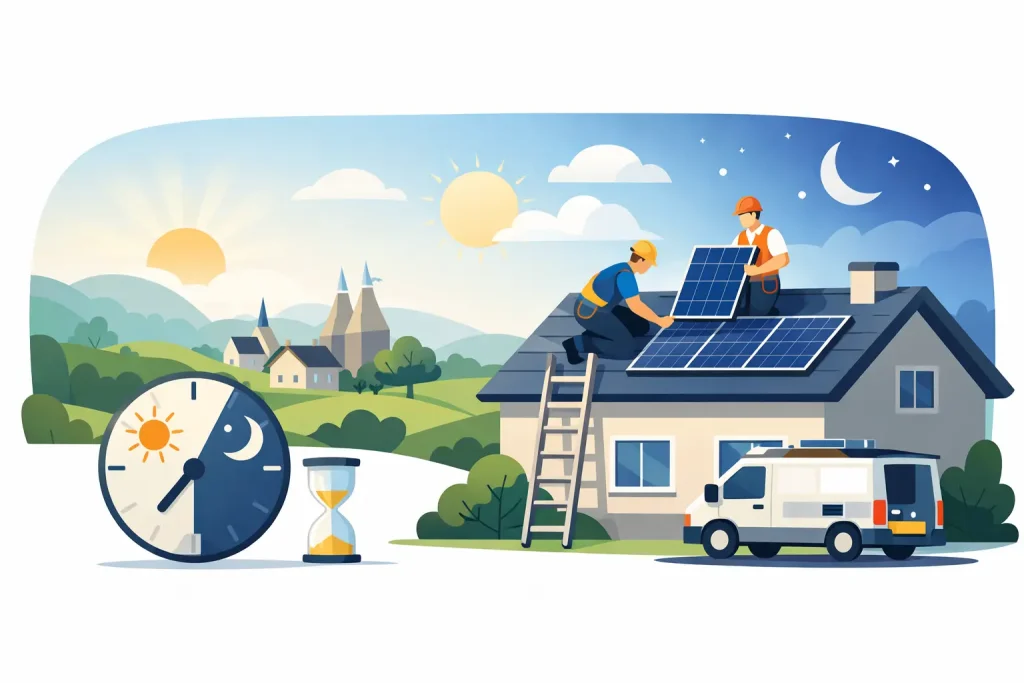
A solar PV installation may only take a day or two on your roof, but that is not the whole project. When homeowners ask, “how long does solar installation take?”, the honest answer is usually four to 12 weeks from first survey to a fully commissioned system – with the on-site work forming only a small part of that time.
The exact timetable depends on your roof, the system size, whether you are adding battery storage, and the approval requirements for your local electricity network. A good installer will explain the likely programme before work begins, rather than promising an unrealistic fitting date and leaving the details until later.
How long does solar installation take from start to finish?
For a straightforward domestic solar PV system in Kent, a typical programme looks like this:
- Initial discussion and site survey: usually within one to two weeks, depending on availability.
- Design, quotation and your approval: often one to two weeks.
- Network application, equipment ordering and scheduling: commonly two to eight weeks.
- Physical installation and commissioning: generally one day, sometimes two.
- Handover documents and export arrangements: usually provided at commissioning, with any network confirmation following the relevant process.
This means a standard installation can sometimes move from survey to completion in around a month. More complex projects can take longer, particularly where the electricity network needs to approve an application before installation can proceed.
The survey and design stage
The first visit is where a realistic timescale begins. An installer needs to inspect the roof, assess shading, check access around the property and identify a suitable route for cables between the panels, inverter, consumer unit and, where applicable, battery.
They will also look at the condition of the roof covering and the electrical installation. Solar panels should not be installed onto a roof that is close to needing major repairs. It is normally better to resolve slipped tiles, ageing felt or structural concerns first than to remove and refit a new solar array shortly afterwards.
For many homes, the survey takes one to two hours. The system design then needs to account for usable roof space, panel orientation, expected generation, your household electricity use and future plans. For example, a household planning to buy an electric vehicle or add a heat pump may benefit from a different inverter or battery arrangement than a home focused purely on daytime electricity savings.
A carefully prepared design may take a little longer than a quick sales quote, but it avoids costly assumptions. It should make clear what is being installed, where the equipment will go and what work is included.
What can slow down a survey?
Access and information are the usual issues. If the loft is difficult to enter, the consumer unit is in an unusual location, or drawings are needed for a new-build property, further checks may be required. Homes with older electrics may also need remedial work before a solar system can be connected safely.
This is not necessarily a reason to abandon the project. It simply needs to be planned properly, with the work and cost explained before an installation date is agreed.
Network approval can be the longest part
Your solar system connects to the local electricity network, so the Distribution Network Operator, or DNO, must be notified. The route depends mainly on the size and specification of the proposed system.
Some smaller domestic systems can be installed under a process that is notified to the DNO after commissioning. Others require approval before installation. This is commonly the case with larger systems, certain inverter capacities, or more involved battery arrangements. Where prior approval is needed, the DNO may need several weeks to assess the application and confirm whether any network work is required.
Most properties are straightforward, but there are exceptions. A rural supply, a property at the end of a long network run, or an area with significant local generation may have limited export capacity. In these cases, the DNO might approve the system with an export limit, request more information, or identify upgrade work that affects the programme.
This is why a responsible installer should not treat network paperwork as an afterthought. It protects you from finding out late in the process that the proposed system needs to change.
Ordering equipment and booking the work
Once the design is agreed and any necessary approvals are in place, the installation can be scheduled. Availability of panels, inverters and batteries can affect timing, although commonly specified equipment is often readily available.
Battery storage can add some planning time because the proposed location needs careful consideration. A battery should be fitted in an appropriate environment with suitable clearances, ventilation where required and a safe cable route. The garage, utility room or a dedicated cupboard may work well, but each property is different.
Weather can also influence the booking. Installers can work in many ordinary British weather conditions, but high winds, lightning risk or unsafe roof conditions may mean postponing roof work. A short delay is preferable to rushing a job when it is not safe to do so.
How long are installers at your home?
A typical solar-only installation on a standard house is often completed in one working day. A larger array, a difficult roof layout or a consumer unit upgrade can extend this to two days.
Solar panels and roof mounting equipment are fitted first, before the electrical work is completed. Cables are routed neatly to the inverter, which converts the panels’ direct current into electricity your home can use. The system is then connected to the consumer unit through the required protective equipment.
If you are having battery storage, allow for additional installation and testing time. A solar-and-battery project commonly takes two days, although a simple system may still be completed in one. EV charger installation, electrical upgrades or work across several roof elevations can also make the programme longer.
You should not expect your home to be turned upside down. There will be some disruption while cables are run and equipment is installed, but good preparation makes a difference. The work area should be protected, access agreed in advance and any dust or packaging cleared away at the end of the job.
Will you lose power during installation?
Usually, any interruption is brief. The electrician may need to isolate the supply while connecting the solar system or making changes at the consumer unit. Your installer should tell you in advance when this is likely to happen, which is especially useful if someone at home relies on medical equipment or works remotely.
Once the system is commissioned, it does not generally start producing useful power only on a perfect summer day. It will generate whenever daylight levels allow, though output naturally changes with the season, cloud cover and the angle of the sun.
Testing, certification and handover
Installation is not complete when the final panel is in place. The electrical system must be tested and commissioned, including checks on generation, safety devices and monitoring. You should also be shown how to use the app or monitoring platform, understand what normal performance looks like and know who to contact with questions.
For an MCS-certified installation, your documentation is particularly important. Keep your electrical certificate, MCS certificate, product warranties, system design information and DNO paperwork safely. These documents support the quality record for the work and may be needed when applying for export payments from an electricity supplier.
The export tariff itself is separate from the physical installation. Once your system is operating, you can choose a supplier and tariff that suits your circumstances. Make sure your meter arrangements are suitable for recording exported electricity, and ask if anything needs updating.
When a solar project takes longer than expected
Delays are frustrating, but not all are avoidable or a sign of poor service. The most common causes are DNO approval, roof repairs, electrical improvements, access complications, specialist equipment lead times and weather conditions that make roof work unsafe.
Planning permission is not required for many domestic solar installations, as they can fall under permitted development rules. However, listed buildings, conservation areas, unusual mounting positions and new-build planning conditions can need additional checks. It is wise to establish this early rather than assume every roof is treated in the same way.
The quickest route is not always the best one. A local, properly surveyed installation that allows time for safe design, clear paperwork and tidy finishing is more valuable than a rushed fitting that creates problems later.
For most homeowners, the reassuring point is this: the visible work is short, and the wider process is manageable when it is planned in the right order. Ask for a clear timeline at quotation stage, make the installer aware of any roof or electrical concerns, and leave enough room in the diary for approvals and sensible weather contingencies. That approach gives your solar system the best possible start.




