
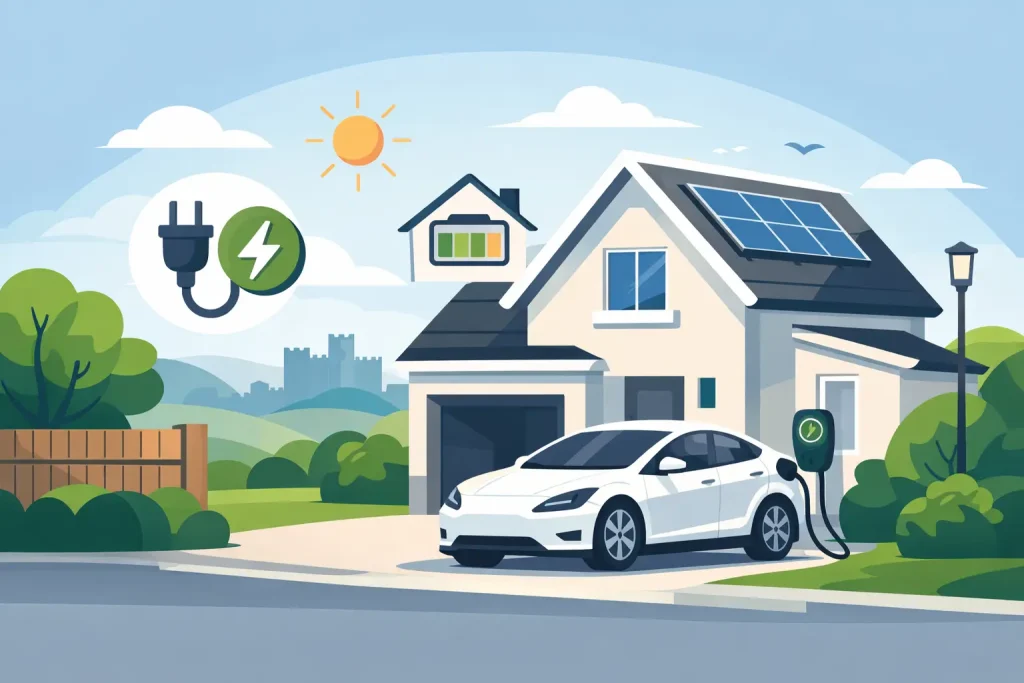
A public charger can be useful when you are away from home, but it is rarely the most convenient or economical way to run an electric car day to day. A properly planned home charger lets you arrive, plug in and wake up with the battery ready for the journeys ahead. This domestic EV charging guide covers the practical decisions Kent homeowners should make before arranging an installation.
Why a dedicated home charger is worth considering
Most electric vehicles can charge from a standard three-pin socket using the portable lead supplied with the car. This can be suitable occasionally, but it is slow and should not be treated as a permanent arrangement without proper consideration of the socket, wiring and load on the circuit. Domestic sockets are not designed for sustained high-current charging night after night.
A dedicated EV charge point has its own circuit, appropriate protection and a weather-resistant enclosure where required. It also gives you a faster, safer and more controllable way to charge. For many households, the real benefit is routine: charging can take place while the car is parked, rather than becoming another errand to fit into the week.
The right specification depends on your vehicle, driving mileage, electricity supply and future plans. A good installer will assess these factors rather than simply fitting the same unit to every property.
Choosing the right charging speed
For most homes, a 7kW charger is the sensible starting point. It can add roughly 25 to 30 miles of range per hour, although the actual result varies by vehicle, battery temperature and charging settings. Overnight, that is enough for the usual daily driving needs of many households.
A 3.6kW charger may be appropriate where the property has a constrained electrical supply, lower charging demand or a particular installation requirement. It charges more slowly, but can still be perfectly adequate if the car is parked for long periods. There is little value in paying for more capacity than your vehicle or household can use.
Three-phase 22kW charging is available at some properties, particularly certain new-builds and larger homes, but it is not common in domestic settings. Your car must also be able to accept that rate of AC charging. A higher-rated charge point does not automatically mean a faster charge if the incoming supply or the vehicle is the limiting factor.
Think about the next car as well as this one
If you are replacing a petrol or diesel vehicle, it is easy to focus on the charging needs of the EV you are buying now. It is also worth considering whether a second electric vehicle may follow, or whether a family member will need to charge when visiting. Installing suitable cable routes, capacity for load management and a well-positioned charger from the outset can avoid unnecessary disruption later.
Tethered or untethered charger?
A tethered charge point has a fixed cable attached. It is quick to use, especially in wet weather or when arriving home late, because the lead is already there. You simply plug it into the vehicle. The cable needs somewhere tidy to sit when not in use, and it will generally be matched to one connector type.
An untethered unit has a socket rather than a permanently attached lead. You use the cable kept in the car. This can look neater and may offer more flexibility if vehicles change, but it adds one more item to take out and put away each time.
Neither option is inherently better. For homeowners who value convenience and have a driveway or garage, tethered is often the preferred choice. For a more discreet installation or properties with changing vehicle requirements, untethered may be a better fit.
The site survey matters more than many people realise
The charge point itself is only one part of the job. The quality and suitability of the installation depend on what is behind the wall, under the drive and inside the consumer unit.
An on-site assessment should establish the available electrical capacity, the condition and layout of the consumer unit, the cable route, the proposed charger position and where the vehicle will park. It should also account for practical details such as gates, access paths, lighting and whether the cable could create a trip hazard.
At some homes, the most logical location is near the consumer unit. At others, the charger needs to be near the driveway, garage or car port, which may require a longer cable route. The neatest route is not always the cheapest, and the cheapest route is not always the one that will look or perform best over time. A clear discussion before work starts prevents surprises on installation day.
Electrical supply and load balancing
A house has a finite electrical supply. An EV charger may be one of the largest electrical loads in the property, alongside an electric shower, oven, heat pump or induction hob. This does not usually prevent installation, but it must be assessed properly.
Many modern smart chargers can use load balancing. This monitors the household demand and adjusts the charging rate so the property stays within its available capacity. It can be particularly useful in homes with electric heating, solar batteries or several high-demand appliances.
Where necessary, the distribution network operator may need to be notified or asked to review the supply. A competent installer will handle the required process and explain any implications before proceeding.
Smart charging, tariffs and running costs
A smart charge point can schedule charging for cheaper overnight electricity periods, show energy use and in some cases respond to grid signals. This is especially useful if you move to an EV tariff with lower off-peak rates. The saving can be meaningful, but check the wider tariff carefully: a low night rate can come with a higher day rate, which may not suit every household.
Set-up should be simple enough that you will actually use it. A charger with more features is not always the best choice if the app is difficult to understand or the household needs a straightforward plug-in-and-charge routine. The key functions for most owners are reliable scheduling, clear charging records and the ability to override the schedule when needed.
If you are supplied by an employer for business mileage, charging records may also help with expense claims. Make sure you understand what the charger app can report before choosing a model.
Charging an EV with solar panels
Solar PV and EV charging can work very well together, particularly when the car is home during the day. Some charge points can adjust their output to make use of surplus solar generation, helping to direct energy that might otherwise be exported to the grid into the vehicle battery.
There is a trade-off. Solar output changes with the weather, season and household demand, so solar-only charging may be slow or interrupted. In winter, or when you need the car ready at a fixed time, scheduled off-peak grid charging will often be more practical. The strongest approach is usually flexibility: use surplus solar when it is available, while retaining the ability to charge at the required speed overnight.
Battery storage adds another decision. It may be possible to charge the vehicle from stored energy, but whether that makes financial sense depends on battery capacity, tariff rates, household consumption and your priorities. It is worth designing the solar, battery and EV system as one home energy plan rather than treating each item in isolation.
Safety, compliance and paperwork
An EV charger installation should include the correct dedicated circuit, protective devices and earthing arrangements for the property. These are not optional extras. They protect the electrical installation, the vehicle and the people using it.
Outdoor equipment must be suitable for its location, and cables should be routed and secured to avoid damage. If the charger is on a shared or exposed driveway, consideration should also be given to accidental impact and sensible positioning. For new-build projects, planning the electrical infrastructure before walls and landscaping are finished is usually cleaner and more cost-effective than retrofitting later.
Once the work is complete, you should receive the relevant electrical certification and clear information on how to use the charge point. Keep this paperwork with your property records. It demonstrates that the installation has been completed properly and can be useful for future maintenance, house sales or insurance queries.
Questions to ask before booking an installer
Ask who will carry out the survey and installation, what is included in the quoted cable route, and whether any additional works could arise. You should also ask how the installer will assess your electrical supply, whether load balancing is included where needed, and what documentation you will receive afterwards.
It is reasonable to expect plain answers. A charger installation is a fixed addition to your home, so the process should not feel rushed or sales-led. At Baird And Brown LTD, the aim is to give homeowners a clear recommendation based on the property, the vehicle and how the household actually uses energy.
A home charger should make owning an EV easier, not introduce another system to worry about. With a suitable charge point, a careful assessment and an installation finished neatly, charging becomes one of the simplest parts of the journey: park up, plug in and let the car prepare for tomorrow.