

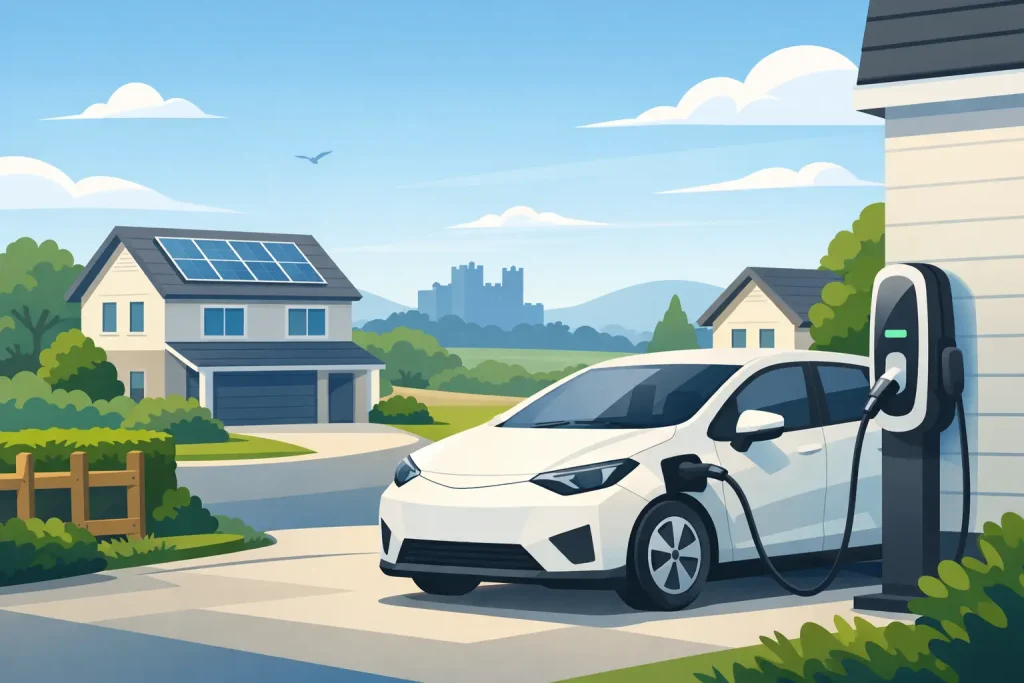
A public charger can be useful when you are out, but it is rarely the most convenient way to run an electric car day to day. For most households, charging at home means starting the morning with the range you need, paying a more predictable price for electricity and avoiding unnecessary stops. This residential EV charging guide explains what Kent homeowners should consider before fitting a charger – from the practical limits of your supply to the role solar and battery storage can play.
Start with how you actually use the car
The right charger is not always the one with the highest power rating or the longest list of app features. A sensible starting point is your usual mileage, where the car is parked and when it is normally at home.
If your car is on the drive overnight, a standard 7 kW home charger will meet the needs of many drivers. It typically adds around 25 to 30 miles of range per hour, depending on the vehicle and conditions. Over a seven or eight-hour overnight charge, that is more than enough for most commuting and local journeys.
A lower-powered charger may still suit a household with modest mileage, while some larger homes or properties with three-phase electricity can consider faster charging. However, faster is not automatically better. Your vehicle’s onboard charger, the available electrical supply and the rest of the household demand all affect what is practical.
It is also worth thinking ahead. If a second electric vehicle is likely within a few years, the installation can be designed with future capacity in mind. That may mean choosing a charger that supports load balancing, allowing for an additional cable route, or assessing whether the supply is likely to need attention later.
Residential EV charging guide: choosing charger power
For most UK homes, the decision comes down to a 7 kW smart charger on a dedicated circuit. This is generally the best balance between charging speed, installation cost and compatibility with a typical single-phase domestic supply.
A 3.6 kW unit can be appropriate where demand is limited or charging time is not a concern. It will still recharge many cars comfortably over a longer overnight period. A 22 kW charger sounds appealing, but it requires a suitable three-phase supply and a car capable of accepting that power. Neither is common in existing homes, so it is usually a specialist rather than default choice.
Smart functionality matters more than many buyers expect. A compliant smart charger can schedule charging for off-peak electricity periods, monitor energy use and, in some cases, respond to changing household demand. The useful features are the ones you will genuinely use: reliable scheduling, clear controls and a stable connection. A complicated app is not a benefit if the charger cannot consistently carry out the schedule you set.
Tethered chargers have a fixed lead, which is convenient if you have one vehicle with the same connector every day. Untethered units use a separate cable, often giving a tidier appearance when not in use and more flexibility between vehicles. This is largely a preference, although cable storage and the distance from parking space to charger should be considered.
The home assessment matters as much as the charger
An EV charger is a significant electrical load, which is why a proper site survey should come before a firm recommendation. The work is not simply a case of fixing a unit to an outside wall and connecting it to the nearest socket circuit.
The installer should assess the consumer unit, earthing arrangement, incoming supply, main fuse rating and likely household demand. They will also consider cable routes, drilling requirements, external finishes and whether the parking position allows the cable to be used safely without crossing a pavement or shared access.
In older properties, a consumer unit may need upgrading or protective devices may need adding before a charger can be installed safely. That is not necessarily a reason to abandon the project. It simply needs to be identified early, costed clearly and completed properly.
Load management is particularly useful where the house already has electric showers, induction cooking, heat pumps or other high-demand equipment. Rather than risking the incoming supply being overloaded, the charger can automatically reduce or pause its output when the property demand rises. When demand falls, charging resumes. For many homes, this avoids the need for a costly supply upgrade.
A good installation should also look considered. Cable routes should be as discreet as the building allows, external equipment should be mounted sensibly, and the area should be left clean and safe. These details matter when the charger is part of your home for years, not just the day it is fitted.
Charging costs depend on timing, not just tariff price
Home charging is often cheaper than relying on public rapid chargers, but the actual cost depends on your electricity tariff, vehicle efficiency and charging schedule. An off-peak tariff can make a noticeable difference if the charger is set to run during the lower-cost window.
It is sensible to check the tariff conditions before changing supplier or selecting a charging schedule. Some tariffs offer attractive overnight rates but have higher prices at other times of day. They can work very well for homes that can shift car charging, washing and battery charging overnight, but they are not automatically the cheapest choice for every household.
Charging losses should also be allowed for. The electricity drawn from the supply will be slightly higher than the energy ultimately stored in the battery, particularly in cold weather. That is normal and should not be mistaken for a fault.
If you are reimbursed for business mileage, the charger’s usage records may help separate vehicle electricity from general household consumption. This is another reason to choose a unit with reporting that is clear rather than needlessly elaborate.
Solar panels, batteries and EV charging
An electric vehicle can work well alongside solar PV, but it is worth being realistic about when solar generation is available. Most cars are away during the middle of the day, while solar output is strongest. In winter, generation is also lower precisely when electricity use and driving energy needs may be higher.
That does not make solar charging a poor idea. It means the system should be designed around your routines. If the car is at home during the day, a smart charger can use surplus solar generation where compatible equipment is in place. If it is away, solar can still reduce wider household electricity costs or charge a home battery for later use.
A battery may give more flexibility, but it does not create free energy. Using a battery to charge an EV involves conversion losses, and the right choice depends on battery size, solar output, tariff structure and how both the car and household are used. Often, the most cost-effective approach is a combination of solar use when available and scheduled off-peak charging overnight.
For homeowners considering solar, storage and an EV charger together, planning the whole system at once can prevent avoidable alterations later. Baird and Brown Ltd can assess the electrical side as a complete home energy project, rather than treating each item as an isolated installation.
Safety, compliance and documentation
A dedicated EV charging circuit should be installed and tested by a competent electrician in line with the relevant electrical requirements. The design must account for the specific charger, the home’s earthing system and the protective measures required for safe use.
The installer may also need to notify the local electricity network operator, depending on the charger rating and supply arrangement. This is a normal part of the process, not something a homeowner should have to decipher alone. Where supply limitations or upgrades are relevant, you should be told plainly what is required and why.
Once work is complete, keep the electrical installation certificate, test results, charger instructions and any network correspondence in a safe place. These documents are useful for future electrical work, warranties and, potentially, when selling the property.
Before agreeing to an installation, make sure you understand these practical points:
- where the charger will be mounted and how the cable will be routed;
- whether the consumer unit or incoming supply needs work;
- how load management will operate, if required;
- what testing, certification and handover information is included; and
- who to contact if you need help setting up charging schedules after installation.
A charger should suit the house, not just the car
The best home charging installation is usually the one you stop thinking about. It is in the right place, charges reliably when electricity is cheapest, does not overload the property and leaves you with clear paperwork and a tidy finish.
Before choosing a model on price alone, arrange a proper assessment of the home and talk through how you drive, park and use energy. A charger selected around those real conditions will be safer, more useful and far less likely to need changing when your household’s plans move on.
