

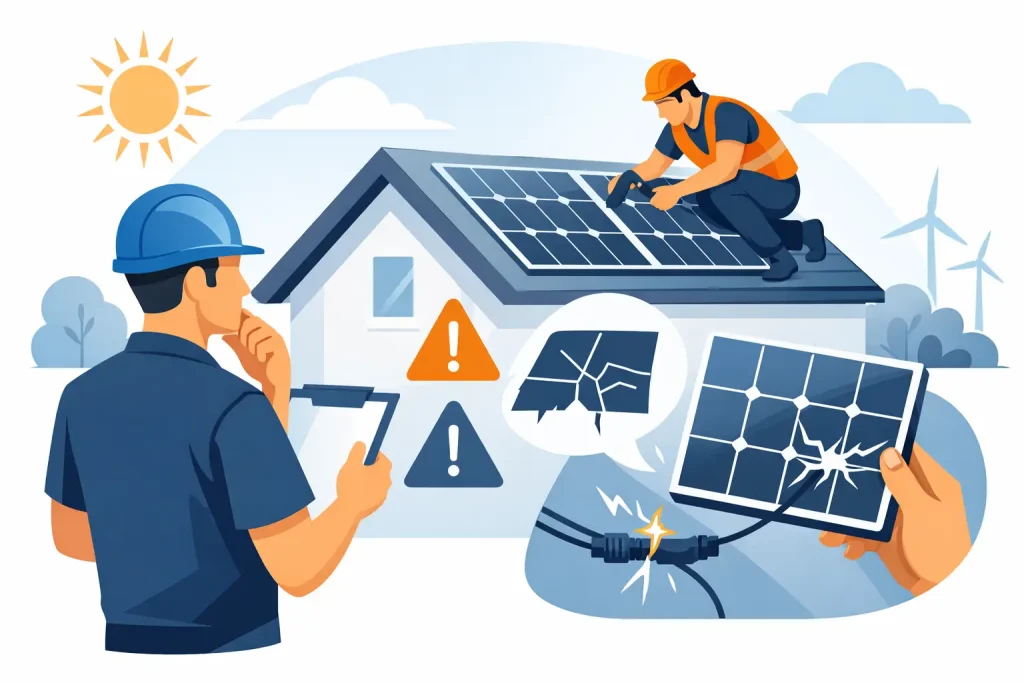
A solar installation should look considered, tidy and properly planned from the first site visit to the final handover. Knowing how to avoid poor solar workmanship is not about becoming an electrical expert overnight. It is about asking sensible questions, recognising warning signs and choosing an installer who is prepared to explain their work clearly.
Solar panels, batteries and associated electrical equipment are long-term additions to your home. A cheap quote can be tempting, particularly when energy bills are high, but poor installation can lead to water ingress, unreliable generation, avoidable remedial work and difficulty obtaining support later. The right installer protects both your roof and your investment.
Start with a proper survey, not a sales call
Good workmanship begins before anyone arrives with panels. A reputable installer should assess the property properly, considering the roof covering, pitch, orientation, shading, available roof space, loft access, cable routes and the condition of the existing electrical installation.
A remote estimate can be useful as an early guide, but it is not a substitute for an on-site survey on every property. Older homes in Kent can have varied roof structures, older consumer units or awkward cable routes that simply cannot be judged accurately from satellite images and a few photographs.
Ask what the survey involves and who will carry it out. You should be able to discuss where equipment will be positioned, how cables will be routed and whether any roof or electrical issues need attention first. If an installer promises a final price and installation date without understanding the property, treat that as a warning sign.
Look beyond panel numbers and headline savings
A well-designed system is not just a maximum number of panels fitted into every available gap. It should suit your household’s electricity use, roof layout and future plans.
For example, a family expecting to buy an electric vehicle may benefit from considering charging demand at the design stage. A household that is usually empty during the day may need to think more carefully about battery storage, export arrangements and how much electricity can realistically be used at home. Larger is not always better if the additional cost will not deliver worthwhile value.
Ask the installer to explain the proposed panel layout and why they have selected the inverter, battery capacity and any optimisers or microinverters. There can be good reasons for different approaches. Shading from chimneys, neighbouring buildings or trees may make module-level technology worthwhile, while a simple, unshaded roof may not need it. What matters is that the recommendation is based on your property, not a one-size-fits-all package.
Check that the roof is treated as part of the job
Poor solar workmanship is often hidden beneath the panels. The roof fixings, flashing details and weatherproofing matter just as much as the visible equipment.
Your installer should use mounting equipment designed for the roof type and follow the manufacturer’s installation requirements. Roof tiles should not be cracked, forced into place or left poorly supported. Penetrations need careful sealing where required, and cables should be secured and protected rather than left loose across the roof or rubbing on sharp edges.
Before work starts, ask how the installer will protect the roof and deal with damaged tiles if any are discovered. On completion, inspect the areas you can safely see from ground level and ask for photographs of the roof work if access makes this difficult. A tidy finish is not merely cosmetic. It often reflects care in the work you cannot see.
Choose accreditation, but verify the whole service
Certification is a useful starting point, not the only test of quality. For domestic solar PV, an MCS-certified installer can provide reassurance that the company works within recognised standards and may be necessary for access to certain export arrangements. You should also expect appropriate electrical competence, insurance and clear responsibility for the installation.
Do not rely solely on a logo shown in an advert. Ask for the company’s registration details and check that they are current. Confirm who will carry out the electrical work, who is responsible for notifying building control where applicable, and whether the company uses subcontractors.
Subcontracting is not automatically a problem. Some projects require additional labour or specialist support. The important point is accountability. You should know who is attending your home, who is supervising the work and who will put things right if there is a problem.
Local installers often have a stronger incentive to get the details right because their reputation is built house by house. At Baird And Brown LTD, that means a practical, owner-led approach rather than handing customers from a sales team to an unknown installation crew.
Read the quotation for the work that is not obvious
A clear quote should tell you more than the number of panels and the total price. It should set out the main equipment, expected generation assumptions, installation scope, warranties and any exclusions.
Pay attention to cable routes, scaffold arrangements, bird protection if included, consumer unit work, internet connection for monitoring, battery location and making good after installation. These details are where misunderstandings tend to arise.
It is also worth checking whether the quote allows for a Distribution Network Operator application. Your installer should explain the process for connecting generation equipment to the local electricity network and whether approval is required before installation. This is particularly relevant for larger systems, batteries and properties with existing generation.
Be cautious of vague wording such as “installation included” with no explanation of what that covers. A lower quote may exclude necessary electrical upgrades or use a design that is quicker to fit but less suitable for the property. Compare like for like, and give greater weight to clarity than to an attractive headline figure.
Ask how electrical work will be completed and tested
Solar PV is not simply roof work with a cable attached. It is an electrical installation that must be designed, protected, tested and documented correctly.
The inverter, isolators, generation meter, consumer unit connections and battery equipment all need suitable placement and protection. Equipment should be accessible for servicing where practical, correctly labelled and installed in a way that does not create unnecessary heat, obstruction or risk. Battery placement deserves particular care, especially in garages, utility spaces and lofts where temperature, access and fire considerations vary.
At handover, the installer should explain what has been tested and give you the relevant electrical certification and commissioning information. You should not be left trying to work out whether the system is generating correctly from an app alone.
Do not overlook cable management and finishing
Visible workmanship is a useful clue. Cables should follow sensible routes, be clipped neatly, enter the building cleanly and be protected where exposed. External equipment should be mounted securely and positioned with thought for access, appearance and practical use of the space.
There will sometimes be compromises. A period property, a restricted loft or a desired battery location may limit the ideal route. A good installer will explain those compromises before work begins and offer the neatest safe option available. They will not simply take the quickest route without discussion.
Expect a proper handover and complete paperwork
The job is not complete when the panels begin producing electricity. A professional handover gives you the information needed to operate the system confidently and proves what has been installed.
You should receive your commissioning documents, electrical certificates, product warranties, system specifications and guidance on monitoring. Ask the installer to show you how to check generation, what the normal indicator lights mean and who to contact if the app reports a fault. If you have a battery, make sure you understand its operating mode and any tariff settings that have been agreed.
Keep this paperwork somewhere safe. It can be useful for warranty claims, future servicing, insurance queries and when selling the property. It also makes it easier for another qualified electrician to understand the installation if work is needed years later.
Judge the installer by how they handle questions
The most reassuring sign is often not the sales presentation. It is the response when you ask a detailed question about a roof fixing, cable route, generation estimate or warranty.
A trustworthy installer will be straightforward if something depends on the site survey or network approval. They will not claim that solar removes every electricity bill, nor promise exact savings that depend on weather, household use and energy tariffs. Honest advice may occasionally mean recommending a smaller system, delaying work until electrical improvements are made, or deciding that a battery is not the right first step.
Take your time before committing. Ask for a written scope, check credentials, compare the quality of explanations and make sure you know who will be responsible after installation. A solar system should give you confidence for years, and that confidence starts with careful workmanship from day one.
