

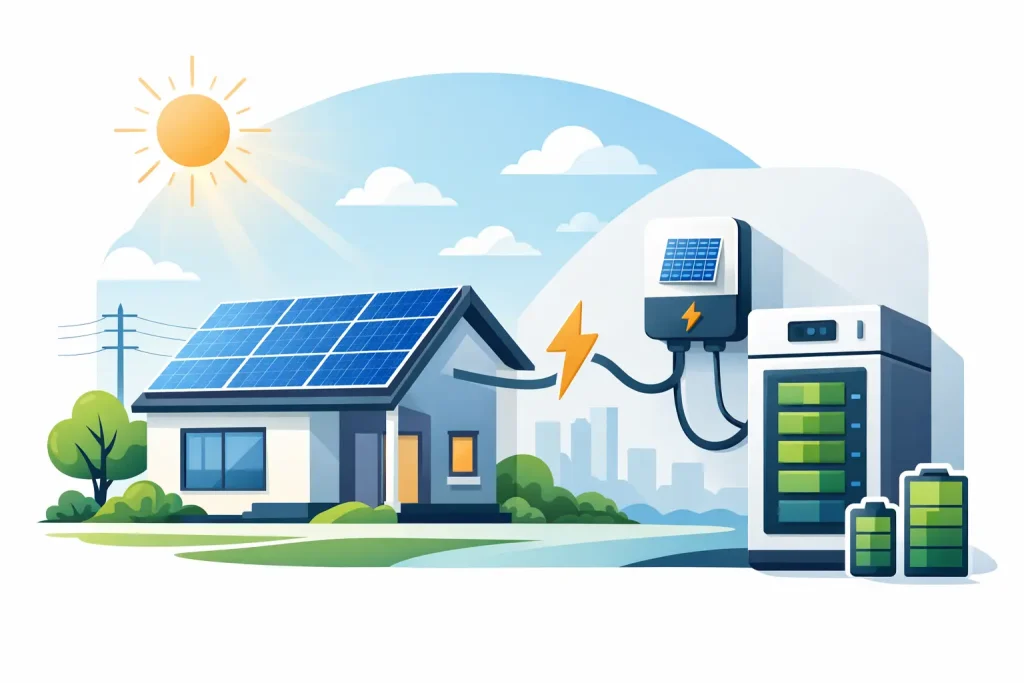
A bright spring afternoon can produce more electricity than a typical home is using at that moment. Without a battery, that surplus is usually exported to the grid. So, can solar panels charge batteries? Yes – and for many households, storing that daytime generation is what makes a solar PV system far more useful after the sun has gone down.
A battery does not make electricity from nothing, nor will it guarantee that your home never buys power from the grid. What it can do is hold onto spare solar energy for later use: evening cooking, lighting, televisions, appliances and, depending on the system, part of an overnight EV charge. The result is usually greater use of your own generation and less reliance on imported electricity.
Can solar panels charge batteries directly?
Not in the simple, direct way people often imagine. Solar panels generate direct current (DC) electricity, while most homes use alternating current (AC). A properly designed solar and battery installation therefore needs equipment to manage the power safely, charge the battery correctly and supply the home when required.
In a new solar installation, this is commonly handled by a hybrid inverter. It converts the electricity from the panels for use in the house and can direct any surplus into a compatible battery. When solar production falls, the inverter can then draw stored energy back from the battery to support household demand.
Another option is an AC-coupled battery. This is often used where solar panels are already fitted and the homeowner wants to add storage later. The solar inverter first supplies the home and exports surplus power through the AC side of the system; the battery system detects that surplus and charges from it. Both arrangements can work well. The right choice depends on the existing equipment, available space, budget and the way the household uses electricity.
The crucial point is that batteries must be installed with the correct inverter, protection devices, monitoring and settings. Connecting panels to a domestic battery without the appropriate control equipment is not a safe or workable home solution.
What happens on a typical day?
The system works automatically, but its priorities can be set up to suit the property. On a sunny day, solar electricity will normally serve the home first. If the house is using 1 kW and the panels are producing 3 kW, the remaining 2 kW can charge the battery, subject to its charge rate and current state of charge.
Once the battery is full, any further surplus is usually exported to the grid. Later, when generation drops below household demand, the battery can discharge to cover some or all of the shortfall. When the battery reaches its minimum reserve level, the home imports electricity from the grid as normal.
This matters because solar generation and household use rarely line up perfectly. Panels tend to generate most around the middle of the day, while many families use more electricity in the morning and evening. Battery storage helps bridge that gap, but it cannot completely remove it, particularly during short, overcast winter days.
The equipment a solar battery system needs
A good installation is designed as a system rather than a collection of products. Alongside the solar panels and battery, there will be an inverter or battery inverter, isolation and protection equipment, generation metering, and monitoring that shows production, consumption, battery charge and grid import or export.
The electricity supply and consumer unit also need to be assessed. Some homes may require adjustments to accommodate the new equipment safely and neatly. Cable routes, inverter location, battery ventilation requirements, access for maintenance and fire safety considerations all form part of the practical design.
For grid-connected systems, the installer must also follow the relevant network connection process. This is not paperwork for its own sake. It confirms that the installation is suitable to operate alongside the local electricity network. Using an MCS-certified installer also supports proper design, commissioning and documentation, and may be relevant where homeowners want to receive export payments.
How much battery capacity do you need?
There is no sensible one-size-fits-all answer. A battery that is too small may fill early and leave substantial solar generation going to the grid. One that is too large may spend much of the year partly empty because the panels cannot charge it fully. Bigger is not automatically better.
A useful starting point is to look at how much electricity the household uses after solar production has reduced, rather than simply choosing a battery based on total annual consumption. A home that uses 8 kWh most evenings has different needs from one where the occupants are out all day and use comparatively little power overnight.
The size of the solar array matters too. A modest array may not regularly fill a very large battery outside the summer months. Conversely, a larger roof installation could justify more storage, particularly in a household with higher electricity use, electric heating controls or an EV.
Battery power is separate from battery capacity. Capacity, measured in kWh, tells you how much energy can be stored. Power, measured in kW, tells you how quickly the battery can charge or discharge. A battery may have enough stored energy for the evening but still be unable to cover every high-demand appliance running at once. This is one reason an on-site assessment is more valuable than an online estimate alone.
Can a battery charge from the grid as well?
Yes. Many systems can be configured to charge from the grid at cheaper off-peak times, then use that stored energy when electricity costs more. This can be particularly useful for homes on time-of-use tariffs, although the benefit depends on the tariff difference, battery efficiency, household demand and the system settings.
Grid charging is not a substitute for solar production, but it can make the battery useful throughout the year. In winter, when solar generation is lower, a planned overnight charge may help manage costs the following day. Some households also keep a portion of the battery in reserve, depending on their priorities.
It is worth being realistic about savings. Every charge and discharge cycle has small losses, and electricity tariffs can change. The best approach is to choose settings based on actual usage rather than chasing a single advertised saving figure.
What about power cuts?
A standard solar battery system does not necessarily keep the house running during a power cut. For safety, grid-connected solar systems normally shut down when the network fails, unless the installation includes specifically designed backup or emergency power equipment.
Backup capability can range from a socket for selected essentials to a system that supports chosen circuits or much of the property. It needs careful planning, as high-load items such as electric showers, ovens and heat pumps may not be practical to run from a battery during an outage. If backup power matters to you, it should be discussed at the design stage rather than assumed.
When battery storage makes the most sense
Battery storage is often a good fit for households that are home in the evenings, use meaningful electricity after sunset or want greater control over when they buy power. It can also suit EV owners, although charging an EV solely from a home battery is not always the most efficient or economical approach. Smart charging from surplus solar or lower-cost overnight electricity is often the better strategy.
It may be less compelling for a property with very low electricity use, heavy daytime consumption that already uses most solar generation immediately, or a roof with limited solar potential. That does not mean solar is unsuitable – it simply means the battery should be sized carefully, or considered as a later addition.
For homeowners in Kent, local roof orientation, shading, household routines and the condition of the existing electrical installation all affect the final recommendation. At Baird And Brown LTD, the aim is to assess those details before proposing equipment, so the system suits the home rather than a standard sales package.
A practical next step
Solar panels and batteries work best when they are planned around how you actually live: when the house is occupied, what uses the most electricity, whether an EV is part of the picture, and what you want the system to achieve. A clear site survey and an honest conversation about expected generation will give you a more useful answer than a headline battery size. The right system should feel straightforward to use, perform safely and quietly in the background, and give you confidence each time the sun is putting power into your home.
