

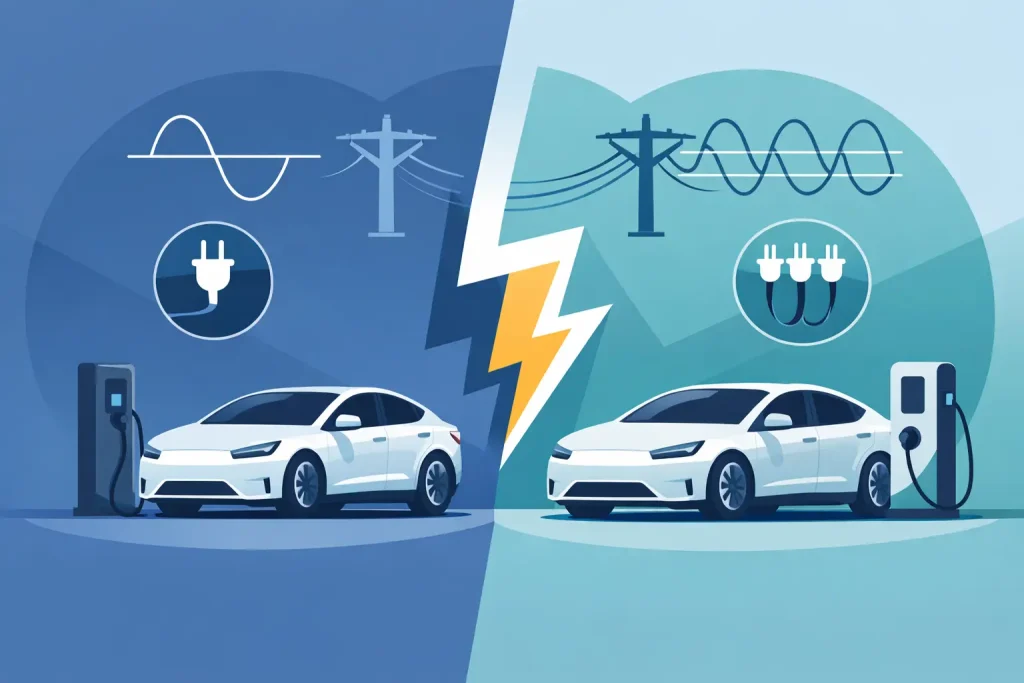
A home EV charger can look like a simple addition to the driveway, but the supply behind it matters. When comparing single phase vs three phase charging, the right answer is not automatically the fastest option. It depends on your incoming electrical supply, the car you drive, how far you travel, and what else your home needs to run at the same time.
For many homes in Kent, a single-phase charger is the practical and cost-effective choice. Three-phase charging can be an excellent option where it is already available, particularly for larger properties, new builds and households planning for more than one electric vehicle. The key is to assess the whole installation properly rather than choosing a charger based on its headline power rating.
What single-phase and three-phase power mean
Most existing UK homes have a single-phase electricity supply. This provides electricity at around 230 volts and is more than capable of running normal household circuits, appliances and a typical home EV charger. A dedicated 32-amp EV charging circuit on a single-phase supply will usually provide up to 7.4 kW.
Three-phase power uses three live conductors rather than one. It is commonly found in commercial premises, larger developments and some newer homes. In a domestic setting, it can support a higher-capacity EV charge point, usually 11 kW or 22 kW, provided the electrical supply, installation and vehicle are all suitable.
Neither supply is inherently better. Single phase is standard and often entirely sufficient. Three phase gives more available capacity and potentially shorter charging times, but it may involve greater cost and is only worthwhile when the rest of the system can use it.
Single phase vs three phase charging speeds
The figures below are useful as a guide, but charging time always depends on the vehicle battery size, its starting state of charge, temperature and the car’s onboard AC charging capability.
A 7.4 kW single-phase home charger can add roughly 25 to 30 miles of range per hour to many EVs. For a typical battery, that makes overnight charging straightforward. Plugging in after work and charging for six to eight hours will cover the needs of most daily drivers.
An 11 kW three-phase charger can add around 35 to 40 miles of range per hour, while a 22 kW three-phase charger may add around 65 to 75 miles per hour. That sounds like a clear advantage, but there is an important limitation: the car controls how much AC power it accepts.
Many EVs sold in the UK can charge at 7 kW on a single phase supply but are limited to 11 kW, or even lower, on three phase. Fewer vehicles can accept the full 22 kW AC rate. Installing a 22 kW charge point for a car that accepts only 11 kW will not make that car charge at 22 kW.
This is also separate from public rapid charging. Rapid and ultra-rapid chargers normally supply DC power directly to the battery and can charge much faster. A three-phase home charger is still an AC charger, so it should not be compared directly with the 50 kW, 100 kW or 350 kW figures seen at motorway charging hubs.
A realistic example
If you drive 30 to 50 miles most days, a 7.4 kW charger is likely to restore that energy in a couple of hours. Even a long day of 150 miles can normally be recovered overnight.
Three phase becomes more appealing where a household has two EVs, one vehicle needs frequent daytime turnarounds, or a high-mileage driver comes home with limited time before needing to leave again. It can also make sense for a new-build project where three phase is being considered from the outset and future capacity is part of the design brief.
Is three-phase power available at your home?
The charge point itself cannot turn a single-phase house into a three-phase property. First, the incoming supply must be checked. Your electricity meter, consumer unit and service head may indicate the type of supply, but this should be confirmed during a proper survey rather than guessed from photographs alone.
If your home has single phase and you want three phase, an upgrade may be possible through your Distribution Network Operator. The process can involve an application, network assessment, excavations or cable work, and costs vary considerably. In some cases it is simple; in others, local network capacity or the distance to suitable cabling makes it less attractive.
This is why the best question is not simply, “Can I have 22 kW charging?” It is, “What will improve day-to-day charging at a sensible cost?” For a household that charges overnight, the answer may still be a well-installed 7.4 kW unit with intelligent controls.
Installation considerations beyond charging speed
An EV charger is a high-load circuit, so the installation needs to account for the property’s wider electricity demand. Electric showers, induction hobs, heat pumps, immersion heaters, ovens and battery storage can all place demand on the supply at different times.
A qualified installer will assess the consumer unit, earthing arrangements, cable route, main fuse rating and expected load before recommending a charger. Where necessary, dynamic load management can reduce or pause vehicle charging if the property is approaching its safe supply limit. This allows charging to continue intelligently without overloading the incoming service.
The cable route matters too. A longer run from the consumer unit to the driveway may require more substantial cable and additional labour. For detached garages, garden offices or remote parking spaces, groundworks and suitable protection for the cable should be planned carefully. A tidy installation should be safe, durable and considerate of how you use the property, not just the shortest route from A to B.
What about solar panels and battery storage?
Solar generation works well with both single-phase and three-phase EV charging, although the controls and design must match the home’s supply arrangement. Smart charging can use surplus solar generation where available, helping you put more of your own electricity into the car rather than exporting it.
It is worth keeping expectations realistic. Solar output changes with the weather, season and time of day, while EVs often need charging in the evening. A smart charger can prioritise solar surplus, schedule charging during cheaper off-peak periods or use a combination of both. Battery storage can add flexibility, but it should be sized around household use and tariff strategy rather than installed solely to charge a car.
For homes with three phase, the interaction between solar, battery storage and EV charging needs particular care. Equipment compatibility and phase balancing can affect the design. This is an area where site-specific advice is far more valuable than an off-the-shelf recommendation.
Cost: when is three phase worth paying for?
A standard single-phase 7.4 kW charger is generally less complicated to install because it aligns with the supply found in most UK homes. If the consumer unit has capacity and the cable route is straightforward, it is often the most sensible route to reliable home charging.
Three-phase installations can cost more because of the charge point, cable, protective devices and potentially the supply upgrade itself. The price difference may be justified if you genuinely need faster AC charging or are preparing a property for multiple EVs. It is less likely to pay back if your car is parked at home for 10 hours every night and cannot accept more than 7 kW or 11 kW anyway.
For a new build, thinking ahead can be wise. Installing suitable ducting, allowing space in the electrical design and considering future load requirements is usually easier before driveways, walls and landscaping are complete. That does not always mean fitting the highest-rated charger immediately, but it can avoid unnecessary disruption later.
Choosing the right setup for your household
Start with your actual routine. Consider how many miles you cover in a normal week, when the car is usually at home, whether a second EV is likely, and whether you are adding solar, a battery or a heat pump. Then check what your vehicle can accept on AC charging and what supply is already present at the property.
For many homeowners, single phase at 7.4 kW provides dependable overnight charging with no need for a costly supply alteration. Three phase is a strong option where it already exists or where the property has higher charging demands that justify the additional work. It should be chosen because it suits the household, not because a larger number looks better on a specification sheet.
A site survey gives you the answers that online comparisons cannot: the condition and capacity of your existing installation, the practical cable route, and a clear recommendation based on how you live. At Baird And Brown LTD, that practical approach means explaining the trade-offs plainly, completing the work neatly and leaving you with a charging setup that remains useful as your home energy plans develop.




