

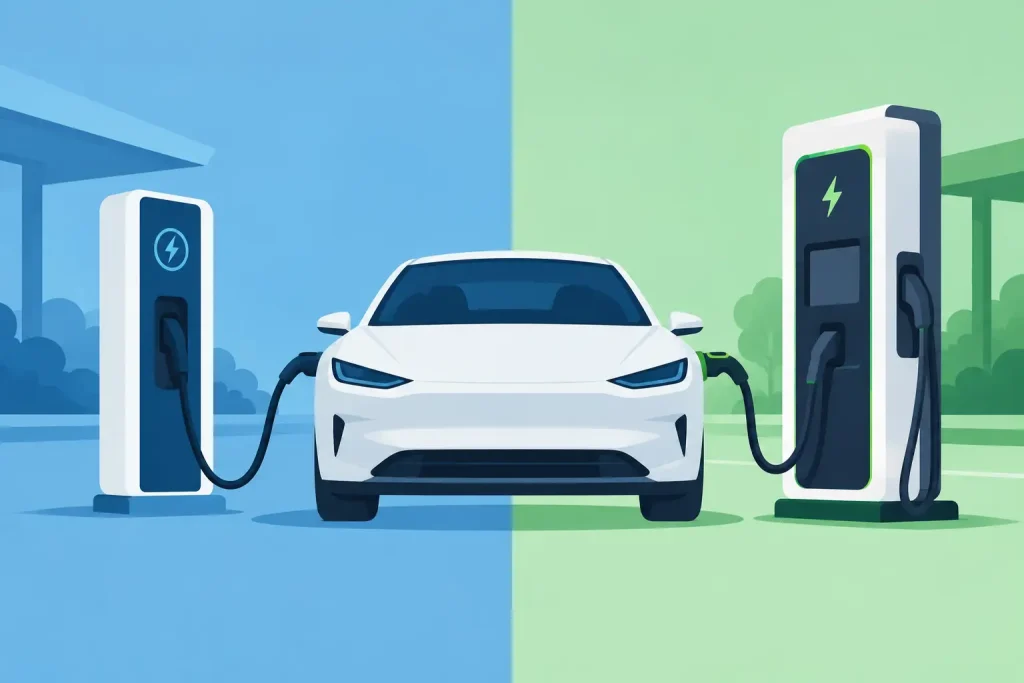
Your EV is parked outside for most of the night, often for 10 hours or more. That makes the charging decision less about finding the fastest possible unit and more about having reliable, affordable energy ready when you need it. In the debate around AC chargers vs DC chargers, the right answer for most homeowners is clear once you understand where each type belongs.
A properly specified home charger can cover the vast majority of everyday driving, work well with an off-peak electricity tariff and, where suitable, make better use of solar generation. DC rapid charging has a valuable role too, but it is generally designed for journeys rather than driveways.
AC chargers vs DC chargers: the core difference
The electricity supplied to UK homes is alternating current, known as AC. Your EV battery stores direct current, or DC. An AC charge point therefore sends AC electricity to the vehicle, where an onboard converter changes it to DC before it enters the battery.
A DC charger does that conversion within the charger itself. It then supplies DC power directly to the battery. This allows much higher charging rates, provided the vehicle and the electrical supply can accept them.
That sounds like DC is automatically better, but charging speed is only one part of the decision. A charger has to suit the time the car is parked, the available supply at the property, the vehicle’s capabilities and the cost of installing and operating it.
Why AC charging is usually the right choice at home
For most Kent households, a 7 kW AC home charger is the practical standard. On a suitable single-phase supply, it can add roughly 25 to 30 miles of range per hour, although the exact figure varies by vehicle, weather and driving style. An overnight charge is normally more than enough to replenish a typical day’s mileage.
A 7 kW unit also fits the way most people use their cars. If you arrive home at 6 pm and leave at 7 am, there is little benefit in paying for equipment designed to charge the battery in minutes. Slow and steady charging during parked hours is convenient, kinder to household demand and can be far cheaper when paired with an off-peak EV tariff.
Many modern AC charge points offer useful controls without making the system complicated. Scheduling lets you charge at lower-cost times. Dynamic load balancing can reduce charging output if the home is using significant power for cooking, showers or heating. This helps prevent excessive demand on the incoming electrical supply.
For homeowners with solar PV, an AC charger can also be set up to prioritise surplus generation where the equipment and tariff arrangement support it. It is worth being realistic here: solar output changes through the day, while many cars are at home overnight. Even so, charging from daytime surplus can be useful for households that work from home, have a second vehicle on the drive or can adjust their charging schedule.
What about 22 kW AC charging?
A 22 kW AC charger is sometimes discussed as an upgrade, but it is not automatically suitable for a domestic property. It usually requires a three-phase electricity supply, which is uncommon at existing UK homes. The EV must also have an onboard AC charger capable of accepting 22 kW. Many cars do not.
Where a three-phase supply is available, particularly on a new-build project, 11 kW or 22 kW charging may be worth assessing. It still needs proper load calculations, cable sizing and consideration of the wider electrical installation. A higher-rated charge point does not guarantee the car will charge at that rate.
Where DC charging makes sense
DC chargers are the rapid and ultra-rapid units commonly found at motorway services, larger petrol stations, supermarkets and dedicated charging hubs. Typical rapid units may deliver 50 kW, while higher-powered units can provide 150 kW, 350 kW or more to compatible vehicles.
Their purpose is to get drivers back on the road quickly. On a longer journey, stopping for 20 to 40 minutes may be more practical than waiting several hours for an AC charge. Charging rates are not constant, however. Most EVs slow the rate as the battery fills, particularly beyond around 80 per cent, and cold batteries may charge more slowly until warmed.
DC charging is also useful for drivers without off-street parking or dependable access to a home charge point. Public rapid charging can be a necessary part of EV ownership in those circumstances, but it is usually more expensive per kilowatt-hour than charging at home on an appropriate tariff.
Why DC chargers are rarely installed at houses
Domestic DC charging is technically possible, but it is rarely the sensible option. The equipment is significantly more expensive, often larger, and may need substantial electrical infrastructure. High-power DC charging can require a three-phase supply, upgraded distribution equipment and, in some cases, involvement from the network operator.
There is also little practical gain for a household whose car is parked for many hours. A 7 kW charger may take longer than a rapid charger, but it generally finishes the job while you sleep. Spending considerably more to shorten a charging session you do not need to watch is hard to justify.
Charging speed depends on more than the charge point
It is easy to focus on the number printed on the charger, but the actual charging speed is set by the lowest limit in the system. A 7 kW home charge point cannot make a car accept 11 kW. Equally, a vehicle capable of rapid DC charging will not receive rapid speeds from a domestic AC installation.
The key factors are the vehicle’s onboard AC charging limit, the battery’s DC charging capability, the property’s electrical supply, the charger rating and any load-management settings. Battery temperature and state of charge also affect DC speeds, especially on public rapid chargers.
This is why it is worth discussing the specific make and model of EV before installation. A good recommendation should consider the car you own now, but also whether your next vehicle may have different requirements.
Cost, convenience and battery considerations
Home AC charging is normally the lowest-cost way to run an EV because it allows you to use your own electricity tariff. Timed charging can make a meaningful difference to running costs, particularly for households that cover regular weekly mileage. Solar can add value too, although it should be considered as part of the whole home-energy picture rather than a promise of free motoring all year round.
Public DC charging offers speed and flexibility, but prices vary considerably by provider and location. It is best viewed as a useful travel service rather than the default everyday charging method for someone with a driveway.
There is no need to avoid DC charging altogether to protect an EV battery. Modern battery management systems are designed to manage charging safely. However, relying on frequent high-power charging can create more heat and may contribute to greater battery wear over a very long period than predominantly lower-rate AC charging. For most owners, the sensible approach is simple: use home AC charging for routine mileage and DC charging when a journey makes it worthwhile.
Choosing the right home charger specification
A home charger should be selected around your property and daily routine, not simply because it has the highest power rating or the most app features. The location matters: cable route, parking position, wall construction, weather exposure and whether the connector will comfortably reach the vehicle all need checking on site.
It is also sensible to think ahead. If you are planning solar panels, battery storage, an electric shower, induction hob or heat pump, the combined demand should be considered. A well-designed installation accounts for how the home will be used, not only what is being fitted that day.
For a straightforward domestic EV installation, Baird And Brown LTD would normally assess the existing consumer unit, earthing arrangement, cable route and available supply before recommending a solution. The final installation should include the appropriate testing, certification and a clear explanation of how to use the charger’s scheduling and safety features.
The practical choice for most drivers
If you have off-street parking and a normal daily driving pattern, a 7 kW AC charger is usually the best balance of cost, convenience and capability. Use DC rapid charging for longer trips, unexpected top-ups and the occasions when time genuinely matters.
The useful question is not, “Which charger is fastest?” It is, “What will make owning this car easiest on an ordinary Tuesday?” For most households, the answer is a well-installed AC charger that quietly does its work while the car is already parked.




