

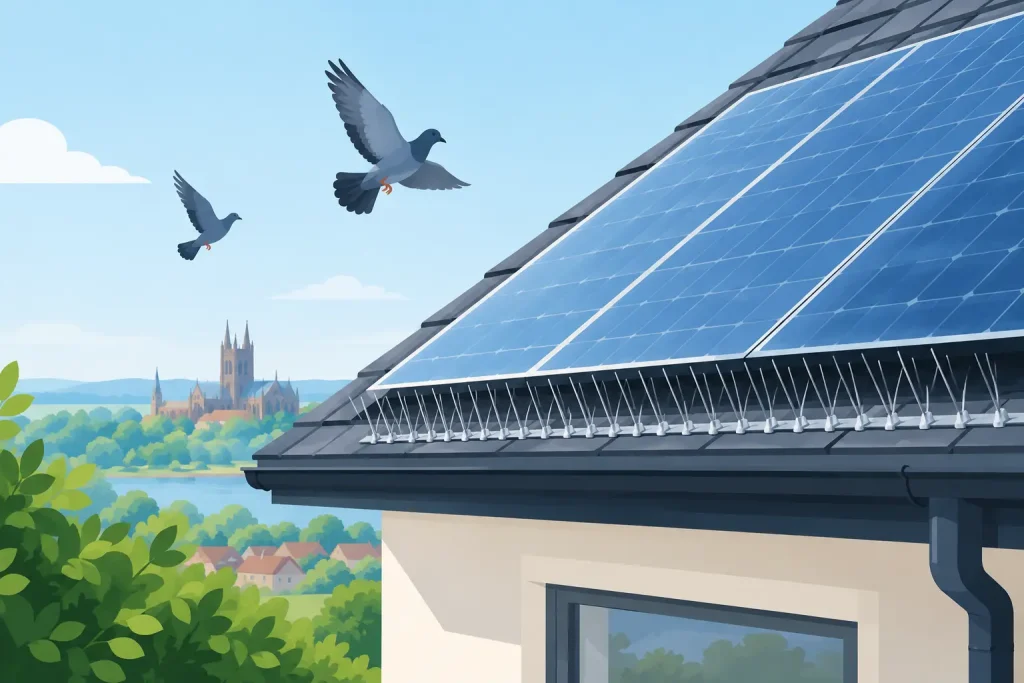
Pigeons nesting beneath solar panels can turn a quiet roof into a surprisingly disruptive problem. The scratching, cooing and debris are unpleasant, but the bigger concern is what cannot be seen easily from the ground: nesting material near cables, blocked drainage routes and reduced airflow around the array. This solar bird proofing guide explains what homeowners should look for, when action is appropriate and how a proper installation should be carried out.
Why birds choose solar panels
Solar panels create a sheltered, dry void between the roof and the underside of the array. For pigeons in particular, it is an attractive place to roost and build a nest. The panels offer protection from rain and wind, while the warmth around the roof can make the space appealing through colder months.
This is common on homes across Kent, especially where a roof is close to trees, ledges, neighbouring properties or established pigeon routes. It does not mean the solar installation is poorly designed. Even a neatly fitted array usually has a necessary gap underneath it for ventilation and drainage, which birds may be able to access unless the perimeter is protected.
The issue is usually more than noise. Nesting material can collect around cables and brackets, while droppings can build up on roof tiles, in gutters and around the lower edge of panels. In a severe case, damp debris may contribute to drainage problems or attract insects. A bird nest will not normally stop a system generating overnight, but leaving the problem unchecked can make routine inspection and maintenance more difficult.
Signs your solar panels need bird proofing
A pair of pigeons occasionally landing on the roof is not, by itself, a reason to install mesh. Repeated activity in the same area is different. Listen for persistent cooing or scratching beneath the panels, particularly early in the morning. You may also see birds disappearing beneath the array rather than simply perching on top of it.
Other warning signs include a regular fall of twigs or nesting material onto the patio, concentrated droppings below the panels, feathers around the eaves, or gutters filling more quickly than usual. If safe to view from ground level, look for gaps at the bottom and sides of the array where birds can enter.
Do not climb onto the roof or attempt to reach behind the panels yourself. Aside from the obvious fall risk, solar arrays contain electrical equipment and cables that should not be disturbed. A roof-level inspection by a competent solar professional is the sensible way to confirm whether there is active nesting, damage or a simple need for prevention.
What effective solar bird proofing looks like
The usual solution is purpose-made, coated wire mesh fitted around the perimeter of the solar array. It prevents birds getting into the void beneath the panels while retaining the airflow the system needs. When installed correctly, it is neat, unobtrusive from ground level and does not interfere with normal panel operation.
A good solar bird proofing installation should use panel-specific clips or approved fixing methods that attach to the panel frame. The mesh should not be screwed through panels, drilled into the frame or fixed in a way that could compromise the panel warranty. It also should not be pushed tightly against the roof where it could trap leaves or make water run-off worse.
The installer will normally trim and shape the mesh to follow the edge of the array, including awkward areas around hips, valleys, tiles and lower roof edges. The aim is to close access points without creating sharp protrusions or leaving loose sections that could rattle in high winds.
Mesh is not designed to stop birds sitting on top of panels, and it will not remove existing dirt from the glass. If droppings are affecting output, cleaning may be considered separately. The priority of bird proofing is to keep the under-panel area clear and accessible for the life of the system.
Solar bird proofing guide: the right order of work
Bird proofing should start with an inspection, not an assumption. Before any mesh is fitted, the installer needs to establish whether birds are actively nesting beneath the panels. In the UK, wild birds, their active nests and their eggs have legal protection. An active nest must not be removed, damaged or blocked off. The work may need to wait until the nesting activity has finished.
Once it is lawful and appropriate to proceed, the area beneath the array should be checked for nesting material, feathers and debris. This needs to be removed carefully, with attention paid to DC cables, connectors and roof tiles. If cables have been moved, chewed or damaged, they should be assessed properly rather than hidden behind mesh.
The next step is fitting mesh around every viable access point. Covering only the most obvious bottom edge can leave birds an easy route in at the sides or around roof details. A competent installer will also look at whether gutters need clearing and whether nearby branches are making access easier, although tree work should be considered separately and responsibly.
Finally, the array should be visually checked once the work is complete. The mesh should sit securely, the panels should remain unobstructed, and there should be no loose fixings, sharp cut ends or obvious gaps. Keeping photographs and a record of the work is useful for household records and future maintenance.
Avoid quick fixes that create bigger problems
Expanding foam, loose netting and general-purpose chicken wire are poor substitutes for a proper solar mesh system. Foam can look untidy, degrade in weather and block ventilation. Loose netting may trap birds or become detached. Basic wire can corrode, scratch panel frames or be difficult to secure safely around a complex array.
Bird spikes are also often the wrong answer beneath solar panels. They may deter a bird from a narrow ledge, but they do not reliably seal the larger protected space under an array. They can also make access more awkward when solar maintenance is required.
It is equally unwise to lift panels simply to clear a small amount of debris unless there is a genuine technical reason to do so. Panels, mounting hardware and electrical connections should be handled by people familiar with solar PV systems. Unnecessary disturbance can introduce faults where none existed before.
Timing, costs and roof access
The best time for preventative bird proofing is before birds establish a nest, but it can be added to an existing solar system at any point where there is no active nesting. Late autumn and winter can be practical periods for planning work, although every site still needs to be checked first. Pigeons can attempt to nest in more than one season, so there is no blanket rule that applies to every roof.
The cost depends on the number of panels, array shape, roof height, access requirements and whether clearing or repairs are needed. A simple, accessible array is very different from a large system spread across several roof faces. If scaffolding or specialist roof access is required, that can affect the price, but it should never be skipped where it is needed for safe workmanship.
For homeowners, the useful question is not simply whether mesh is the cheapest option. It is whether the work protects the roof, preserves safe access to the solar equipment and is carried out without compromising the system. Clear advice after a site assessment is more valuable than a fixed price given without seeing the roof.
Looking after a bird-proofed solar array
Once mesh is fitted, there is usually very little for a homeowner to do. Keep an eye on the roof and gutters from the ground, particularly after storms. If you notice new debris, loose mesh, unusual noise or a change in generation that cannot be explained by the season or weather, arrange an inspection rather than trying to adjust it yourself.
Annual visual checks are sensible, particularly for older systems or roofs near mature trees. A solar professional can check the mesh condition alongside the visible condition of panels, cables and mounting equipment. This is also a good opportunity to discuss any concerns about shading, cleaning or battery performance.
For Kent homeowners who can hear birds beneath their panels or see repeated nesting activity, early advice is usually simpler and less disruptive than waiting for the problem to grow. Baird And Brown LTD can assess the array, explain what is appropriate for the roof and help keep a well-installed solar system working as it should.




