

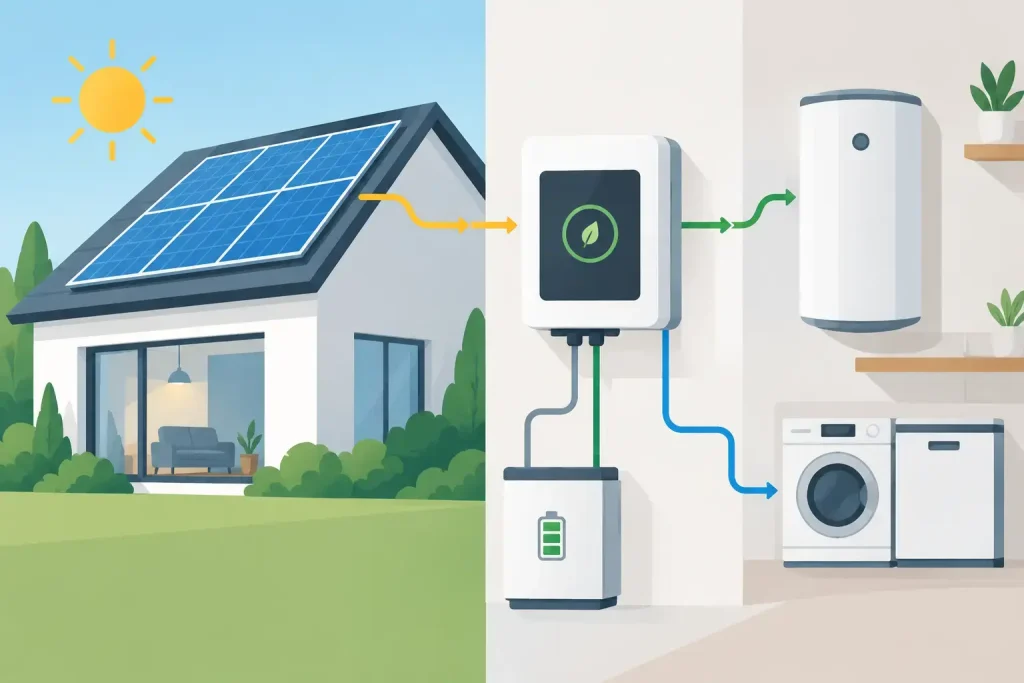
A sunny afternoon can produce more electricity than your home is using. Without a battery or smart control, that surplus is exported to the grid. Learning how to use solar diverter controls gives that spare generation a useful job: heating the water in your cylinder before it leaves the property.
For many Kent households with solar PV, a diverter is a practical way to reduce the fuel used for hot water. It is not a replacement for a well-designed solar and battery system in every home, and it will not create electricity from nothing. Used correctly, though, it can turn otherwise-exported solar power into stored heat for washing, showers and household use.
What a solar diverter actually does
A solar diverter monitors the flow of electricity at your incoming supply. When your panels are producing more than the house needs, it sends the spare power to a compatible load, most commonly an immersion heater in a hot water cylinder.
Rather than switching the heater fully on and drawing power from the grid, a good diverter varies the power supplied. If there is 800W of genuine surplus solar available, it can feed roughly that amount to the immersion. When a cloud passes and surplus generation drops, it reduces the output accordingly. The aim is to avoid importing electricity simply to heat water.
The hot water cylinder becomes a form of thermal storage. You may not be storing electricity in a battery, but you are storing the value of that electricity as hot water to use later.
Check whether your home is suitable first
The key requirement is a hot water cylinder with an electric immersion heater. If your home has a combi boiler and no cylinder, there is usually nothing for a standard diverter to heat. In that case, battery storage, changing how you run appliances, or another hot-water solution may be more relevant.
Your immersion heater must also be in good working order. Many cylinders have a 3kW element, although diverters can operate below that level by modulating their output. An electrician should check the immersion circuit, isolator, cable sizing and protective devices before any control equipment is fitted.
It is also worth considering your usual hot water demand. A couple who are out during the day may build up plenty of solar-heated water for the evening. A larger household with several showers in quick succession may still need help from its boiler or other heat source, particularly through winter.
How to use a solar diverter day to day
Once correctly installed and commissioned, a solar diverter should need very little daily attention. Its job is to respond automatically to generation and household demand. You do not need to wait for sunshine and manually switch the immersion on.
The most useful habit is to leave the immersion circuit available for the diverter, while keeping any manual boost setting switched off unless you genuinely need it. A manual boost draws electricity at the immersion’s full rated power. If there is not enough solar generation at that moment, the difference comes from the grid.
In practice, using the system well means allowing it time to work. On bright days, avoid running several high-demand appliances at exactly the same time if heating water is your priority. A kettle, oven, dishwasher, washing machine and EV charger can all use power that might otherwise have been diverted to the cylinder.
That does not mean you should organise family life around the diverter. The electricity savings from shifting one small appliance may be modest. It simply helps to understand that a diverter can only use what is left after the home’s immediate demand has been met.
Set sensible hot water priorities
Most households need their boiler, heat pump or other primary hot water system to remain available. Solar output is variable, especially in the UK between October and March. A diverter is best treated as a way to reduce conventional water-heating demand, not as a guarantee of hot water every day.
If your hot water is normally heated on a timed schedule, consider whether that schedule is competing with your solar generation. For example, heating a cylinder with gas early every morning may leave little useful capacity for solar heat later in the day. Depending on your household’s needs, you may be able to shorten the timed heating period, lower the frequency, or use a later backup period.
Any changes must still maintain safe hot water temperatures and follow the advice for your specific cylinder and heating system. This is particularly important where stored water temperatures and hygiene controls are concerned. A heating engineer can advise on an appropriate setup rather than relying on a one-size-fits-all timer programme.
Use boost only when it solves a real problem
Many diverters have a boost function. This can be useful before guests arrive, after a run of dull weather, or when you know demand will be higher than normal. It is a convenience feature, not free solar energy.
Before using boost, check whether the cylinder has already been heated by the boiler or whether there is sufficient hot water available. If the cylinder is already up to temperature, further heating will not improve the result and may simply waste energy. Some systems show the diverted energy or immersion run time, which can help you spot how well it is working over a week rather than judging it hour by hour.
Solar diverter or battery: which gets priority?
This is the question that needs an honest answer. If you have both a battery and a diverter, the right order depends on your tariff, lifestyle, battery size and whether you use an EV.
A battery can store solar electricity for evening use, when it may power lighting, cooking, appliances and other electrical loads. A diverter stores surplus as hot water, which is useful but can only serve one purpose. In many homes, charging the battery first makes sense because electricity is more flexible than heat.
However, if the battery is full, the diverter can make excellent use of further generation. It may also be the better first investment for a household with a cylinder, no battery budget, and a meaningful gas or electricity cost for hot water.
The details matter. If you are on an export tariff that pays well for solar sent to the grid, exporting may sometimes be worth more than diverting it to replace cheap gas. If you heat water with an electric immersion at standard electricity prices, using free surplus solar is often more attractive. Comparing the cost of the fuel displaced with your export payment gives a clearer answer than assuming self-consumption is always best.
A properly designed system can assign priorities so that solar power goes first to the house, then perhaps the battery, then hot water, and finally export. The exact arrangement should be agreed at design stage, particularly where EV charging and time-of-use tariffs are involved.
Common mistakes to avoid
The most common mistake is expecting a diverter to heat a full cylinder quickly on any sunny day. A 3kW immersion may take a few hours to heat a cylinder at full power. If only 500W of surplus is available, the process will take longer. That is normal, not a fault.
Another mistake is leaving a fixed immersion timer running through the middle of the day. The diverter cannot distinguish between solar power and grid power once a timer has forced the immersion on. A better arrangement is usually automatic diversion with a carefully chosen backup boost, where required.
Do not assume every solar PV system can accept a diverter without assessment. Existing consumer units, older immersion circuits, battery arrangements, export limitations and monitoring equipment can all affect the installation. The control must be fitted and configured so it measures power correctly and does not interfere with other electrical protection or energy controls.
Finally, do not judge performance solely by a single cloudy day. Review several weeks of generation, hot water use and imported electricity. Summer results will be very different from winter results, and realistic expectations are part of getting value from the equipment.
Getting the installation and settings right
A solar diverter is a relatively compact piece of equipment, but it sits within an electrical and heating system that deserves careful assessment. A qualified installer should establish whether your cylinder, immersion circuit and solar PV setup are suitable; fit the monitoring clamp in the correct position; test the controls; and show you how to use any app, boost function and backup settings.
For homeowners in Kent, Baird And Brown LTD can assess how a diverter would work alongside existing or planned solar PV, battery storage and EV charging. Straightforward advice at this stage can prevent spending money on a control that does not match how your household actually uses energy.
The best setup is rarely the one with the most settings. It is the one that heats enough water when the sun allows, keeps a reliable backup for the days it does not, and lets you see clearly where your solar generation is going.


