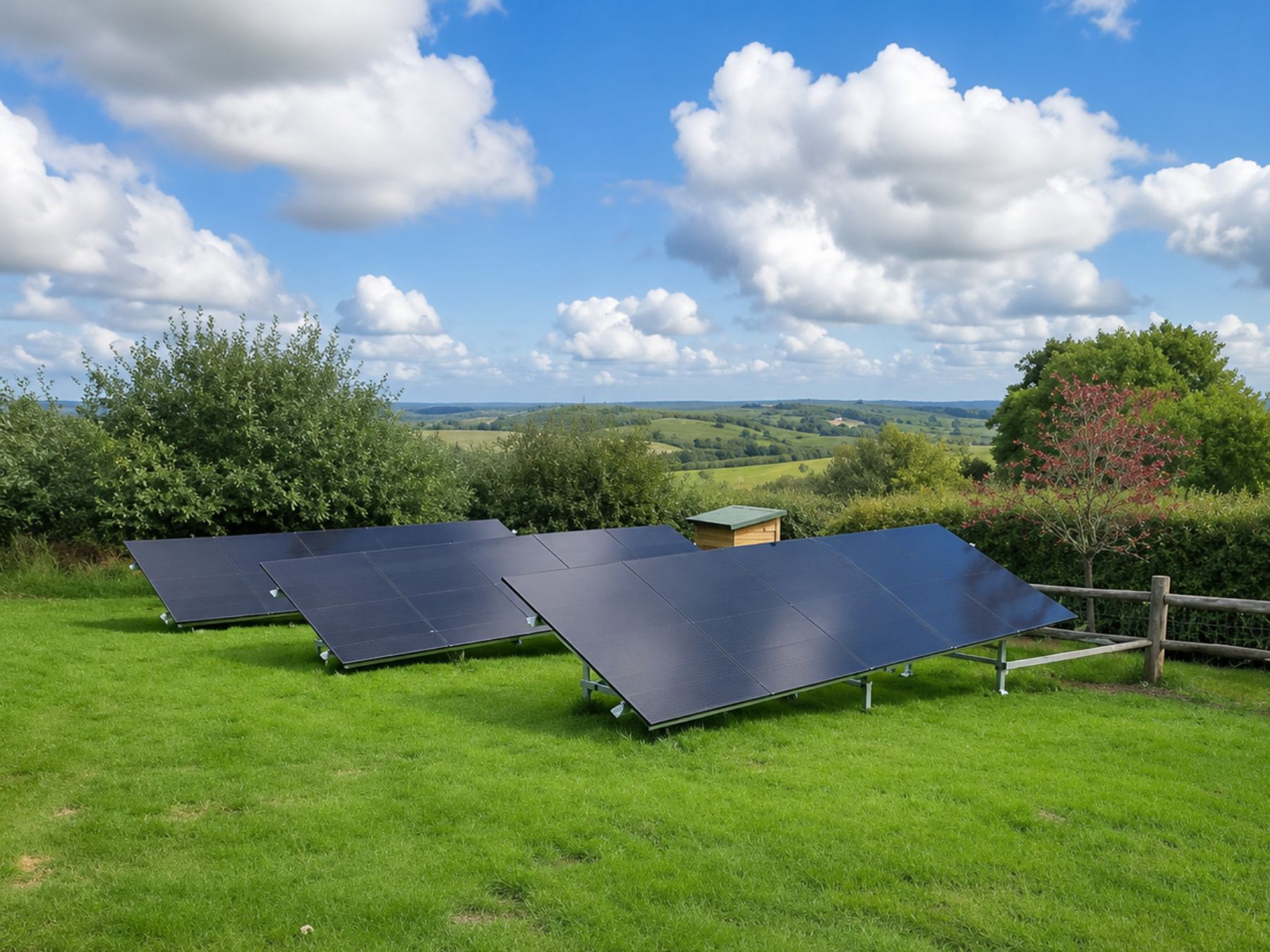
Jinko has been the world's biggest solar panel maker by shipments for most of the last decade. Its Tiger Neo range is the panel we reach for when a home needs strong, proven performance without a premium price.
We are independent installers. We are not tied to Jinko, or to anyone. We choose the panel that suits your roof, your usage and your budget. This page explains where Jinko fits, and where it does not.
Most homes do not need the most expensive panel on the market. They need a good panel, correctly sized, fitted well, from a maker that will still be here in 20 years.
Jinko has been the world's largest module supplier by volume for most of the last decade, according to PV Tech Research. By mid-2026 it had shipped more than 420GW of panels in total, over 250GW of them Tiger Neo. Scale matters. It means a deep track record, with many panels on many roofs.
Big does not mean best for every roof. Read on.
Tiger Neo panels use n-type TOPCon cells. TOPCon stands for tunnel oxide passivated contact. The name is a mouthful. The idea is simple.
A very thin layer at the back of each cell stops electrons being lost before they reach the wiring. Fewer losses mean more power. N-type silicon also fades more slowly than the older p-type silicon used in cheaper panels.
The wiring still runs across the front of the cell, as on most panels. That is the main difference from back contact panels like Aiko and Longi. TOPCon is the mainstream technology now. It is well understood and widely tested.
Tiger Neo 3.0 adds refinements aimed at rooftops, including better treatment of the cell edges to cut losses. All residential Tiger Neo 3.0 panels use dual-glass construction. That means glass on the front and the back, which adds strength and resists moisture.
These panels are sometimes called bifacial, meaning the back can catch light too. On a pitched roof the back sits against the tiles and sees little light. The gain is small. Here, dual glass is about durability, not extra power.
On a ground mount, or a flat roof with raised frames, the rear gain is real. We use that when we design those systems.
Jinko names its panels in generations. The names confuse buyers when they compare quotes. This is how they line up.
| Series | Power | Efficiency | Notes |
|---|---|---|---|
| Tiger Neo (Neo 2.0) | Up to 475W | About 22% to 23.8% | 108-cell. Dual glass, black options |
| Tiger Neo 3.0 (residential) | About 460W to 490W | Up to 24.52% | 1762 × 1134mm. Under 25kg. Dual glass. All-black version available |
| Tiger Neo 5.0 (announced) | 510W | 25.52% | Announced October 2026. Jinko quotes a 40-year warranty. Not yet what we fit |
We will review Tiger Neo 5.0 once UK stock and independent test results exist. A launch is not a track record.
We confirm the exact model, wattage and warranty in your quote.
| Specification | Tiger Neo 3.0 (residential) |
|---|---|
| Cell type | N-type TOPCon |
| Power | Up to 490W |
| Efficiency | Up to 24.52% |
| Size | 1762 × 1134mm |
| Weight | Under 25kg |
| Construction | Dual glass |
| Temperature coefficient (power) | −0.26% per °C (Jinko's figure for Neo 3.0. Earlier Tiger Neo: −0.29%) |
| First-year loss | 1% at most |
| Yearly loss | 0.35% at most (Jinko's recent figure) |
| Output guaranteed at year 30 | 88.85% |
| Performance warranty | 30 years, linear |
| Product warranty | 12 years as standard. Up to 25 years with registration |
Jinko's launch material for Neo 3.0 quoted 0.4% a year. Later material says 0.35%. We quote the figure on the datasheet for the model in your quote.
Panel size is almost identical to Aiko and Longi. About 2 square metres. So the comparison is simple. More watts on the same size means more power on a small roof.
Take a 5kWp target. Twelve 440W panels give 5.28kWp. Eleven 490W panels give 5.39kWp. One panel fewer. On a big roof, that saves little. On a small roof, it can decide whether the system fits.
Two warranties apply. Read both.
The performance warranty is the strong part. Jinko guarantees 30 years of linear output. For the earlier Tiger Neo, output falls no more than 1% in year one and 0.4% a year after that, leaving 87.4% at year 30. Neo 3.0 improves that to 0.35% a year, 88.85% at year 30.
The product warranty covers faults in the panel. Older Tiger Neo panels carry 25 years in the UK. Tiger Neo 3.0 starts at 12 years, with a 25-year option on registration. Registration needs doing properly, and that is part of our handover.
A 30-year output guarantee with a 12-year product warranty is weaker than it sounds. We tell you which cover you are getting, in writing, before you sign.
This is where Jinko is strongest.
A word of context. The 2026 Kiwa PVEL report found test failures at an all-time high, with 87% of manufacturers failing at least one test. Even good brands fail some tests. It is one reason we favour makers with long test records.
Jinko builds panels in several countries. The origin of the panels on your roof is on the datasheet, and we can tell you.
If Jinko is not right, we say so, and show you why.
Jinko panels work with standard inverters. For solar-only systems we usually pair them with Growatt or SolaX. With a battery, we pair them with Sunsynk, Sigenergy SigenStor or the Myenergi Libbi. A Myenergi Zappi, Hypervolt or Easee One charger can then use the solar power for your car.
We check the panel's voltage and current against the inverter's input limits before we quote. We also size the string layout to your roof's faces. This is basic design work, and it is where cheap quotes cut corners.
Yes. Jinko is one of the two largest panel makers in the world and has strong independent test results. Its panels are a safe, mainstream choice for most roofs.
Jinko Solar was founded in 2006 and is headquartered in Shanghai, China. It sells panels in nearly 200 countries and regions.
Tiger Neo 3.0 is the newer generation. It gives more power from the same size panel, up to 490W against about 475W, and a lower temperature coefficient. Check the warranty terms on each, since they differ.
The performance warranty runs 30 years. Panels usually work past that, with slowly falling output. No maker can promise an exact life.
Not better. Different. Aiko and Longi use back contact cells and lead on efficiency. Jinko uses TOPCon, with a longer record and usually a lower price. The right choice depends on your roof.
Yes. We are not tied to any maker. We fit what suits your home.
Book a free survey. We will look at your roof and your bills, and tell you which panel fits. If it is Jinko, we will say why. If it is not, we will say that too.
Proven panels at a sensible price.
Back contact panels fit more power in the space.
Installing solar panels is a long-term investment, so choosing the right installer is just as important as choosing the right equipment.
Our consultative approach means we focus on understanding your goals before recommending a solution.
That means that we assess roof orientation, shading, electricity usage, future energy requirements, battery storage opportunities and EV charging plans.
Every solar and battery system is carefully designed around your property, energy usage and long-term goals—never a one-size-fits-all package.
We're not tied to any manufacturer, so our recommendations are based solely on what's right for your home, budget and future energy needs.
From cable management to commissioning, every installation is completed with exceptional attention to detail for a finish that's built to perform and made to last.
Our relationship doesn't end when the system is switched on. We're here to help with monitoring, optimisation and expert advice whenever you need us.
Request a free survey. Contact us
Every successful solar installation starts with understanding the property.
That’s why we take the time to listen, survey your home and design a bespoke system before a single panel is installed.
Our proven five-step process ensures every project is delivered with care, quality and long-term performance in mind.
We discuss your property, electricity usage and what you'd like your solar system to achieve.
A detailed site survey allows us to assess roof suitability, shading, energy usage and future requirements.
We design a bespoke solar PV system tailored to your property rather than recommending a standard package.
Our experienced team installs, commissions and thoroughly tests your new solar system.
We'll demonstrate your system, explain monitoring and remain available whenever you need us.
Hilary and David wanted protection from regular power cuts at their rural property. Following a detailed survey, we designed a complete solar, battery storage and backup power solution. Charles Everett required a bespoke ground-mounted solar installation for a challenging site. Tom Lewis wanted a system designed around specific requirements without unnecessary upgrades. Each project was designed around the customer rather than a standard package.
Read our case studies.
If you are considering solar PV, battery storage or expanding an existing system, we would be delighted to help. Contact Baird & Brown to arrange a free initial discussion and discover what a professionally designed renewable energy solution could achieve for your property.


 Trustindex verifies that the original source of the review is Google.
 Trustindex verifies that the original source of the review is Google.
 Trustindex verifies that the original source of the review is Google.
 Trustindex verifies that the original source of the review is Google.
 Trustindex verifies that the original source of the review is Google.
 Trustindex verifies that the original source of the review is Google.
 Trustindex verifies that the original source of the review is Google.
 Trustindex verifies that the original source of the review is Google.
 Trustindex verifies that the original source of the review is Google.
 Trustindex verifies that the original source of the review is Google.
This website is hosted, maintained and optimised by DigiVisi Ltd.
 Optimized by Seraphinite Accelerator