

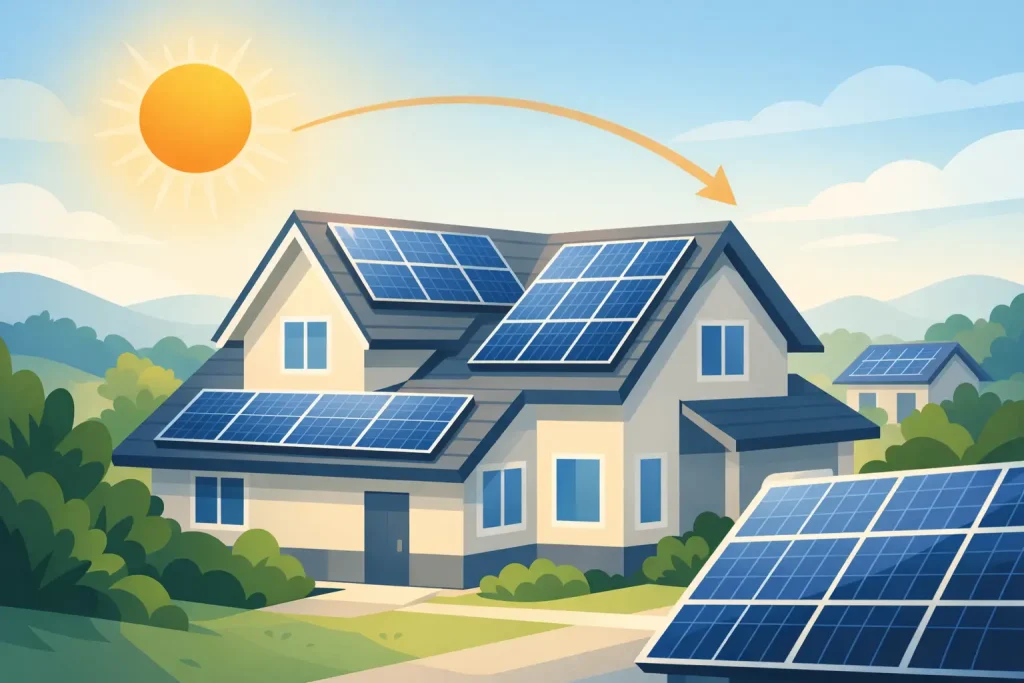
If you are looking at solar for your home, one of the first questions is usually whether your roof faces the right way. Roof orientation for solar does matter, but it is rarely a simple yes or no. A south-facing roof will often give the highest overall generation in the UK, yet plenty of homes with east- or west-facing roofs still make very good sense for solar panels.
What matters most is how your roof, your electricity use and your wider property all work together. A good design is based on real site conditions, not a generic rule taken from a sales leaflet.
Why roof orientation for solar matters
Roof orientation affects how much sunlight your panels receive through the day. In simple terms, a south-facing roof in Kent will usually capture the most sunlight over the course of a year. That generally means higher annual generation.
But annual generation is not the whole story. If you are out at work all day and use more electricity in the morning and evening, an east-west split can sometimes suit your household better than a pure south-facing system. East-facing panels tend to produce earlier in the day, while west-facing panels carry on stronger later into the afternoon and early evening.
That difference can have a real effect on how much of your own solar electricity you use at home. And self-use matters, because the electricity you use directly is usually worth more than the electricity you export.
Which roof direction is best?
For most UK homes, south is the strongest roof orientation for solar if the aim is maximum yearly output. South-east and south-west are also very good and often perform close enough to south that the practical difference is smaller than people expect.
East and west can still be highly worthwhile. You may see lower total annual generation than an equivalent south-facing system, but not so low that solar stops being a sensible investment. In many cases, the shape of the generation curve is actually more useful for day-to-day living.
North-facing roofs are more limited. That does not automatically rule them out, but it does call for more caution. A shallow-pitched north-facing roof may still produce a reasonable amount, whereas a steep north-facing roof is less likely to offer good value. This is where proper assessment becomes important.
If your property has more than one usable roof face, the right answer may be to spread panels across different orientations. That can reduce peak output at midday but improve production across more of the day.
Roof pitch matters as well
Orientation and pitch work together. A roof that faces slightly away from south can still perform very well if the pitch is favourable. Likewise, a perfectly south-facing roof can underperform expectations if the pitch is unusually steep or shallow.
For homes in Kent, typical pitched roofs are often well within a sensible range for solar. That is good news, because it means many households do not need the roof to be perfect. They simply need it to be viable.
Flat roofs are a separate case. Panels can usually be mounted on frames to achieve a suitable angle and direction, but spacing, ballast, wind loading and roof structure all need checking carefully. Flat roofs can work very well when designed properly, although they do require a more detailed approach than standard on-roof systems.
South-facing is not always the best financial choice
This is the part that often gets missed. The highest-generating roof is not always the one that delivers the best practical return for a homeowner.
If your household uses a lot of electricity during breakfast time, school runs, late afternoons and evenings, west- or east-facing generation may line up better with demand. If you have battery storage, the calculation changes again because excess daytime generation can be stored for later use.
The same applies if you charge an electric vehicle at home. A household with daytime charging needs may benefit from one orientation, while a household charging mainly overnight with a battery and off-peak tariff may prefer another system layout entirely.
That is why a proper solar design should look beyond direction alone. Usage habits, available roof space, shading, inverter configuration and battery plans all play a part.
How shading can outweigh orientation
A slightly less ideal roof direction can still outperform a better-oriented roof if the better one suffers from shading. Chimneys, neighbouring properties, dormers, trees and overhead obstructions can all reduce solar output.
Shade is especially relevant in established residential areas, where mature trees and varying rooflines are common. Even partial shade at key times of day can affect how well a system performs, particularly if it is not designed with the right equipment.
In some cases, module-level optimisation or a different panel layout can help. In others, the smarter decision is to install fewer panels in the most productive areas rather than filling every available part of the roof. Honest advice matters here, because squeezing panels onto a poor section of roof does not always improve the outcome.
East-west systems on modern homes
Many modern homes and new-build properties are well suited to east-west layouts. These systems use both sides of the roof rather than relying on a single south-facing slope. While peak generation is lower than a south-facing array of the same size, output is spread more evenly through the day.
For homeowners, that can be useful. The system starts earlier, keeps going later and can match normal household demand more closely. It can also allow more panels to be installed where roof geometry limits the size of a single roof face.
There are trade-offs. The total annual yield may be lower than the very best south-facing option, and the design needs careful electrical planning. Still, for many properties, east-west is not a compromise in the negative sense. It is simply the right fit for the building.
What about north-facing roofs?
North-facing roofs usually prompt concern, and rightly so. In the UK they receive less direct sunlight, especially on steeper pitches, so they are rarely the first choice.
That said, there are exceptions. A shallow north-facing roof with minimal shading may still generate enough to be worth considering, particularly if there is no other usable roof space. Panel efficiency has improved over the years, and system economics are not based on orientation alone.
The key is not to assume. A measured assessment will show whether a north-facing installation is workable or whether the returns are likely to disappoint. Straightforward advice is better than forcing a marginal design.
The best roof orientation for solar depends on your home
When we assess a property, the question is not just which way the roof faces. We also look at the age and condition of the roof, the available area, any likely shading, where cables and equipment can be run neatly, and whether future battery storage or EV charging should be factored in from the start.
For example, a homeowner in Maidstone with a broad west-facing roof and high evening electricity use may be in a better position than someone with a smaller south-facing roof that is interrupted by dormers and shaded by trees. On paper, south wins. In practice, the west-facing system may be the better job.
This is one reason local survey work matters. Homes across Kent vary widely, from older properties with more complex roof shapes to newer estates with cleaner roof lines but tighter equipment placement options. A sensible recommendation has to reflect the actual building.
Common mistakes homeowners make
One common mistake is ruling out solar too early because the roof is not due south. Another is assuming all south-facing roofs are automatically ideal.
A third is focusing only on panel count. More panels are not always better if some sit in poor-performing areas or create awkward electrical design. The aim should be a well-balanced system that is safe, tidy and properly matched to the property.
It is also easy to overlook timing. If a roof needs repairs or replacement in the near future, it is usually better to deal with that before installation rather than after. Good planning avoids unnecessary disruption and cost.
What to expect from a proper assessment
A proper solar assessment should give you a realistic picture of what your roof can do. That includes expected generation, likely self-consumption, any shading concerns, and whether the proposed orientation suits the way you actually use electricity.
It should also explain the limits. Not every roof is ideal, and not every homeowner needs the same system. Clear advice is often more valuable than a bigger quote.
For a company like Baird And Brown LTD, that means looking at the whole installation from survey through to design and documentation, not just trying to sell the maximum number of panels. The right answer is the one that works well on your home and still makes sense years down the line.
If you are unsure whether your roof is suitable, do not get too hung up on compass points alone. The useful question is not whether your roof is perfect. It is whether it is good enough to make solar a worthwhile improvement to your home.
