

If you already have solar panels, or you are weighing up a full solar installation, one question usually comes up quite quickly: is home battery storage worth it? The honest answer is that it can be, but not for every household and not in the same way. The value depends on how you use electricity, when you are at home, whether you have an EV, and what matters most to you – lower bills, better use of your solar, or more control over your energy.
A battery is not a magic box that makes every system pay back quickly. What it does do is store electricity that would otherwise be exported to the grid, so you can use more of your own power later in the day. For many homeowners, that is where the real benefit sits.
Is home battery storage worth it for most households?
For a lot of homes, battery storage makes the most sense when it is paired with solar PV. Without solar, a battery can still have value if you are charging it on a time-of-use tariff and using that cheaper electricity later, but the case is usually more dependent on tariff structure and your daily routine.
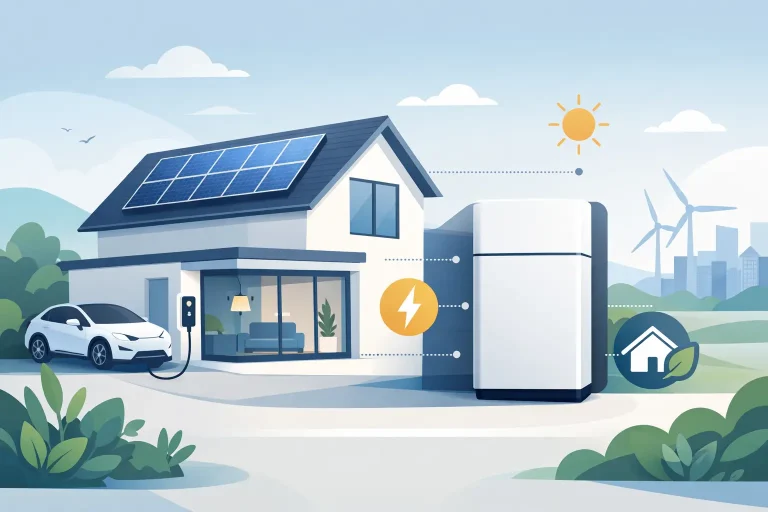
With solar, the logic is easier to see. During the middle of the day, your panels may generate more electricity than the house is using. Without a battery, that surplus is exported. With a battery, some of that energy can be stored and used in the evening, when demand at home is often highest. That means less electricity bought from the grid at peak retail prices.
So, is home battery storage worth it in financial terms? Sometimes yes, but rarely on a one-size-fits-all basis. Households that use a fair amount of electricity in the evening often see stronger value than homes that are occupied all day and already consume most of their solar generation as it happens.
Where the savings usually come from
The main financial benefit is improved self-consumption. In plain terms, that means using more of the electricity your own system produces instead of buying power from your supplier later.
If you generate solar at 1pm but need that energy at 7pm, a battery bridges the gap. That can reduce imports from the grid and improve the return on your solar system. It can also help if you are on a tariff with cheaper overnight electricity, because some systems can be set up to charge when rates are low and discharge when rates are higher.
That said, savings vary a great deal. A battery does not create electricity on its own. It stores and shifts it. Once you factor in the cost of the battery, installation, usable capacity, round-trip efficiency, and how many cycles it will realistically perform each year, the payback period is not always short.
This is why honest system design matters. The right battery size should reflect the home, not a sales target.
When a battery is more likely to be worth it
A battery tends to be better value when your home has one or more of the following characteristics.
You are out during the day, so a good share of your solar would otherwise be exported. You use more electricity in the evening, perhaps with cooking, heating controls, appliances, or EV charging. You want to get more from an existing or planned solar system. Or you are on an electricity tariff that rewards shifting when you import energy.
Larger households can benefit more simply because demand is higher. Homes with heat pumps or regular EV charging may also see stronger long-term value, although system design becomes more important in those cases. A battery that is too small may be depleted quickly. One that is oversized for the property may cost more than the savings justify.
In Kent, where many homeowners are planning upgrades with a long view in mind, batteries can also make sense as part of a broader move towards a more electric home. If you are already thinking about solar, an EV charger, and future energy costs, battery storage can be part of that joined-up plan.
When it may not stack up as well
There are also cases where the answer to is home battery storage worth it is probably not yet, or at least not in the way people expect.
If your electricity use is low and you are at home during the day, you may already use a good proportion of your solar generation directly. In that case, the battery has less surplus energy to store and less room to improve your savings.
The same applies if your export tariff is relatively favourable and your import costs are not dramatically higher. A battery may still offer convenience and energy management benefits, but the financial case may be weaker.
Older properties with limited installation space, awkward cable routes, or consumer unit upgrades may also involve extra works. That does not mean a battery is unsuitable, but it does mean the installed cost matters just as much as the battery price itself.
Backup power: useful, but not always included
Some homeowners look at batteries mainly for resilience during power cuts. That is understandable, but it is worth being clear here. Not every home battery system provides backup power as standard.
Some systems can be configured to supply essential circuits during an outage, but this depends on the battery, inverter, and the way the system is designed and installed. If backup is important to you, it needs to be discussed early. It should never be assumed.
For most households, backup is a secondary benefit rather than the main reason to install a battery. The day-to-day value is still usually tied to better use of generated or cheaper-rate electricity.
The importance of battery size and system design
This is where good advice makes a real difference. A battery should be sized around your usage pattern, not just your roof size or the biggest unit available.
A smaller battery can often perform well if it cycles regularly and captures the right amount of surplus energy. A larger battery may look attractive on paper, but if it is rarely filled or regularly left underused, the return can suffer. The goal is not to install the most storage possible. It is to install the amount that suits the property.
That is why a proper assessment matters. Looking at annual consumption is useful, but it is only part of the picture. Half-hourly usage patterns, occupancy, future EV plans, and the likely solar yield all affect the result.
A well-designed system should also consider where equipment will go, ventilation requirements, cable runs, monitoring, and how neatly the installation can be integrated into the home. Practical details count.
Is home battery storage worth it if you are adding solar now?
If you are already planning solar, adding a battery at the same time can be more straightforward than retrofitting later. The system can be designed as one package, which often makes better technical and practical sense.
That does not always mean you must install a battery immediately. Some homeowners prefer to install solar first, see how the house uses energy, and then decide. That can be a sensible approach, especially if budget is tight or your usage may change in the near future.
But if you already know that most of your demand is later in the day, or you want to make fuller use of your solar from the start, including battery storage upfront can be the right call.
Looking beyond simple payback
It is easy to focus only on whether the maths works in the shortest possible timeframe. That matters, of course, but it is not the whole story.
Many homeowners choose battery storage because they want greater control over how their home uses energy. They like the idea of relying less on imported electricity, making better use of what they generate, and preparing the property for future changes in energy prices and technology.
That does not replace the need for clear figures, but it does explain why two households can look at the same system and reach different decisions. One may want the quickest return. Another may value flexibility, resilience, and reduced grid dependence just as much.
For a company like Baird And Brown LTD, the right advice is not about pushing a battery into every quote. It is about being clear where it adds value, where it does not, and what the likely outcome is for that particular home.
So, is it worth it?
If your home has solar or is about to, you use a fair amount of electricity outside daylight hours, and you want to reduce grid reliance, battery storage can be a very worthwhile addition. If your usage is lower, your daytime demand is already high, or your budget is better spent elsewhere first, it may be something to phase in later rather than do straight away.
The best starting point is not the battery brochure. It is an honest look at how your household actually uses electricity. Once you understand that, the decision tends to become much clearer.
A good battery system should feel like a considered part of your home, not an upsell. When it matches the property and the people living in it, that is usually when it earns its place.
