

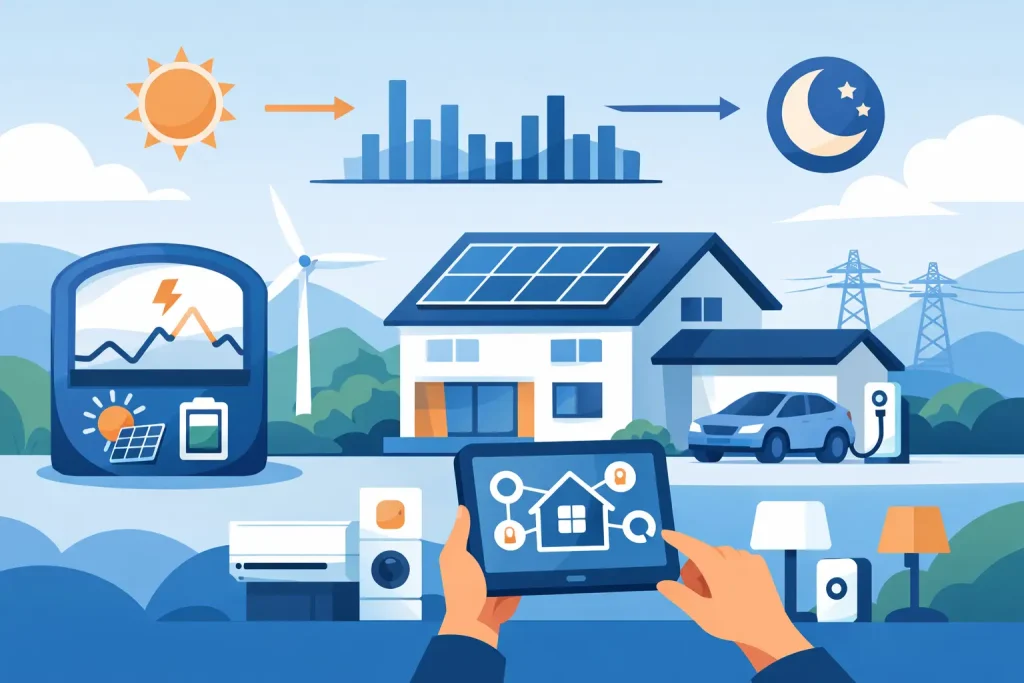
The expensive part of many household electricity bills is no longer simply how much power you use over a month. It is when you use it. If your washing machine, oven, electric heating, immersion heater and EV charger all run during the early evening, you may be buying a large share of your electricity at its highest rate. Knowing how to reduce peak electricity costs starts with identifying those busy periods, then moving, storing or generating power more sensibly.
For homeowners in Kent, the right answer is rarely one product or one setting. It is usually a combination of a suitable tariff, a few changes to daily habits and, where it makes financial sense, properly designed solar and battery storage.
What peak electricity costs actually mean
Peak periods are times when demand on the national grid is high, commonly in the morning and particularly between late afternoon and evening. Suppliers that offer time-of-use tariffs charge different rates through the day. Electricity may be cheaper overnight or in the middle of the day and more expensive during the peak window.
Not every household is on this type of tariff. If you pay a flat unit rate, switching appliances on at 6pm rather than 11pm will not usually change the unit price. It can still help the wider grid, but it will not directly reduce your bill unless your tariff rewards off-peak use.
Start by checking your bill or supplier app. Look for the unit rates, the times they apply, and whether there are separate rates for export if you have solar. A smart meter is generally needed to access and accurately bill time-of-use tariffs. Without clear half-hourly usage data, it is difficult to judge whether a tariff or battery will genuinely suit your household.
Start with the loads you can move
The simplest savings often come from shifting flexible electricity use away from the most expensive hours. This does not mean living around your energy supplier. It means making use of timers, smart controls and routines where they are practical.
An EV is often the biggest flexible load in a home. Charging it overnight on a lower-rate tariff can be considerably cheaper than plugging in as soon as you arrive home. Most modern chargers and vehicles allow scheduled charging, but the settings should be checked carefully. A schedule in the car can conflict with one in the charger, leaving the vehicle uncharged when you need it.
Dishwashers, washing machines and tumble dryers can also be scheduled for cheaper periods, provided it is safe to do so and does not disturb the household or neighbours. Avoid leaving appliances running unattended if the manufacturer advises against it. For many homes, setting a dishwasher to finish shortly before the morning routine is a sensible compromise.
Hot water is another opportunity. If you have an immersion heater or electric boiler, a timer or smart controller can heat water during lower-priced periods. The trade-off is heat loss from the cylinder, so this works best with a well-insulated tank and a schedule that matches your actual hot-water use.
Choose a tariff around your real routine
A time-of-use tariff can offer worthwhile savings, but it is not automatically the cheapest option. A household that cooks electrically, uses a heat pump heavily and charges an EV during the evening may be exposed to high rates unless it can shift those loads. Equally, a family that is out during the day and can charge a car overnight may benefit greatly.
Before changing tariff, review several weeks of smart-meter data if it is available. Consider when the home is occupied, when the car needs to be ready, whether anyone works from home, and how much electricity is used for heating. Winter use matters especially, because short solar days and greater heating demand can change the picture.
Some tariffs offer very low overnight prices, while others have changing half-hourly prices. The latter can reward active management but need more attention. A simple fixed off-peak window may suit a household that wants predictable routines. The best tariff is the one you can use consistently, not the one with the most attractive headline rate.
Use battery storage to avoid buying at the wrong time
A home battery stores electricity for later use. With solar panels, it can retain surplus daytime generation for the evening, when household demand and grid prices are often higher. On an appropriate tariff, it may also charge from the grid during cheaper hours and discharge during the peak period.
This is one of the most direct ways to reduce peak electricity costs, but battery capacity and control settings matter. A battery that is too small may be empty before the evening meal. One that is oversized may take longer to justify financially, particularly if the household has modest electricity use or little surplus solar generation.
Battery systems also have losses. You do not get every kilowatt-hour back after charging and discharging, so the gap between cheap and expensive electricity needs to be large enough to make cycling worthwhile. Battery warranties, expected throughput, usable capacity and the installer’s proposed control strategy all deserve proper discussion before committing.
A well-designed system should retain enough stored energy for the period that matters most to you. For some households that means covering the evening peak. For others, it means reserving capacity for an EV, a heat pump or a degree of backup during an outage, where the system has been designed with backup capability. These are different objectives and should not be assumed to come as standard.
Let solar work with your household, not against it
Solar PV produces most of its electricity when the sun is highest, which does not always match the time a household uses most power. The value of solar therefore depends partly on how much generation you use on site, store, or export under a suitable export tariff.
Running flexible appliances during daylight can increase self-consumption. On bright days, charging an EV slowly, heating hot water or running the dishwasher while solar is producing can reduce the amount bought from the grid. In winter, however, solar output is lower and these habits alone will not remove evening peak costs.
Solar and battery storage are often strongest together, but not every home needs both immediately. A solar-only system can still reduce daytime imports and provide a useful base for adding storage later. The roof, shading, household demand, available budget and future plans all affect the design. For example, a household expecting to buy an EV within two years may sensibly allow for that in the system design now.
Reduce unnecessary evening demand
Some peak use is unavoidable. Families cook, wash, heat rooms and relax at home in the evening. The aim is not to make life inconvenient, but to avoid wasting electricity during the hours when it costs the most.
Look first at the constant or repeated loads. Electric underfloor heating left on longer than necessary, an immersion heater without a timer, portable heaters used in poorly insulated rooms and older appliances can all add significantly to evening demand. Heating controls should be reviewed before spending money on batteries, as reducing the load is usually better than repeatedly paying to supply it.
Small changes can help too. Batch cooking earlier in the day, using microwave or air-fryer cooking for smaller meals, and avoiding simultaneous high-load appliances can smooth the evening spike. These measures will not transform every bill, but they can make a time-of-use tariff or battery work more effectively.
Be careful with automated controls
Smart plugs, EV charge scheduling, battery apps and energy-management systems can make peak avoidance easier, but they need commissioning and occasional checking. An incorrect clock, a supplier tariff change or a lost internet connection can leave a system following the wrong schedule.
Ask how controls will behave if electricity prices change, what happens during a power cut, and whether you can override them easily. Good automation should reduce effort without taking away control. It should also be set up around the household’s priorities, such as having the car charged by 7am or ensuring enough hot water for a family morning.
Build a plan before buying equipment
A practical starting point is to monitor your usage, understand your tariff and move the easiest loads first. Once those changes are in place, you will have a clearer view of how much peak demand remains and whether storage would deliver value.
For a solar, battery or EV charging project, an on-site assessment is valuable because the detail matters: roof orientation, consumer-unit capacity, cable routes, charging habits, shading and future electrical demand all influence the outcome. Baird And Brown LTD approaches these decisions with the aim of matching the system to the property and the way the household actually lives, rather than fitting a generic package.
The most useful next step is often to keep an eye on your evening usage for a fortnight and note what is running. That simple record can reveal where your peak costs are coming from and make the right improvement far easier to choose.
