

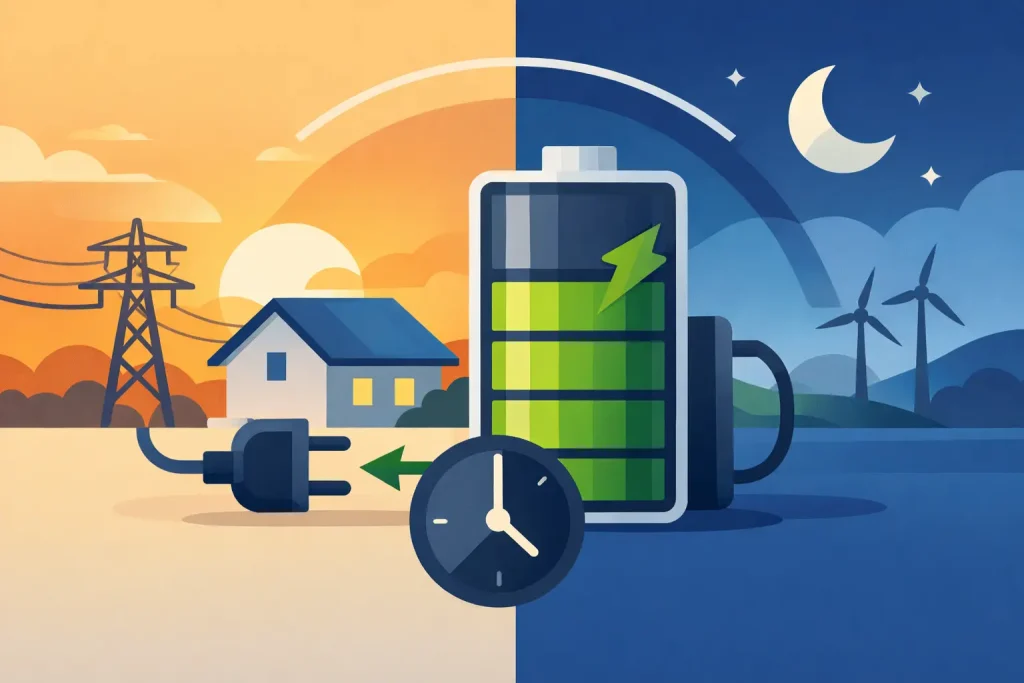
A home battery can do more than store surplus solar electricity. With the right electricity tariff and system settings, battery charging from off peak tariffs lets you buy electricity when it is cheaper and use it later, when household demand and standard unit rates are higher.
For many Kent households, this can make battery storage worthwhile even through darker winter months, when solar production is limited. It is not a guaranteed saving in every property, though. The results depend on your tariff, electricity use, battery capacity, heating system, EV charging habits and how intelligently the system is configured.
How battery charging from off peak tariffs works
Time-of-use tariffs charge different prices for electricity at different times of day. An off-peak window often falls overnight, when national demand is lower. Rather than paying a single flat rate all day, you may have a few hours where imported electricity costs substantially less per unit.
A compatible battery system can be scheduled to charge during that lower-priced period. It then supplies your home through the morning and evening, reducing the amount of electricity you need to buy at the more expensive daytime rate.
As a simple example, a household may charge a battery overnight and use that stored energy for breakfast-time demand, cooking, appliances, lighting and evening use. If solar panels are also fitted, daytime solar generation can cover part of the load and recharge the battery further where there is spare generation.
The aim is not to avoid the grid completely. It is to use grid electricity at more sensible times, while making the best use of your own generation.
The calculation that matters: price difference, not just cheap electricity
A low overnight unit rate looks attractive, but the saving comes from the gap between that rate and the price you would otherwise have paid later. Battery losses also need to be allowed for.
No battery returns every unit put into it. Electricity is lost during charging, storage and conversion back to AC power for the home. A good system may have a round-trip efficiency of around 85 to 95 per cent, depending on the equipment and operating conditions.
Suppose an off-peak rate is 8p per kWh and the daytime rate is 30p per kWh. Even after modest losses, charging overnight and using the energy later can offer a worthwhile margin. If the difference is much smaller, the financial case becomes less compelling.
It is also worth comparing your import costs with any export payment you receive for solar electricity. On a sunny day, it can sometimes be better to export surplus solar at a strong export rate rather than store it, especially if the battery is already charged from a cheap overnight period. This is where sensible settings make a real difference.
A battery should not be set to charge blindly every night
The best approach changes with the weather, the season and your household routine. In winter, scheduled overnight charging is often useful because solar generation is lower. In summer, filling the battery from the grid every night may leave little space to store free solar power the next day.
Some systems can use forecasts, tariff information and consumption patterns to make these decisions automatically. Others rely on schedules that need occasional adjustment. Neither method is inherently better. Automated control can be convenient, but it still needs to be commissioned correctly and checked against the tariff you actually use.
Is your tariff suitable for battery charging?
Not every off-peak tariff works in the same way. Some offer a fixed overnight window, while others have several periods with different prices. Certain tariffs are designed around EV charging and may have conditions, such as requiring a compatible smart meter or a particular charging arrangement.
Before choosing a tariff, look beyond the cheapest advertised overnight rate. Check the following practical points:
- the exact off-peak hours and whether they suit your household;
- the peak and standard rates for electricity used outside those hours;
- any standing charge, contract term or eligibility condition;
- whether your battery inverter can schedule charging accurately around the tariff window;
- your export tariff and whether it remains suitable alongside the import tariff.
A tariff with a very cheap four-hour window can work well for a battery if it has enough charge power to fill meaningfully during that time. For example, a larger battery paired with a low-power inverter may not be able to take in the energy you expect before the cheap period ends.
Your smart meter is equally important. Time-of-use billing relies on half-hourly readings being recorded and communicated correctly. Without this, you may not receive the rate you think you are receiving.
Battery size and charging power need to match the home
It is tempting to focus only on battery capacity, measured in kWh. Capacity matters, but charging and discharge power matter too. A 10 kWh battery is of limited help during an expensive tariff period if the inverter cannot supply enough power for the kettle, oven, heat pump or other high-demand appliances without importing from the grid.
Equally, an oversized battery is not automatically the right answer. If a household only uses a few kWh outside its cheap tariff window, a very large battery may spend much of its life partly utilised. The extra cost may take longer to recover.
A proper design starts with actual consumption data. Smart meter readings can show overnight use, daytime baseload, evening peaks and seasonal changes. An installer should also consider whether you have an electric vehicle, an immersion heater, electric cooking, a heat pump or plans to add these later.
For a home with solar, the objective is usually to balance three things: capturing solar generation that would otherwise be exported, shifting cheap grid electricity into expensive periods, and maintaining enough battery capacity for the times you value most. That could be evening household use, backup provision where supported, or reducing imports during peak rates.
How solar and off-peak charging work together
Solar panels and low-cost overnight electricity are sometimes presented as competing ideas. In practice, they complement each other when the controls are set up for the household.
During winter, charging from an off-peak tariff can reduce expensive daytime imports when solar output is modest. During spring and summer, solar may do more of the charging, allowing the overnight grid schedule to be reduced or turned off on bright days.
The complication is battery headroom. If the battery reaches 100 per cent overnight, there is nowhere for the next day’s solar surplus to go. That may not matter if the export rate is good, but it can reduce solar self-consumption. Many homeowners choose a lower overnight state-of-charge target in brighter months, keeping room for anticipated solar production.
There is no universal percentage that suits every system. A household that leaves empty all day may benefit from preserving space for solar. A family that needs reliable energy for a busy morning may prefer a higher overnight charge level. This is a practical conversation, not a one-size-fits-all setting.
Battery wear, warranties and sensible use
Using a battery daily is what it is designed to do. However, every battery has a finite number of charge and discharge cycles, and heat, sustained high charge levels and repeated deep cycling can all influence long-term performance.
That does not mean you should avoid off-peak charging. It means the expected savings should justify the extra cycling. Where the tariff gap is substantial, daily cycling can make sound financial sense. Where the gap is small, constantly charging and discharging simply to save a few pence may offer little benefit.
Check the manufacturer’s warranty carefully. Warranties commonly include a time period, a retained-capacity figure and a throughput or cycle limit. The details vary between products, so it is sensible to understand them before deciding how aggressively the battery will be used.
Getting the settings right from the start
The battery, inverter, meter configuration and tariff need to work as one system. A technically sound installation can still underperform if the tariff schedule is wrong, solar priority has not been considered, or the system is unable to see the correct grid import and export data.
During commissioning, the important questions are straightforward. When will the battery charge from the grid? What charge limit will it use? Will it reserve capacity for solar? What happens if an EV charger and battery both operate in the same overnight window? And how will you review performance after the first few bills?
At Baird And Brown LTD, the most useful recommendations begin with how a household actually uses electricity, rather than a battery size chosen from a brochure. A clear design and handover should leave you knowing what your system is set to do and why.
Before changing tariff or battery schedules, gather a few weeks of smart meter data and note the appliances that drive your highest demand. That small amount of preparation gives you a far better basis for choosing settings that save money without compromising how your home runs.
