

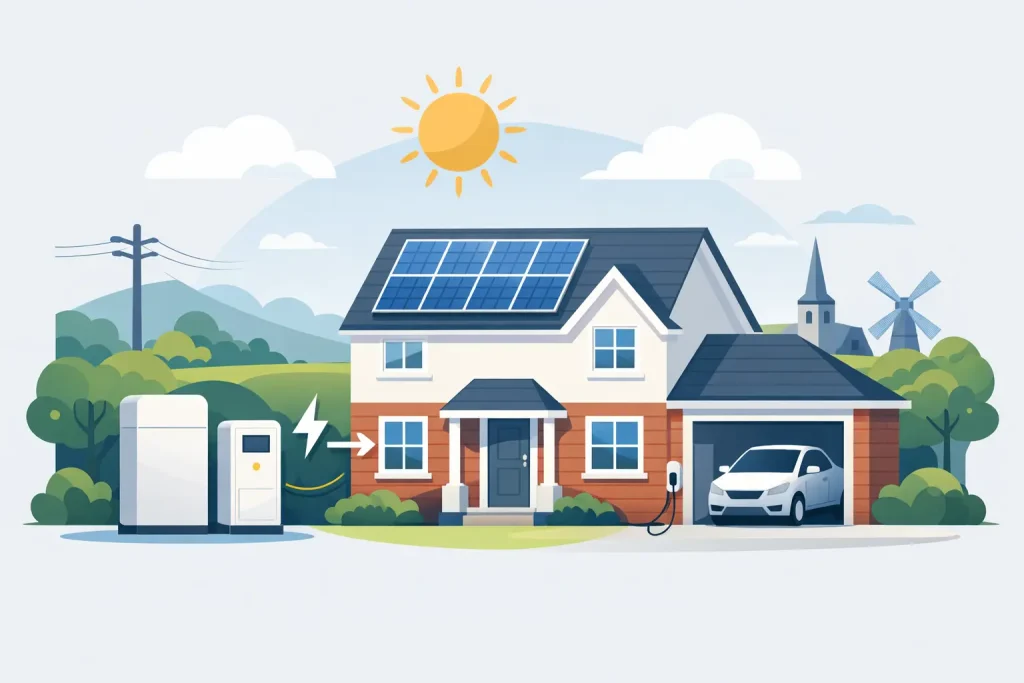
A solar battery can make a home solar system far more useful after the sun has gone down. But a battery does not automatically keep every light, socket and appliance running during a power cut. This solar battery backup guide explains the difference, so Kent homeowners can choose a system based on how they actually use electricity rather than a sales figure alone.
For many households, the main benefit is simple: store surplus solar generation during the day and use it later in the evening. Backup power is a separate design choice. It can be very worthwhile, particularly where continuity matters, but it needs the right equipment, sensible expectations and a proper assessment of the property.
What a solar battery does day to day
Solar panels generate most electricity around the middle of the day. Unfortunately, many homes use more power in the morning and evening, when people are getting ready for work, cooking, washing and charging devices. A battery stores electricity that would otherwise be exported to the grid, then releases it when your home needs it.
This can increase the proportion of your own solar power that you use. It may also allow you to charge at cheaper off-peak electricity rates and use that stored energy at more expensive times, where your tariff and usage pattern make this worthwhile.
Battery storage is not a replacement for the grid. In winter, solar generation is lower and some homes will still need significant imported electricity. The value comes from reducing avoidable imports, making better use of your panels and giving you more control over when energy is used.
Battery storage and power-cut backup are not the same
This is the point that causes most confusion. A standard solar and battery installation will usually switch off during a grid outage. This is a safety requirement. Engineers working on the local network must not be exposed to electricity being fed back from a home system.
To provide power during an outage, the system needs a backup or emergency power arrangement. Depending on the equipment selected, this may use an automatic changeover device, a dedicated backup output or an essential-loads consumer unit. The battery and inverter must also be capable of operating safely when separated from the grid.
A backup system normally supplies selected circuits rather than the whole house. That could include the broadband router, lighting, fridge-freezer, a few sockets and perhaps a boiler or heating controls. It is often a more practical and affordable approach than trying to run every circuit.
Whole-home backup: possible, but not always sensible
Whole-home backup can be designed, but it requires careful load management. High-demand appliances such as electric showers, immersion heaters, ovens, heat pumps and EV chargers can drain a battery quickly or exceed the inverter’s output rating.
A battery might hold enough energy to run a fridge, lights and Wi-Fi for many hours, while an electric shower could use a large share of that energy in minutes. The important figures are battery capacity, measured in kilowatt-hours (kWh), and inverter power, measured in kilowatts (kW). One tells you how much energy is stored; the other helps determine what can be run at one time.
How to size a solar battery for your home
There is no useful one-size-fits-all battery size. A suitable system depends on your solar generation, household demand, tariff, appliances and reason for installing it.
Start with your electricity use. Half-hourly smart meter data is particularly useful because it shows when you consume electricity, not merely the annual total. A household that is empty most days and uses power mainly after 5pm will have a different battery requirement from a home where someone works remotely and uses solar generation as it is produced.
Next, consider solar output. A larger array may produce enough surplus energy to charge a larger battery in spring and summer, but winter performance still needs realistic expectations. Oversizing storage can leave capacity sitting unused for long periods. Undersizing it may mean regularly exporting usable solar energy or importing electricity earlier in the evening.
For backup, list what genuinely needs to stay on. A short, honest list is better than designing around every appliance in the home. Think about food refrigeration, communications, lighting, medical equipment where applicable, heating controls and a small number of sockets. Then consider how long you want those essentials to operate if there is an outage.
Do not overlook inverter output
Two batteries with similar kWh capacities can feel very different in use. If several appliances start at once, the inverter needs sufficient output to handle them. Kettles, microwaves and hairdryers are common examples of short, high loads.
The installation design should account for normal household behaviour, not assume everyone will monitor every switch. A qualified installer can explain which loads are appropriate for backup and whether a dedicated essential-loads board is the right solution.
The practical checks before installation
A site survey is where good advice becomes a workable design. The installer should look at your existing consumer unit, earthing arrangement, incoming supply, meter position, cable routes and the available space for equipment. Battery units need a suitable location with appropriate clearances and access for installation and future servicing.
It is also worth discussing future plans. If you expect to buy an electric vehicle, install a heat pump, extend the property or add more panels, the system can be designed with that in mind. This does not always mean buying the largest possible battery now. It may mean choosing equipment that can be expanded later, or ensuring the electrical infrastructure will not need to be redone.
For a backup system, the installer must also assess the connection arrangement and notify the relevant network operator where required. Documentation matters here. You should receive clear information on the equipment installed, system operation, commissioning and warranties, along with the relevant electrical certification.
A solar battery backup guide to common trade-offs
The best choice usually sits between everyday savings, resilience and upfront cost. A larger battery can store more energy, but it costs more and may not be fully used throughout the year. Whole-home backup offers greater convenience, but it often needs a higher-output inverter, more battery capacity and greater control over demanding appliances.
Charging from off-peak tariffs can improve the economics of a battery, especially in darker months. However, tariff savings depend on the rates available, how much energy your household can shift and whether you are comfortable with the charging schedule. Export payments also matter. In some cases, exporting surplus solar and importing cheap electricity later can be a reasonable strategy; in others, self-consumption will be the priority.
There is no honest answer that applies to every home. The right design is the one that matches your habits, budget and expectations of backup power.
Questions worth asking an installer
Before agreeing to a system, ask what will happen during a power cut, exactly which circuits will remain live and whether the changeover is automatic. Ask for the usable battery capacity, inverter output, warranty terms and whether the proposed system can be expanded.
Also ask how the installer has used your consumption data to select the battery size. A clear explanation is a good sign. You should not feel pressured towards a particular capacity without seeing how it fits your property and electricity use.
For homeowners across Kent, a properly surveyed installation is usually more valuable than a package selected from a price list. Baird And Brown LTD approaches battery storage as part of the wider electrical system, with the aim of leaving you with equipment that is safe, understandable and suited to the home.
Making the system work once it is installed
A battery performs best when it is monitored and adjusted over time. Most systems provide an app showing solar generation, household demand, grid imports, exports and battery charge. The first few months are useful for seeing whether the charging schedule and reserve level match your routine.
If backup is your priority, you may choose to keep a portion of the battery in reserve rather than using every available unit for daily savings. That means slightly less capacity for normal evening use, but more stored energy if the supply fails. If reducing bills is the priority, you may set a lower reserve. Neither setting is universally right.
Treat a solar battery as a carefully designed part of your home, not a promise of unlimited free electricity. With clear priorities, the right backup arrangement and an installation carried out properly, it can provide useful savings and welcome reassurance whenever the lights on the street go out.




