

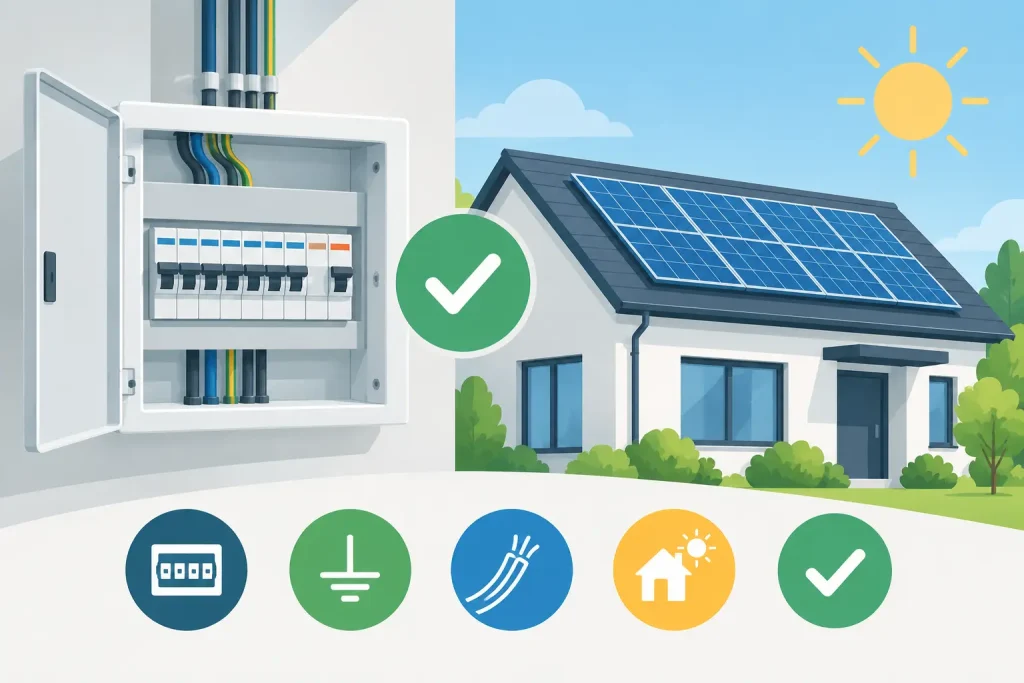
A tidy fuse board with a few empty spaces can look reassuring, but appearances alone do not answer the question, is my consumer unit solar-ready? Solar PV changes the way electricity moves around your home. Rather than only receiving power from the grid, your electrical installation may also receive power from an inverter, battery or both.
That does not mean every solar installation needs a new consumer unit. Many homes in Kent can accommodate solar safely with the right assessment and design. Equally, fitting panels to an ageing board without checking its condition, capacity and protective devices can create avoidable complications. A proper survey should look at the whole installation, not just the spare ways in the board.
What does solar-ready actually mean?
There is no official sticker or single test that makes a consumer unit “solar-ready”. In practical terms, it means the existing electrical installation is suitable to accept a solar inverter connection safely, in line with current wiring requirements and the manufacturer’s instructions.
The consumer unit needs an appropriate way to connect the inverter circuit and suitable protection for that circuit. It should also be in good condition, properly enclosed and correctly labelled once the work is complete. The incoming supply, main switch rating, earthing arrangement and overall condition of the wiring all matter too.
If you are planning battery storage, an EV charger or backup power alongside solar, the assessment becomes more involved. These systems can place different demands on the installation, and they need to work together rather than compete for space and capacity.
Is my consumer unit solar ready? The key checks
An experienced electrician will not make the decision from a photograph of the fuse board. They will inspect the equipment, test relevant parts of the installation and consider the proposed solar system size. These are the areas that usually determine whether an upgrade is advisable.
Age, condition and enclosure type
Older fuse boards may contain rewireable fuses, outdated protective devices or signs of heat damage. A cracked enclosure, loose fittings, missing blanks or poorly identified circuits are all warning signs that should be addressed before solar is connected.
A plastic consumer unit is not automatically unsuitable simply because it is plastic. However, modern domestic installations commonly use metal consumer units, and an older board may not offer the space, condition or protection expected for new work. If a replacement is recommended, it should be because of the findings on site, not because a new board is being sold as a blanket extra.
Spare capacity and usable ways
A solar inverter normally needs its own dedicated circuit at the consumer unit. An installer must check whether there is a suitable spare way, but an empty space is only part of the picture. The board must be rated and configured correctly for the additional protective device and for the way electricity can flow back from the inverter.
Solar battery systems may require further circuits. If you want essential circuits to keep operating during a power cut, the backup arrangement needs particularly careful design. Not every circuit in a house can simply be placed on backup power, and the changeover equipment must prevent electricity being fed back into the public network during an outage.
RCD and RCBO protection
Modern consumer units often use RCBOs, which provide individual protection for each circuit. This can reduce the chance of one fault taking out large parts of the home. Older split-load boards may use shared RCD protection, which is not always the best arrangement for an inverter circuit.
The right protection depends on the inverter manufacturer’s requirements, the circuit design and the existing installation. This is why the protective device cannot be chosen by guesswork. The installer should specify suitable equipment and test it once installed.
Main switch, supply capacity and earthing
Your consumer unit is only one part of the electrical system. The main switch must be suitable for the installation, while the incoming supply and service fuse need consideration when solar, a battery, electric heating or EV charging are involved.
Solar panels do not usually increase your imported electricity demand in the way a large new appliance does. However, the system can export electricity, and the Distribution Network Operator may need to be notified or give permission depending on the generation equipment and its settings. Your installer should deal with the appropriate process and provide the relevant paperwork.
The earthing and bonding arrangements also need checking. These safety measures help protect people and equipment if a fault occurs. They are particularly important where additional electrical equipment is being connected to the property.
Surge protection and labelling
Surge protection devices can help protect sensitive electrical equipment from voltage surges. Their need should be assessed as part of the installation design under the current wiring regulations. With homes increasingly containing inverters, batteries, smart controls, heat pumps and EV chargers, it is sensible to give this proper consideration rather than treating it as an afterthought.
Clear labelling is equally important. A future electrician, emergency responder or homeowner needs to know that the property has more than one source of electricity. Labels at the consumer unit and near isolation points provide important safety information, particularly if a battery is present.
When a consumer unit upgrade makes sense
A replacement consumer unit is often the sensible route if the existing board is damaged, obsolete, overcrowded or unable to accommodate suitable protection. It may also be recommended where testing identifies faults in the installation that should be resolved before new generation equipment is added.
An upgrade can be worthwhile when several improvements are planned at once. For example, a household adding solar PV now, battery storage next year and an EV charger later may benefit from a board designed with sufficient capacity from the outset. This can be neater and more cost-effective than repeatedly altering an unsuitable unit.
There is a trade-off, though. Replacing a consumer unit involves testing the existing circuits, and that may reveal issues in older wiring that need attention. This is not a reason to avoid the work. It is a reason to budget realistically and choose an installer who explains the findings clearly before proceeding.
Solar panels, batteries and EV charging are not the same job
It is easy to assume that once solar panels are fitted, the consumer unit is ready for every future upgrade. That is not always the case.
A straightforward solar-only system may need one dedicated circuit. Adding a battery can introduce further equipment, different operating modes and the possibility of backup circuits. An EV charger is another high-load circuit that needs its own assessment, including load management where appropriate. A heat pump or electric shower can affect the available capacity too.
Thinking ahead is useful, especially for homeowners planning a wider move towards electric living. During the survey, mention any likely future additions, even if they are not being installed immediately. A good design leaves sensible options where possible, without charging you for equipment you do not yet need.
What happens during a proper electrical survey?
A thorough solar survey should include more than measuring the roof. The installer should inspect the consumer unit, look at the incoming supply and meter position, identify the earthing arrangement and check the routes for cabling and isolation equipment.
They should ask about your electricity use, large appliances and future plans. A household with daytime use, an electric vehicle and plans for a battery will need a different design from a home that is empty for most of the working day and only wants to reduce imported electricity.
Where required, electrical testing helps establish whether the existing installation is suitable. You should receive clear documentation after the work, including electrical certification and system information. For solar PV, the installation should also be registered and notified through the correct channels.
At Baird And Brown LTD, the aim is to give homeowners a straightforward answer based on the property in front of us. Sometimes that means the existing consumer unit is suitable. Sometimes it means recommending an upgrade before installing solar. Either way, the reason should be clear, proportionate and supported by the condition of the installation.
A consumer unit is not the most exciting part of a solar project, but it is where good workmanship shows. Before choosing panels or comparing battery sizes, make sure the electrical foundations are being checked with the same care.


