

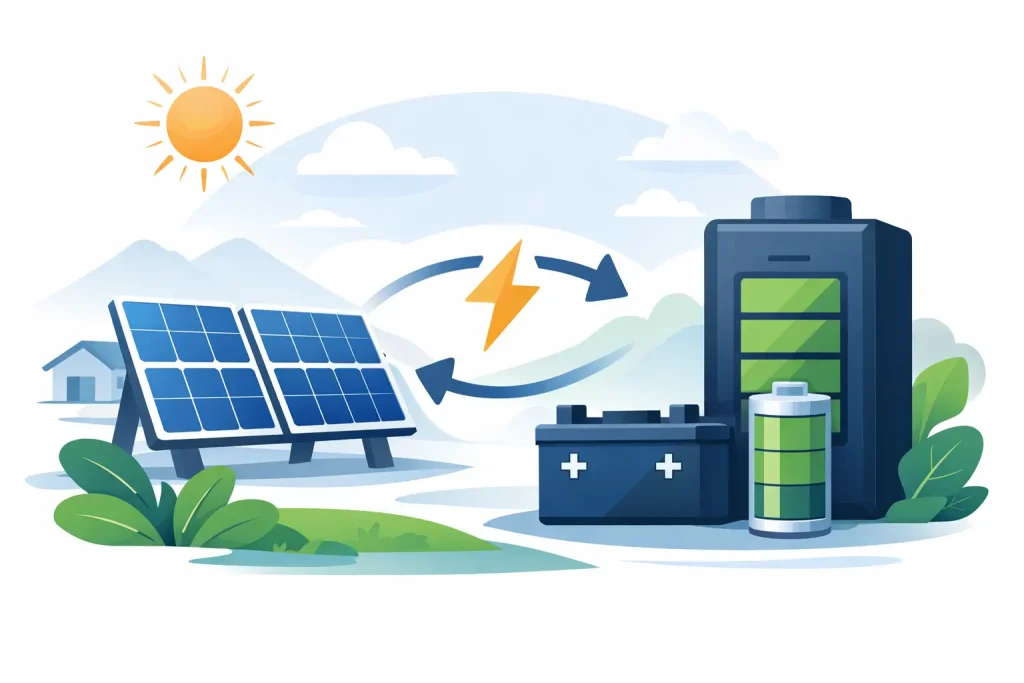
If your solar panels are already on the roof and you are watching surplus electricity head back to the grid for a modest return, it is only natural to ask, can I add battery to solar panels? In many homes, the answer is yes. The more useful answer, though, is that it depends on how your current system was installed, what inverter you have, how you use electricity, and what you want the battery to achieve.
For some households, adding battery storage is a sensible upgrade that improves self-consumption and gives more control over energy use. For others, it is possible but not especially good value without a few wider changes to the system. That is why this is best treated as a design question, not a simple add-on purchase.
Can I add battery to solar panels on an existing system?
In most cases, yes, a battery can be added to an existing solar PV system. A good installer will first look at the age and specification of the system, the inverter model, the generation profile, and the household’s usual demand. That initial assessment matters because not every solar setup is battery-ready in the same way.
There are two common routes. One is to add an AC-coupled battery system. This works alongside your existing solar inverter and is often the more straightforward retrofit option. The other is to move towards a hybrid arrangement, which may involve replacing the current inverter with one that can manage both solar generation and battery charging more directly.
Neither option is automatically better in every property. AC-coupled systems can be easier to retrofit where the existing solar installation is otherwise performing well. A hybrid approach can be cleaner and more efficient in some scenarios, but it can also mean more cost and more disruption if major equipment has to be changed.
What has to be checked before adding a battery?
The first thing to check is inverter compatibility. Some inverters are designed with future battery integration in mind. Others are not. Even where a manufacturer offers a matching battery range, the details still matter. Firmware, communication protocols, generation limits and physical installation space all need to be confirmed properly.
The second issue is your consumer unit and overall electrical setup. Battery storage is not just a box on the wall. It has to be integrated safely into the property’s electrical system, with correct protection, isolation and certification. A competent installer should review the existing installation and flag any upgrades needed before work starts.
The third point is how you actually use electricity. If most of your solar generation is already used during the day because someone is often at home, battery savings may be lower than expected. If the house is usually empty in daylight hours and demand picks up in the evening, battery storage tends to make more sense.
Roof size and panel output also matter, but perhaps less than people expect. You do not need a huge solar array to justify a battery. What matters more is whether there is enough regular surplus to charge it and whether your evening and overnight use is high enough to benefit.
When adding a battery makes good sense
Battery storage tends to work well for households that export a fair amount of daytime generation and then import electricity later on at higher rates. In simple terms, it lets you hold onto more of what you generate and use it when you actually need it.
That can be particularly useful if you run appliances in the evening, charge devices overnight, or have an EV that is not always charged during daylight hours. It can also suit homes that want more predictable energy costs over time, even if the payback is not immediate.
There is also the practical side. Many homeowners like the idea of getting more value from the solar system they already have, rather than feeling that excess generation is being wasted. Technically, exported electricity is not wasted, but from a household budgeting point of view it often feels that way.
When it may not be the right move
A battery is not the right answer for every home. If your solar array is small, heavily shaded, or not generating much surplus, the benefit may be limited. The same applies if your electricity use is already concentrated in daylight hours and your export levels are low.
Cost is another factor. Battery prices have improved, but it is still a meaningful investment. If the goal is a quick payback, expectations need to be realistic. Some homeowners choose battery storage partly for financial reasons and partly for control, future-readiness or reduced reliance on imported electricity. That broader view is often more realistic than chasing a single headline saving.
It is also worth being clear about backup power. Many people assume a battery will keep the whole house running during a power cut. Some systems can provide backup capability, but not all do, and not always across the entire property. If backup is important, that needs to be built into the design from the start.
Can I add battery to solar panels without replacing everything?
Often, yes. That is one of the main reasons retrofit battery systems are popular. If your panels are in good condition and the current solar installation is sound, there may be no need to replace the array itself. The work may centre on the inverter arrangement, battery unit, protection equipment and control settings.
That said, there are cases where replacing older equipment is the sensible route. If the inverter is nearing the end of its life, or if the original setup was not designed particularly well, trying to bolt on a battery at any cost is not always the best long-term decision. A proper survey should tell you whether a tidy retrofit is possible or whether a more comprehensive upgrade would serve you better.
For homeowners, this is where honest advice matters. A sales-led answer is often yes, of course. A technical answer is yes, probably, but only if the whole system still makes sense once the battery is included.
Choosing the right battery size
Bigger is not always better. An oversized battery can sit partly unused for much of the year, especially in winter when solar generation is lower. An undersized battery may fill quickly and leave you exporting energy that could have been stored.
The right size depends on your daytime surplus, evening demand and tariff arrangement. A household that uses most of its electricity after sunset may benefit from a larger usable capacity. A smaller home with modest evening demand may be better served by a more compact system.
This is one area where real usage data is far more useful than guesswork. Looking at historic generation and consumption patterns usually leads to a better outcome than choosing a battery based on headline size alone.
Installation standards and paperwork matter
Battery storage should never be treated as a casual electrical add-on. The installation needs to be designed and fitted correctly, with appropriate certification and documentation. That includes checking notification requirements, commissioning, labelling and handover information.
For homeowners in Kent, choosing an installer who is used to both solar PV and battery systems is usually the safer route than using separate trades. It reduces the risk of compatibility issues being missed and makes aftercare more straightforward. Companies such as Baird And Brown LTD build their service around that joined-up approach, which is often exactly what homeowners want when they are making a high-value upgrade to their property.
Just as important is the practical side of the visit itself. Battery work should be carried out neatly, safely and with clear communication throughout. People remember whether installers turned up on time, explained the options properly and left the place tidy. Those things are not extras. They are part of doing the job well.
Is it worth adding a battery now or waiting?
There is no universal right moment. If your current solar system is performing well and you are exporting a noticeable amount of electricity, adding a battery now may make immediate sense. If you are planning wider changes, such as an EV charger, heat pump or major home renovation, it can be worth looking at everything together.
Future plans matter because energy systems work best when they are designed as part of a whole household picture. A battery that looks slightly too large today may be exactly right once an electric car is in regular use. Equally, if you expect your usage to fall, a smaller system may be the more sensible choice.
The best decision usually comes from matching the battery to your home as it is actually used, not to a generic sales example. Every house is a little different. Every family is too.
If you are asking can I add battery to solar panels, the real question is whether a battery will improve the way your home uses energy. Once that is answered properly, the next step is usually much clearer.
