

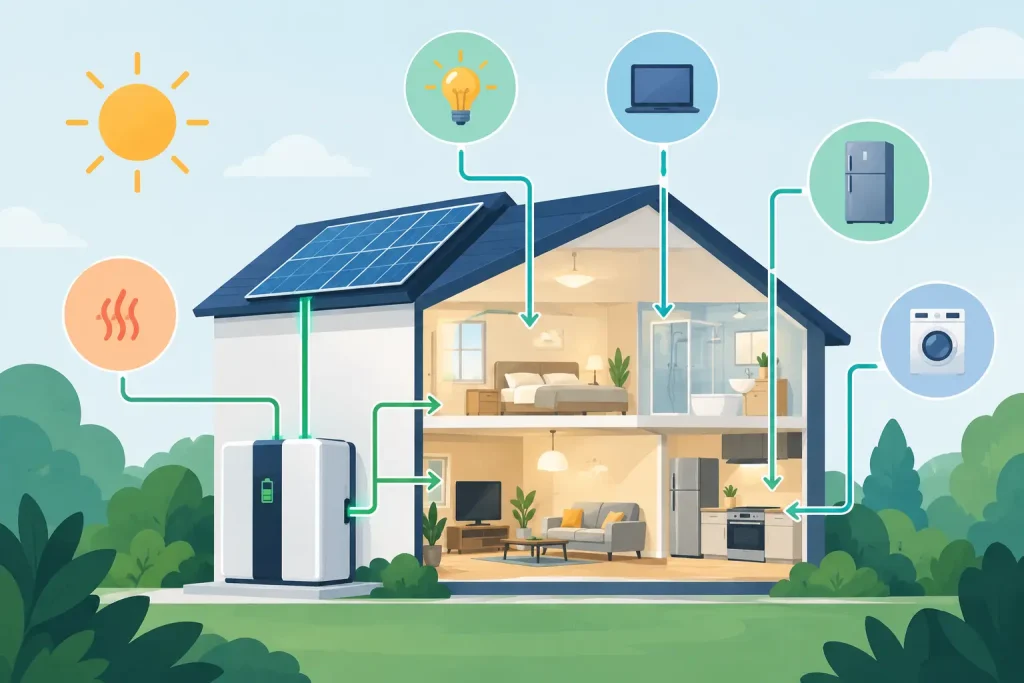
A home battery earns its keep after the sun has gone down. Rather than exporting spare solar electricity for a modest payment, you can keep it for the evening meal, the washing machine, home working, or the overnight base load that continues when everyone is asleep. The best ways to use stored energy depend on how your household uses electricity, the size of your solar array, your tariff and whether you have an electric vehicle.
The aim is not simply to fill a battery every day. It is to use the electricity stored in it at the times when buying from the grid would otherwise cost the most. A properly designed system should do much of this automatically, but the right settings and realistic expectations make a noticeable difference.
Best ways to use stored energy from solar
For most Kent households, the strongest use of battery power is covering electricity demand between late afternoon and bedtime. Solar generation often peaks around midday, while household demand usually rises when people return home, cook, switch on lights and use appliances. Without storage, much of that daytime solar may be exported. With a battery, it can be retained for the period when grid electricity is most valuable.
This is particularly useful in spring and summer, when a well-sized solar PV system may generate more electricity than the home can use during the day. The battery can charge from that surplus and discharge gradually through the evening. It will not make a home entirely independent of the grid, especially through a darker British winter, but it can reduce the amount of electricity bought at expensive times.
The most effective approach is usually to let the battery support normal household consumption rather than trying to reserve it for one appliance. Fridges, lighting, televisions, broadband equipment, cooking and general plug loads add up. A battery that responds to this changing demand can cover a broad range of consumption without the homeowner needing to chase the sun around the house.
Run flexible appliances while the sun is generating
Battery storage works best alongside sensible daytime use. If possible, run high-consumption appliances such as washing machines, tumble dryers and dishwashers while solar panels are producing well. This allows the solar electricity to power the appliance directly, leaving more surplus available to charge the battery for later.
There is a balance to strike. On a dull day, it may not be worth starting several energy-hungry appliances at once if that means drawing heavily from the grid. On a bright day, timed programmes can make excellent use of generation that would otherwise be exported. Many modern appliances have delay-start functions, and monitoring apps can help households understand their usual generation pattern.
Use off-peak electricity carefully
A battery does not only have to charge from solar. Some electricity tariffs offer cheaper overnight or off-peak periods, which can make it sensible to charge the battery from the grid and use that electricity later. This can be valuable during winter, when solar production is lower, or on days when the weather has been particularly poor.
The saving depends on the gap between the off-peak and peak electricity rates, as well as battery losses. No battery returns every unit put into it: a small proportion is lost during charging and discharging. If the price difference is modest, grid charging may offer little benefit. If the difference is substantial, it can help reduce daytime electricity costs.
It is also worth checking how grid charging interacts with your export arrangement. A correctly configured system should not charge the battery cheaply from the grid simply to export that stored electricity later. Settings should prioritise household use and comply with the requirements of the energy supplier and network operator.
For households on time-of-use tariffs, automated scheduling is often more useful than manual switching. Your installer can explain what the chosen battery and inverter can do, and whether the controls suit the tariff you intend to use.
Charge an electric vehicle at the right time
An EV is one of the largest electrical loads in many homes, so its charging routine has a major effect on how stored energy is used. In most cases, it is not sensible to drain a home battery into an electric vehicle every evening. A typical EV battery is far larger than a domestic battery, and charging the car this way can leave little stored power for the house.
A more practical arrangement is usually to charge the EV directly from surplus solar during the day, or from a low-cost overnight tariff. Smart EV chargers can be set to respond to solar surplus, scheduled charging windows, or both. This helps the household avoid paying a standard daytime rate while protecting the home battery for evening use.
There are exceptions. A household with a smaller EV, regular daytime parking and plenty of summer solar may choose to direct some stored electricity to the car. The right choice depends on driving mileage, battery capacity and whether the vehicle must be ready early each morning. The useful question is not whether every available unit can go into the car, but where each unit saves the most money and provides the most convenience.
Keep a reserve for power cuts, if your system supports it
Some battery systems can provide backup power during a grid outage, but this is not automatic on every installation. Standard solar and battery systems generally shut down when the grid fails unless they have suitable backup hardware and have been designed for that purpose.
Where backup is included, a reserve setting can hold back part of the battery for essential circuits. That might cover lighting, the fridge, broadband, selected sockets and possibly a boiler control system. It is a reassuring feature for properties in areas that experience occasional supply interruptions, but it comes with a trade-off: energy held in reserve is not available for normal daily savings.
Backup also has limits. High-load equipment such as electric showers, ovens, immersion heaters and heat pumps may exceed the system’s backup capability, particularly if several items start at once. Before choosing this option, decide what genuinely needs to remain powered and have the backup arrangement designed around those circuits.
Consider hot water and heating controls
If your home has an immersion heater, surplus solar can sometimes be used to heat water before it is exported. A solar diverter monitors excess generation and sends it to the immersion heater in small amounts. This can work well in homes with a hot-water cylinder, particularly where hot water demand is steady and daytime solar output is good.
Whether this is better than charging the battery first depends on the household. Stored electricity is versatile: it can run lights, appliances and other loads later. Hot water stored in a cylinder is useful too, but only for hot water. In many cases, it makes sense to prioritise the battery until it reaches a chosen level, then divert further surplus to the immersion heater.
Heat pumps need a slightly different approach. They are usually most economical when operated steadily and controlled around the home’s heat demand, rather than being switched on and off purely to follow solar output. Battery storage can help reduce grid imports, but it should not compromise a well-designed heating control strategy or comfort in the home.
Size and settings matter as much as the battery itself
A larger battery is not always the better investment. If a household rarely fills a large battery, much of its capacity may sit unused. If it is too small, it may fill by midday and export a large amount of solar, then run out early in the evening. The right capacity depends on your annual consumption, daytime occupancy, solar generation, tariff and major loads such as an EV or heat pump.
It is equally important to look at power, not only capacity. Capacity is measured in kilowatt-hours and shows how much energy the battery can store. Power is measured in kilowatts and affects how quickly it can charge or discharge. A battery with ample capacity but limited discharge power may still import electricity when several high-demand appliances are running.
Good monitoring is useful once the system is installed. Review a few ordinary weeks, not only the sunniest day of the year. Look at when the battery fills, when it empties, how much electricity is imported overnight and how much solar is exported. Small adjustments to charge schedules or reserve levels may improve results, but frequent tinkering is rarely necessary.
A site survey and clear discussion of daily routines are the foundation of a useful design. At Baird and Brown Ltd, that means considering the property, your existing electrical installation and how you actually live, rather than recommending a one-size-fits-all battery.
The best result is a system that quietly fits around your home: solar power used when it is available, stored electricity used when it has the greatest value, and clear controls that still make sense years after installation.


