

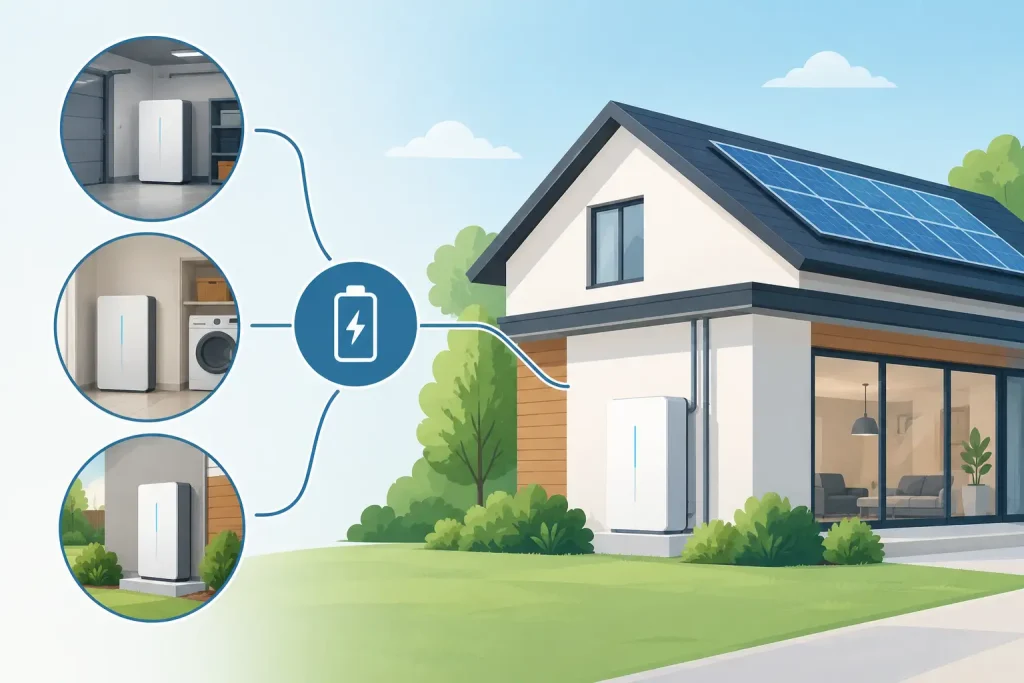
A home battery is often one of the least visible parts of a solar installation, but where it sits has a real effect on safety, performance and day-to-day convenience. Knowing how to choose battery placement means looking beyond the nearest spare wall. The right location needs suitable temperature conditions, safe access for installers and future servicing, adequate clearance, and a sensible route to your consumer unit, solar inverter and meter.
For many Kent homes, the answer is a garage, utility room or dedicated plant area. That is not a rule, though. Every property has different space, wiring and usage requirements, which is why a proper site survey should come before deciding where the battery will go.
Start with the battery manufacturer’s requirements
Battery storage systems are not all the same size, shape or specification. Some are designed primarily for indoor installation; others are suitable for an external wall when installed with the correct protection. Each manufacturer sets requirements for operating temperature, ventilation, mounting surface, clearance around the unit and permitted locations.
These requirements are not small print. A battery that regularly becomes too hot or too cold may reduce its usable performance, limit charging or discharging, and potentially have a shorter working life. It also needs to be fixed securely to a suitable surface, with enough room around it for safe installation and inspection.
Your installer should select a location that follows the equipment instructions rather than trying to make a preferred space fit. If the most convenient-looking spot does not meet the manufacturer’s criteria, it is better to consider another location early in the design process.
Choose a stable temperature, not just an empty corner
Lithium battery systems work best within a defined temperature range. A dry, sheltered area with relatively steady temperatures is usually preferable to a loft that gets exceptionally hot in summer, an unheated outbuilding that becomes very cold in winter, or a wall that receives prolonged direct sun.
A garage can be a very good option, particularly when it is attached to the house and remains reasonably temperate. Utility rooms and cupboards can also work where there is enough space and the manufacturer permits the arrangement. The key is not simply whether a location is indoors, but whether it is dry, accessible and suitable for the specific system.
External installation can be practical where indoor space is limited. It may be the right choice for a property with a suitable shaded wall close to the electrical supply. However, external batteries need the correct weather protection, secure mounting and cable routing. They should not be placed where they are likely to be struck by vehicles, exposed to continual water run-off, or difficult to reach safely.
Put safety and access ahead of appearance
A battery should be out of the way, but never out of reach. It needs to remain accessible for commissioning, maintenance, fault finding and any future replacement. Hiding it behind stored boxes, garden equipment or a built-in unit may make a room look tidier initially, but it creates a problem when work is required.
Avoid locations that obstruct escape routes, narrow hallways or areas where people regularly pass with bags, buggies or bicycles. A battery installation also needs clear working space for an electrician. This is one reason garages, utility spaces and purpose-designed plant cupboards are often more suitable than living areas.
Think about how the space will be used in five or ten years’ time. A small battery on a clear garage wall may be straightforward today, but that wall might later be needed for an EV charger unit, shelving, a heat pump cylinder or additional battery capacity. Leaving sensible room around the installation makes the home easier to adapt.
Consider the route to your electrical equipment
The battery does not need to sit directly beside your solar panels. In most homes, it is positioned according to the electrical layout rather than the roof layout. The important practical question is how cables can be routed safely and neatly between the battery, inverter, consumer unit, generation meter and, where applicable, the solar array.
Shorter cable runs can reduce installation complexity and may help keep the finished work neat. However, the closest position is not automatically the best position if it is damp, cramped, poorly ventilated or difficult to access. A good design balances cable routes with the requirements of the battery and the way you use the property.
The location of your meter and consumer unit matters too. Older properties in particular can have electrical equipment in cupboards, under stairs, garages or less obvious parts of the home. During a survey, an installer should assess the available capacity, protective devices, earthing arrangements and cable route before confirming a battery position. This avoids promises based on photographs alone.
Think about noise and everyday living
Battery systems are generally quiet, but they are not always completely silent. Some equipment includes cooling fans, and associated inverters can make a low operating sound when charging or discharging. It is usually unobtrusive in a garage or utility room, but may be more noticeable if mounted beside a bedroom, home office or frequently used sitting room.
For that reason, it is worth considering when the system will be most active. A battery may charge during sunny daytime hours, from lower overnight electricity tariffs, or both. If your household is sensitive to background noise, place equipment away from sleeping areas where possible.
Appearance is also a fair consideration. A well-planned installation can be tidy and unobtrusive without compromising service access or safety. Neat containment, sensible cable routes and a location that does not dominate a living space all make a difference. Good workmanship should look considered, not simply functional.
Allow for future solar, EV charging and extra storage
Battery placement should support the energy system you expect to have, not only the equipment being fitted this month. If you are installing solar now but may add an EV charger, heat pump or further panels later, say so at the survey stage. Those plans can affect the best route for cables and where capacity should be reserved.
Additional battery modules may need to sit alongside the first unit. Leaving no room for expansion can turn a simple future upgrade into a more disruptive redesign. Equally, there is no benefit in paying for an oversized location or equipment arrangement if expansion is unlikely. The right approach is honest: plan for realistic changes, rather than every possible eventuality.
New-build projects offer more freedom, as a dedicated plant cupboard or garage wall can be allowed for before finishes are complete. In an existing home, a careful survey is especially valuable because the best solution often comes from working with the building, not fighting it.
Do not overlook fire precautions and local conditions
Battery technology is designed with multiple safety protections, but placement still needs careful thought. The installation must follow the product instructions and relevant electrical requirements, with suitable isolation and protection equipment. Your installer should explain where the battery will be fitted, why that location has been selected and how it can be isolated if necessary.
Avoid treating a battery like an ordinary household appliance that can be squeezed into any spare cupboard. Damp areas, locations vulnerable to flooding, spaces with poor access and positions close to heat sources can all be unsuitable. A basement may seem discreet, for example, but its suitability depends on moisture levels, flood risk, access and the specific equipment being proposed.
For properties near the coast in places such as Deal, Dover or Thanet, external installations also deserve particular attention. Salt air and exposed weather do not automatically rule out an outdoor battery, but they make correct equipment selection, enclosure rating and mounting detail more important.
Use a site survey to make the final decision
The best battery location is usually clear once the installer has seen the property. A proper assessment should look at your electricity use, the proposed battery size, solar generation, current electrical installation, available walls or floor space, cable routes and future plans. It should also consider practical details such as parking, storage, household routines and whether you want to retain easy access to your garage.
At Baird And Brown LTD, this is approached as part of system design rather than an afterthought once the equipment has arrived. A straightforward conversation on site often identifies the trade-offs quickly: the shortest cable route may not be the quietest, an external wall may save indoor space, or a larger utility area may make future expansion easier.
A battery should earn its place in your home for years, not merely fit into the first available gap. Choosing a dry, accessible, correctly specified location gives the system the best chance to operate efficiently while keeping your home practical, safe and ready for what comes next.


