

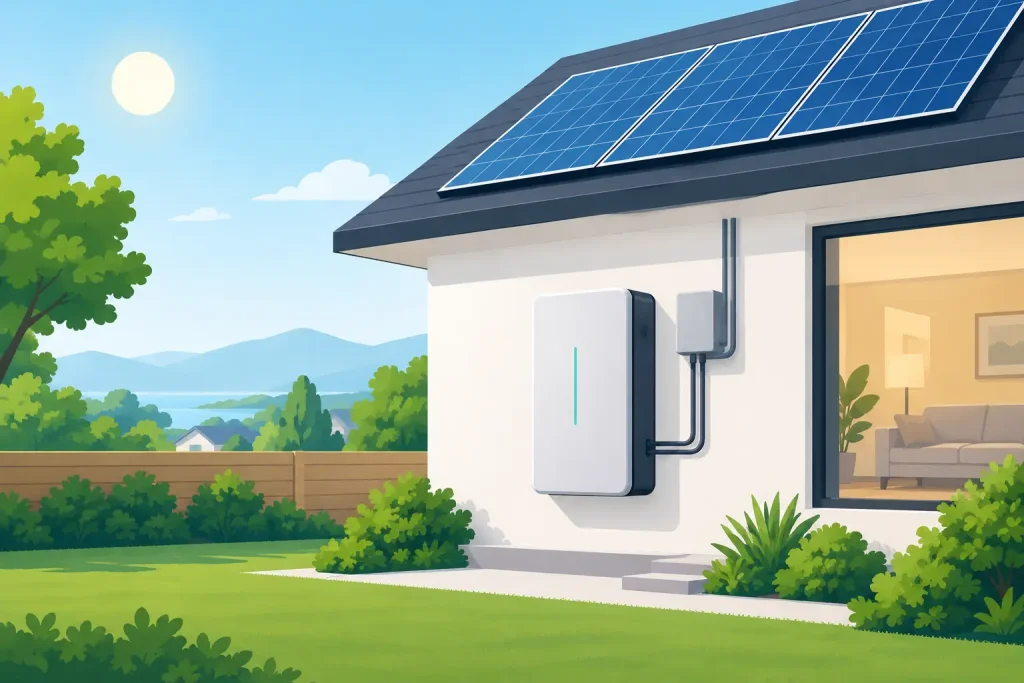
A home battery is not simply another box added beside your consumer unit. A well-planned battery storage installation changes when your household uses electricity, how much solar power you keep, and how confidently you can manage rising energy costs. Get the design wrong, however, and even a good battery can be oversized, poorly located or set up in a way that does not suit your tariff or daily routine.
For homeowners in Kent, the best starting point is not a headline battery capacity or a tempting package price. It is an honest look at how your home uses electricity now, what your solar panels produce, and what you want the system to achieve over the next few years.
What a home battery actually does
A battery stores electricity for later use. In most homes, that means capturing surplus generation from solar panels during the day and using it in the evening, when demand is often higher. It can also be charged from the grid during lower-priced periods on a suitable time-of-use tariff, then used when electricity costs more.
This can increase the amount of solar electricity you use in your own home rather than exporting it. It can also make your energy use more flexible, particularly where the household has an electric vehicle, heat pump, immersion heater or a high level of evening demand.
The savings are not identical for every property. A family who is out all day may have plenty of solar surplus to store, while someone working from home may already use a large share of their generation as it is produced. Likewise, a household on a flat-rate tariff will assess the benefit differently from one willing to shift usage around cheaper overnight periods.
Some systems can provide backup power during a grid outage, but this should never be assumed. Standard battery systems often shut down with the grid for safety reasons. Backup requires the right equipment, careful circuit design and a clear decision about which parts of the home should remain powered.
Planning a battery storage installation
A proper survey is where the useful decisions are made. It allows an installer to assess the electrical installation, existing solar equipment, available mounting space and the practical cable route between the battery, inverter and consumer unit. It also gives you the chance to explain what matters most to you: making better use of solar, reducing peak-rate imports, preparing for an EV, or adding backup capability.
Start with your actual electricity use
Annual consumption is helpful, but it does not tell the whole story. Half-hourly smart meter data, where available, shows when electricity is being used. That matters because a battery’s value comes from moving energy from one time to another.
For example, a home using 4,000 kWh a year may need a very different design depending on whether most of that demand happens after 5pm, overnight, or throughout the day. Electric cooking, laundry patterns, home working and seasonal heating all affect the picture.
It is also sensible to plan for known changes. If an EV is arriving next year, or a new heat pump is part of a future renovation, the system should be designed with that in mind. That does not always mean installing the largest possible battery now. It may mean selecting equipment that can be expanded later without replacing the core system.
Battery size is a balance, not a competition
Battery capacity is usually quoted in kilowatt-hours (kWh). A larger figure means more stored energy, but larger is not automatically better. A battery that rarely fills or empties may take longer to justify its cost, while one that is too small may regularly run out before the evening is over.
Usable capacity matters more than the headline figure. So do charging and discharging power, known as kW. A battery may hold enough energy for several hours, but if its output is limited it may not be able to support several high-demand appliances at once. Kettle, oven, shower and EV charging loads all need to be considered realistically.
For homes with existing solar, the inverter arrangement is equally important. Some batteries work with a hybrid inverter, while others can be added to an established solar array using an AC-coupled approach. Both can be appropriate. The right choice depends on the age and specification of the current system, its condition, the desired battery size and the wider electrical design.
Location and safety need careful thought
The best location is rarely chosen on appearance alone. A battery needs an accessible, suitable position with appropriate clearances, a safe cable route and conditions that meet the manufacturer’s instructions. Garages, utility rooms and some external locations may be suitable, but each home is different.
The survey should consider escape routes, heat, ventilation, flood risk, physical protection and whether the space will remain accessible for inspection or maintenance. A garage that gets extremely cold or hot, for instance, may affect performance. A cramped cupboard near a main exit may be a poor choice even if it is convenient for cabling.
Good workmanship is also visible in the details: neat containment where required, secure fixings, clearly labelled equipment and a work area left clean at the end of the day. These are not cosmetic extras. They help make the installation safer and easier to understand in years to come.
Your electrical system and network approval
A battery installation must work safely with the property’s existing electrical installation. Before work starts, the installer should assess the consumer unit, earthing and bonding arrangements, protective devices, cable routes and available capacity. In older homes, upgrades may be needed before new generation or storage equipment can be connected properly.
Grid-connected solar and battery systems also involve notification to the local distribution network operator (DNO). Depending on the equipment and design, this may be handled through the relevant G98 process or require approval under G99 before installation. This is not paperwork to leave until later. It is part of making sure the system is connected correctly and lawfully.
If solar panels are being installed at the same time, choosing an MCS-certified installer also supports the correct design, commissioning and documentation process. For a new-build property, early coordination with the builder and electrician is particularly valuable, as cable routes, meter arrangements and equipment positions can be planned before finishes are complete.
What should happen on installation day?
Once the design and approvals are in place, installation should feel organised rather than disruptive. The team should confirm the agreed equipment position, protect the working area, complete the electrical work safely and test the system before it is put into service.
Commissioning matters as much as fitting the equipment. This is when the battery and inverter settings are checked, monitoring is connected and the system is configured for the agreed operating approach. If you plan to use an off-peak tariff, the charging schedule needs to reflect it. If maximising solar self-consumption is the priority, the settings should support that instead.
At handover, you should receive clear documentation and an explanation of how to use the monitoring app, isolate the system if necessary and read the key information on the equipment. Ask how the system behaves during a power cut, what warranty cover applies, and who to contact if an alert appears. A good installer will answer these questions plainly, without making you feel you are being difficult.
How to judge the value over time
The financial case for a battery depends on export payments, electricity tariffs, solar generation, household demand and the installed cost. It is better to view projected savings as a reasoned estimate than a promise. Weather changes, tariff rates move and a family’s habits are not fixed.
There are benefits that do not fit neatly into a spreadsheet. Some homeowners value seeing more of their own solar generation used at home. Others want greater control over EV charging, or prefer to be less exposed to expensive evening electricity. Those are valid reasons, provided the system specification still makes practical and financial sense.
Baird And Brown LTD approaches battery work as part of the wider home electrical system, not as a one-size-fits-all add-on. A site assessment and straightforward conversation will usually reveal whether storage is worthwhile now, whether it should be paired with solar, or whether preparing the property for a later installation is the sensible route.
The right battery should fit around your household rather than asking your household to fit around it. Start with your usage, your plans and the constraints of the property, then let the design follow.


