
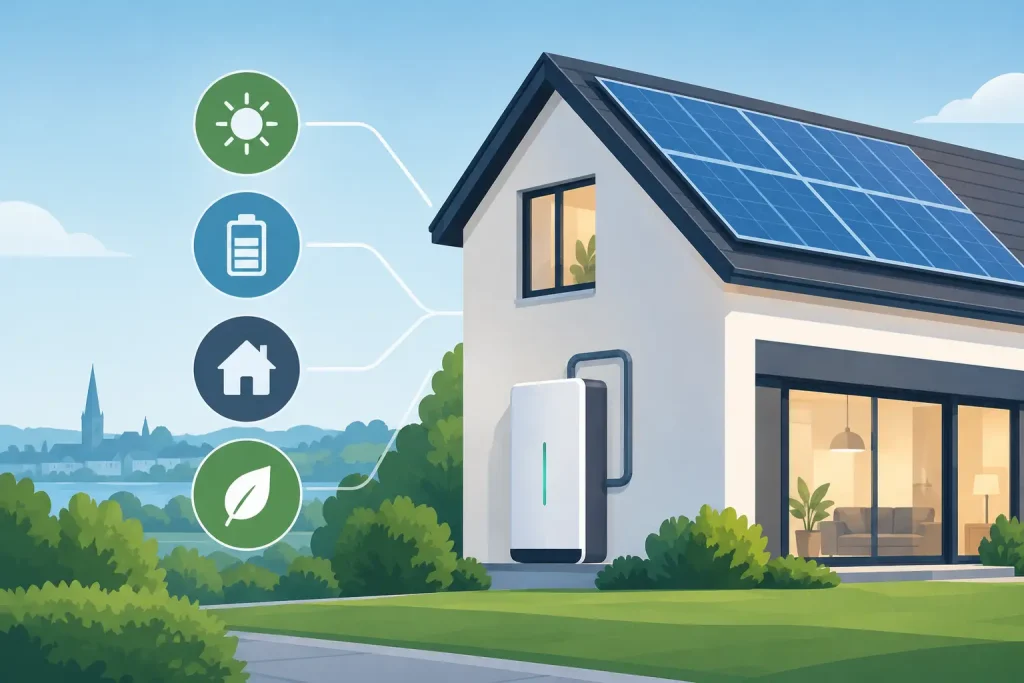
A home battery can look similar on a quotation while delivering a very different result once it is installed. The best battery storage features are not necessarily the ones with the biggest headline numbers. They are the features that suit how your household uses electricity, work properly with your solar system and tariff, and remain dependable for years to come.
For many homeowners in Kent, battery storage is about making better use of solar generation, reducing the amount of electricity bought at peak prices, and gaining more control over energy use. The right system should be designed around those aims, rather than chosen from a standard package.
The best battery storage features to look for
Usable capacity, not just the battery size
Capacity is usually the first figure people see. It is measured in kilowatt-hours (kWh) and indicates how much energy the battery can store. However, the important figure is usable capacity: the amount you can actually draw from the battery in normal operation.
A 10kWh battery does not always give 10kWh of usable energy. Manufacturers protect part of the battery to support longevity and safe operation. That is sensible engineering, but it means two products with similar advertised capacities may not perform identically.
The appropriate size depends on your household. A smaller battery may be enough for a couple with modest evening consumption and a well-sized solar array. A larger household with electric cooking, a heat pump, regular home working or an EV may benefit from greater storage, particularly if it can charge cheaply overnight on a time-of-use tariff. Bigger is not automatically better if much of the stored energy routinely goes unused.
Adequate power output for real household demand
Capacity tells you how long a battery can supply energy. Power output, measured in kilowatts (kW), tells you how much it can supply at one time. This is often overlooked.
For example, a battery may hold plenty of energy but have a limited discharge rate. If the oven, kettle, dishwasher and other appliances run together, your home may still draw some power from the grid. A higher power output can cover more of these short, busy periods.
This does not mean every home needs the highest available output. It means the battery, inverter and your likely electrical loads should be considered together. A proper site assessment and conversation about how you live in the property will identify whether output is likely to be a limiting factor.
Smart tariff charging and useful controls
Solar charging is only part of the picture. One of the most valuable modern battery features is intelligent control that can charge from the grid during lower-priced periods and reserve energy for more expensive times.
Some systems offer automated tariff optimisation, while others allow the homeowner or installer to create schedules. The better arrangements balance convenience with transparency. You should be able to see what the system is doing, adjust settings where appropriate and understand the reason for the battery charging or discharging.
Tariff-led charging can be particularly worthwhile during darker months, when solar production is lower. It can also be useful for households that have an electric vehicle, as careful scheduling helps prevent several high-demand activities from occurring at the same time. Savings will depend on the tariff, household demand and export arrangements, so this should be discussed honestly rather than presented as a guaranteed figure.
Backup power: understand what is and is not included
A battery does not automatically provide electricity during a power cut. This is one of the most common misunderstandings when comparing battery storage systems.
Many installations are designed to switch off when the grid fails, even when the battery contains stored energy. This is a safety requirement that prevents electricity being fed back onto the network while engineers may be working on it. To provide backup, the system needs the correct inverter capability, isolation arrangement and electrical design.
Whole-home backup versus essential circuits
There are generally two approaches. Whole-home backup aims to keep the property operating, subject to the battery and inverter limits. Essential-circuit backup supplies selected circuits, such as lighting, refrigeration, broadband and a few sockets.
Essential-circuit backup is often the more practical and cost-effective choice. It avoids trying to support high-load appliances such as electric showers, ovens or induction hobs from a battery during an outage. Whole-home backup can suit some properties, but it requires more careful load management and is not always appropriate.
If backup matters to you, raise it at the first design stage. Ask exactly what will remain powered, how quickly the system will change over, and what appliances should not be used during an outage. Clear answers are more useful than a vague promise of “backup power”.
Safety, siting and battery chemistry
A battery is a significant electrical installation, not simply a box fitted to a wall. The best battery storage features include strong internal safety systems, thermal management, monitoring and a design that meets the relevant product and installation standards.
Most domestic systems now use lithium iron phosphate battery cells, often referred to as LFP. This chemistry is widely used because it offers good thermal stability and a long cycle life. It is still vital that the equipment is installed in a suitable location, with correct clearances, protection and cable routing.
The ideal position will depend on the property. A garage, utility area or suitably selected external location may work well, but accessibility, temperature, ventilation, flood risk and protection from accidental damage all need consideration. A tidy installation is not just about appearance. It makes future inspection and maintenance easier, and it shows that the system has been planned rather than squeezed into the first available space.
Warranty terms that stand up to scrutiny
A long warranty is reassuring, but the number of years alone does not tell the full story. Battery warranties often include conditions relating to usable capacity after a set period, total energy throughput, registration, internet connectivity or servicing requirements.
Throughput is the total amount of energy that can pass through the battery over its life. A battery that cycles heavily because it is charging overnight and discharging every day may reach a throughput limit sooner than one used mainly to store summer solar generation. Neither approach is wrong, but the warranty should suit the intended use.
Ask for the warranty terms in writing and check who will support you if there is a fault. A dependable local installer can explain the paperwork, register the equipment where required and provide clear handover information. That matters more than being left with a manufacturer name and a helpline number.
Compatibility with solar, EV charging and future expansion
Battery storage can be installed alongside a new solar PV system or added to an existing one. The most suitable arrangement depends on the equipment already in place, the age of the system and what you want it to achieve.
AC-coupled batteries are often a sensible route for retrofitting storage to existing solar. DC-coupled systems can be efficient where solar panels and battery storage are designed together from the outset. There is no universal winner: compatibility, roof generation, available space and budget all affect the decision.
If you expect your electricity use to increase, expansion capability is worth considering. An EV, heat pump, extension or growing family can change the energy profile of a house quickly. Some batteries can be increased later with additional modules, while others are fixed at their original size. Expansion is useful only where it is technically supported and likely to be worthwhile, so it should not be treated as a reason to overspecify from day one.
Monitoring that helps rather than confuses
A clear app or monitoring portal is one of the most practical features of a home battery. It should show solar generation, household demand, battery charge level, grid imports and exports in a way that makes sense to the homeowner.
Good monitoring helps you spot patterns. You may find that the battery is full before midday in summer, that overnight charging is cheaper than expected, or that a particular appliance is driving evening demand. That information can help you adjust routines and get more from the equipment you have paid for.
It should not require you to become an energy analyst. The system should work automatically day to day, with useful information available when you want to check it.
Choose the system around your home
The most suitable battery is rarely selected by capacity alone. It should be matched to your solar generation, evening demand, electricity tariff, future plans and whether backup is a genuine priority. It should also be installed with proper design, documentation and a straightforward explanation of how to use it.
At Baird And Brown LTD, that starts with understanding the property and the household rather than pushing a one-size-fits-all package. A well-planned system should feel simple once it is in place: quiet, tidy, safe and working steadily in the background while you get on with life.




