

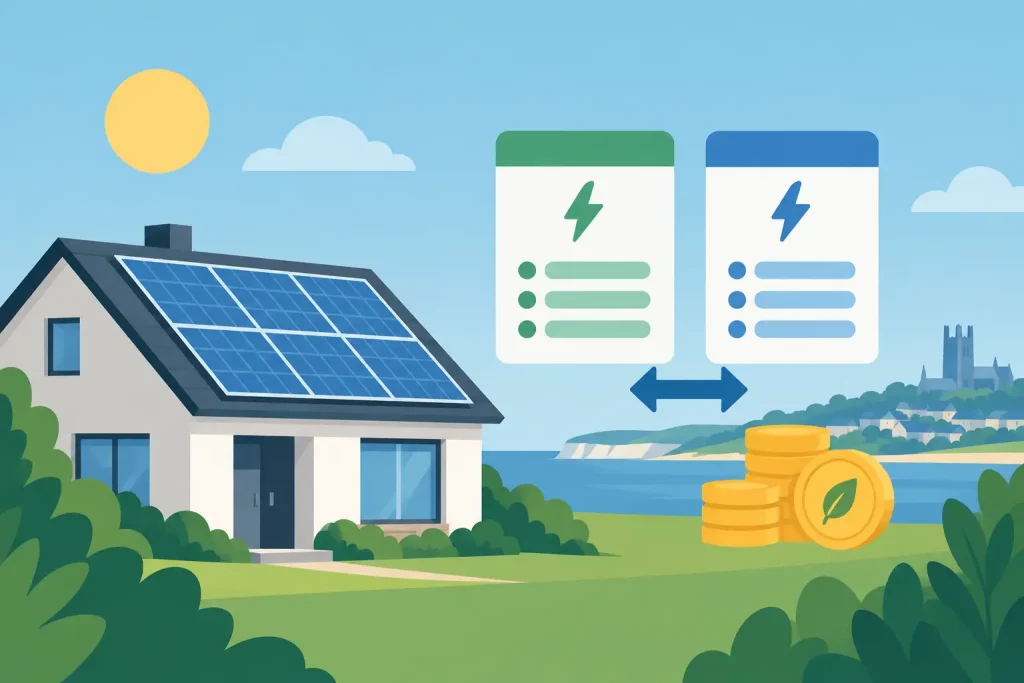
A useful export tariff comparison starts with one simple question: what happens to the solar electricity your home does not use? On a bright Kent afternoon, panels can produce more power than your appliances need. You can store that surplus in a battery, use it to charge an EV, or send it to the grid and receive a payment through an export tariff.
The advertised export rate matters, but it is not the whole story. The best option depends on your household’s daytime use, whether you have battery storage, your import tariff, and the supplier’s terms. A very high export price can look attractive, yet be less valuable if it comes with an expensive electricity import rate or restrictions that do not suit the way your home uses energy.
What an export tariff pays for
An export tariff pays you for each kilowatt-hour (kWh) of eligible electricity exported from your property to the grid. Most domestic arrangements sit under the Smart Export Guarantee (SEG), which requires larger electricity suppliers to offer at least one export tariff to eligible small-scale generators.
For a solar household, this normally means electricity generated by your PV system that is not used in the home, sent to a battery, or used to charge an EV at that moment. Your smart meter records the exported amount, allowing the supplier to calculate payment.
Rates are usually quoted in pence per kWh. If a tariff pays 15p per kWh and you export 2,000 kWh over a year, the export payment would be £300. That is straightforward enough, but the decision becomes more involved when you compare it with the cost of buying electricity from the grid and the value of storing solar energy for later.
The basic rule: use, store or export
Solar electricity is generally most valuable when it avoids buying electricity at your normal import price. If you pay 25p per kWh to import electricity and export electricity for 15p per kWh, using a solar kWh in the home is worth more than exporting it.
Battery storage can increase self-use by holding daytime generation for the evening. However, where an export tariff pays more than the relevant import cost, it may make financial sense to export some generation and buy power back later on a lower-priced import period. This is often described as tariff-led battery control.
That approach can work well for some households, but it should be set up carefully. Battery cycling has a small efficiency loss and contributes to normal battery wear. It also relies on tariff conditions remaining favourable, which cannot be assumed indefinitely.
Export tariff comparison: look beyond the headline rate
An export tariff comparison should assess the whole energy arrangement, not just the highest number on a supplier’s website. Suppliers may offer fixed export rates, time-of-use rates that vary during the day, or specialist plans intended for homes with solar and batteries. Terms and prices can change, so check the current tariff information before switching.
A fixed export rate is easier to understand. Every kWh exported receives the same payment, regardless of when it leaves your property. This can suit homeowners who want predictable returns and do not want to adjust battery settings around changing time periods.
Time-of-use export tariffs can pay more at selected times, often when demand on the network is high. They can be worthwhile with a compatible smart meter, a battery and controls that can respond sensibly to the tariff. Without storage, however, your solar production may not line up with the highest-paying hours. Solar generation is naturally strongest around the middle of the day, while premium export periods may fall later.
It is also worth checking whether the supplier requires you to take its import tariff as well. A combined deal may be genuinely competitive, but compare the annual cost of imported electricity alongside expected export income. A household importing 4,000 kWh a year can lose more through a higher import rate than it gains from an improved export payment.
A simple worked example
Consider a home that exports 2,500 kWh a year. One tariff pays 12p per kWh for export, giving £300 per year. Another pays 18p per kWh, giving £450. At first glance, the second deal is £150 better.
But if the higher export tariff requires an import deal that costs 4p more per kWh, and the household imports 4,500 kWh annually, that adds £180 to the import bill. In this example, the apparently better export tariff leaves the homeowner £30 worse off over the year.
Actual figures vary with panel size, household demand, shading, battery capacity, EV charging and seasonal changes. The point is not to predict every household’s result precisely. It is to compare estimated annual import and export costs together.
Check the practical requirements before switching
Export payments depend on accurate metering and the right documentation. Your property will normally need a smart meter capable of recording half-hourly export, and your solar installation must meet the supplier’s eligibility rules.
For many SEG tariffs, an MCS certificate is required for the solar installation. You may also be asked for proof of export, your Meter Point Administration Number, bank details and confirmation of the registered account holder. Keep installation documents in a safe place, as they are useful when arranging export payments, selling the property or making future changes to the system.
If you are planning a new solar installation, the system design should consider export from the outset. The Distribution Network Operator must be notified or approval obtained, depending on the equipment and proposed export capacity. This is not paperwork to overlook. A correctly designed and properly notified installation protects the network and helps prevent difficulties with commissioning or tariff registration later.
At Baird And Brown LTD, we place value on handing over clear documentation, because it gives homeowners the information they need long after installation day.
How battery storage changes the calculation
A battery does not automatically mean you should export less. Its purpose depends on your tariff and priorities. Many homeowners choose batteries primarily to use more of their own solar power in the evening, reduce grid imports and have greater control over energy use. That remains a sensible, easy-to-manage approach.
Other households use a battery more actively. It might charge from excess solar, discharge during peak-priced periods, or occasionally charge from a cheap overnight import window for use later. With the right tariff, a battery may even reserve capacity so that midday solar can be stored rather than exported at a lower rate.
There are trade-offs. An overly complicated schedule can leave a battery full before the sun comes out, or empty when the household needs it most. Export-focused settings can also mean buying electricity at times when you would otherwise have used stored solar. The best control strategy should reflect everyday comfort and resilience first, then financial optimisation.
For a home with an EV, charging habits deserve the same attention. Charging during solar-producing hours can raise self-consumption, while an overnight tariff may be cheaper and more convenient for many drivers. There is no single setting that suits every household.
Questions to ask during an export tariff comparison
Before choosing a tariff, establish how much electricity you currently import and export over a full year if possible. A few summer months can give a misleading picture, because winter solar generation is much lower while household demand is often higher.
Ask whether the export rate is fixed or variable, whether it changes by time of day, how often payments are made, and whether an import tariff is required. Confirm any minimum contract term, exit fee, smart-meter requirement and whether your battery or inverter is compatible with the supplier’s preferred controls.
Also consider what you value beyond the payment rate. Some homeowners want the simplest possible arrangement and steady bills. Others are happy to review tariff windows and battery performance regularly. Neither choice is wrong, provided it is based on realistic expectations rather than a headline figure alone.
Choose a tariff that fits the system you actually have
Solar panels, a battery, a smart meter and an EV charger can work together very effectively, but they should not be treated as separate purchases. The way they are designed and controlled determines how much electricity you buy, store and export.
A sound export tariff comparison uses your own expected generation and consumption, then tests the numbers against the supplier’s full import and export terms. For Kent homeowners, that usually produces a more dependable answer than chasing the highest advertised export rate. Review the arrangement as your household changes, particularly after adding a battery or EV, and let the tariff support the way you want your home to run.




