...
How Battery Backup Protects Homes in Power Cuts

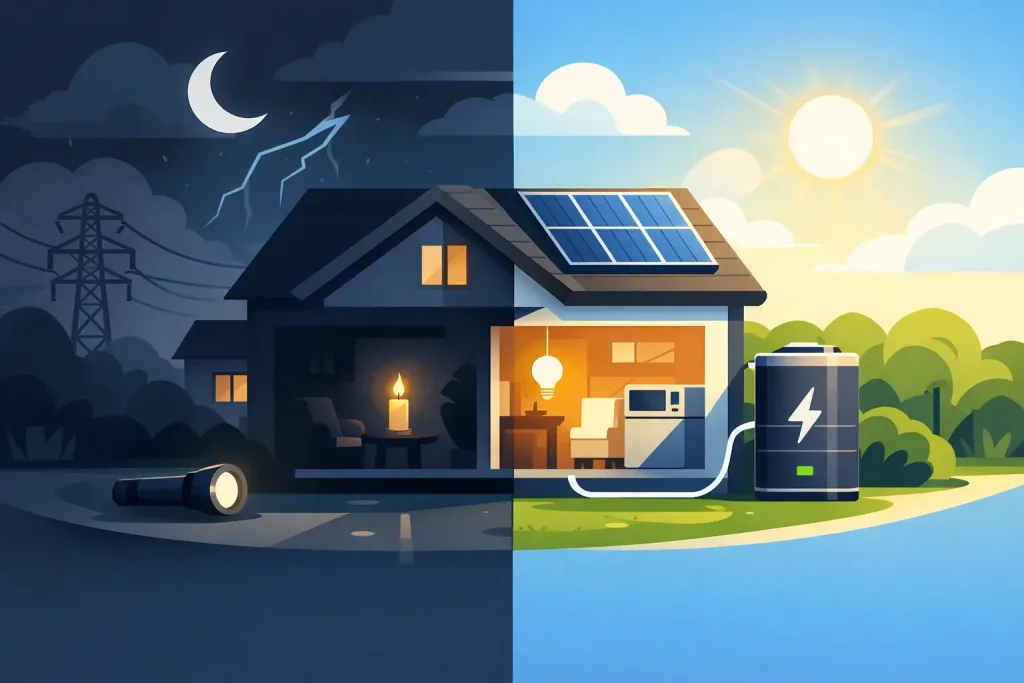
A power cut quickly shows which parts of a home matter most: the fridge and freezer, heating controls, internet router, lighting and a way to charge a phone. Understanding how battery backup protects homes starts with a simple distinction. A home battery can reduce electricity bought from the grid every day, but it will only keep your property powered during an outage if the system has been designed with backup capability.

For homeowners in Kent considering solar panels or battery storage, that distinction is worth making before any equipment is chosen. Backup is not an automatic feature, and the right arrangement depends on what you need to keep running, how long for, and how much you are prepared to invest.

How Battery Backup Protects Homes During a Power Cut

A battery stores electricity for later use. In a typical solar installation, it may charge from surplus solar generation during the day, then supply the home in the evening when household demand is higher and solar output has fallen. It can also charge from the grid at cheaper off-peak times where an electricity tariff makes this worthwhile.

During a grid outage, however, a standard solar and battery system will usually switch off. This is a safety requirement. Engineers working on the electricity network must not be exposed to power being exported from a home system onto lines that are assumed to be dead.

To provide usable backup, the installation needs an emergency power supply function, often called EPS or backup mode. When the grid fails, suitable equipment disconnects the property from the network and creates a controlled supply from the battery. The system then powers either selected circuits or, in some cases, much of the house.

This protects the household from the immediate inconvenience of an outage. It can keep food chilled, provide light after dark, maintain communications and allow essential devices to remain charged. For homes reliant on an internet connection for work, security systems or remote monitoring, that continuity can be particularly valuable.

Backup Power Is Different From Whole-Home Power

The phrase “battery backup” can sound as though every socket and appliance will work exactly as usual. That is not always realistic or sensible. Most domestic batteries are designed around everyday energy use, not around supplying every high-demand item in a modern home at once.

An electric oven, induction hob, immersion heater, electric shower, heat pump, tumble dryer and EV charger can each draw significant power. Running several of them during an outage could drain the battery quickly or exceed the inverter’s output limit, even where the battery has plenty of stored energy in kilowatt-hours.

For this reason, many well-planned systems use a protected loads consumer unit. This is a separate board for the circuits that matter during a power cut. It might cover the kitchen fridge and freezer, downstairs lighting, broadband router, selected sockets and boiler controls. The rest of the installation remains off until the grid returns.

This approach is often the most practical balance of cost, resilience and battery life. It also makes expectations clear. You are not trying to run the house as normal. You are keeping the essentials working safely and comfortably while the supply is interrupted.

Capacity and power both matter

Two figures shape how useful backup will be. Battery capacity, measured in kilowatt-hours (kWh), indicates how much energy can be stored. Inverter output, measured in kilowatts (kW), indicates how much equipment the system can run at one time.

A larger-capacity battery can support essential loads for longer, but it does not automatically run a high-demand appliance if the inverter output is too low. Equally, a powerful inverter will not provide overnight resilience if there is insufficient stored energy.

Actual duration depends on the home. A modest protected-load setup may use relatively little electricity overnight. Add a kettle, microwave or heating appliance and consumption rises sharply. A proper assessment looks at both the appliances you want available and the way your household genuinely uses electricity.

Solar Can Extend Backup, But Weather Still Matters

When solar panels are producing, they can recharge the battery and help supply backed-up circuits during the day. This can make a significant difference in spring and summer, particularly if the household keeps consumption sensible while the grid is unavailable.

There are limits. Solar output changes with cloud cover, time of year, roof orientation and the time of day a power cut occurs. In winter, production may be modest just when lighting and heating-related demand are higher. A solar-backed battery is therefore not a guarantee of unlimited independent power.

The sensible view is that solar extends the time your essential services can operate. The battery provides the immediate reserve, while solar may replenish some of what has been used. If prolonged resilience is essential, such as for critical medical equipment, discuss the requirement openly and consider additional measures rather than relying on a domestic battery alone.

Protection Goes Beyond Keeping the Lights On

Battery backup is often discussed as a convenience, but it can protect a home in several practical ways. It reduces the risk of spoiled refrigerated food during a longer outage. It keeps phone charging and broadband available so occupants can receive updates, contact family or work from home. It can also support lighting and selected security equipment at a time when a dark, disconnected property feels more vulnerable.

For households with a boiler, keeping the controls, circulation pump and relevant sockets supplied may allow heating to continue, provided the boiler itself has fuel available and its electrical demand is within the backup design. This needs checking rather than assuming. Not every heating system behaves the same way, and some homes will require a more tailored solution.

There is also everyday protection from rising and less predictable electricity costs. By storing solar energy that would otherwise be exported, or by using lower-cost off-peak electricity carefully, a battery can reduce dependence on peak-rate grid imports. Financial savings vary with tariff, consumption patterns and export rates, so backup capability should not be sold purely on a payback calculation. For many homeowners, the reassurance of having a reserve is part of the value.

A Good Design Starts With Honest Priorities

The best battery system is not necessarily the largest one. It is the one that fits the property, electrical supply, solar generation and the household’s priorities.

Before specifying equipment, an installer should ask what you want to protect in an outage, whether whole-home backup is genuinely required, how often the property is occupied and whether an EV, electric heating or heat pump changes the demand profile. An on-site assessment also identifies the practical details: consumer unit space, cable routes, battery location, earthing arrangements and any changes needed to make the backup arrangement safe.

Battery location deserves care. Equipment should be installed in a suitable area with adequate access and in line with the manufacturer’s requirements. A neat installation is not just about appearance. Clear labelling, correct protection devices, sensible cable containment and complete handover documentation all help homeowners understand their system and support future maintenance.

At Baird And Brown LTD, the aim is to explain these choices plainly rather than fitting a generic package. Some households will benefit from a straightforward solar battery for self-consumption. Others will place real value on a protected backup supply. Both can be sensible, but they are different designs with different costs and expectations.

What Happens When the Grid Returns?

A correctly configured backup system monitors the network and reconnects once the grid supply is stable again. This is usually automatic. The battery and inverter return to their normal operating mode, supplying the home, charging from solar or following the chosen tariff settings.

There may be a brief interruption when the system changes into backup mode or returns to grid operation. The length and behaviour depend on the equipment selected. Sensitive items such as computers should still be treated with care, particularly if uninterrupted operation is essential. A domestic battery backup system is not always a replacement for a dedicated uninterruptible power supply.

The key is to agree the intended behaviour before installation. Knowing which circuits will stay live, what high-load appliances must remain off and how to monitor the system removes uncertainty when a power cut happens.

A battery cannot prevent a grid fault, but a thoughtfully designed backup system can make that fault far less disruptive. Start with the essentials you would miss first, then build a system around the way your home actually works.

Leave a Reply

Your email address will not be published. Required fields are marked *

Seraphinite AcceleratorOptimized by Seraphinite Accelerator
Turns on site high speed to be attractive for people and search engines.