
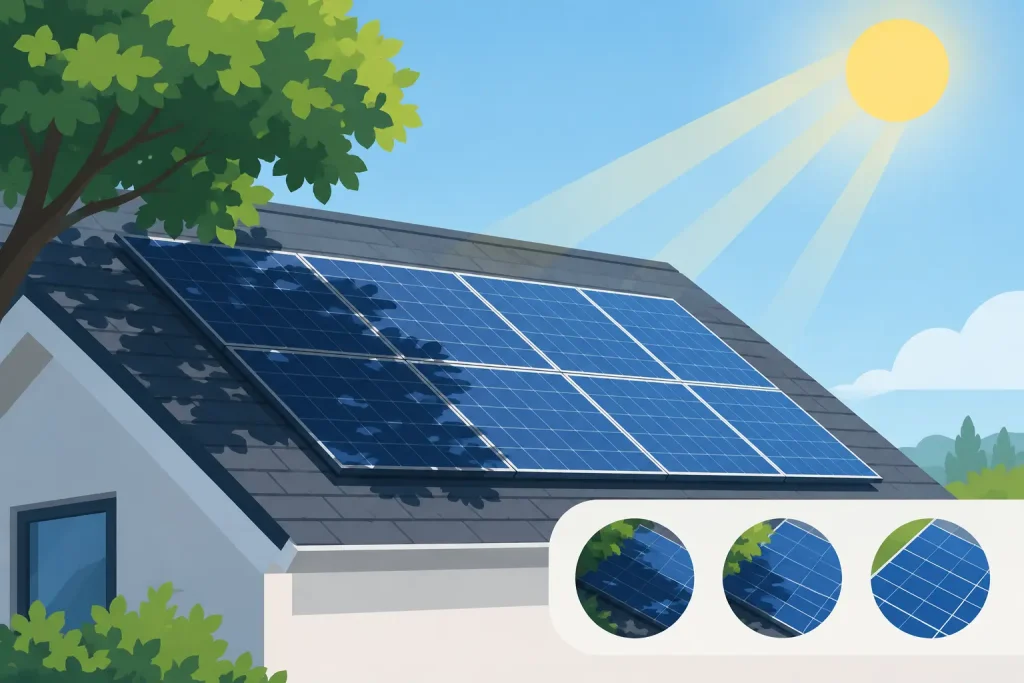
A roof can look perfectly clear at midday and still lose a useful amount of solar generation at other times of day. A neighbour’s chimney, a mature tree at the end of the garden or the ridge of a nearby property can all cast shadows that change as the sun moves. Knowing how to assess roof shading before choosing a solar PV system helps make sure the design is based on realistic generation, not best-case assumptions.
For homeowners in Kent, shading is particularly worth checking because many properties sit among established gardens, chimneys and closely spaced homes. It does not automatically rule solar out. The key is understanding where the shade falls, when it occurs and how the system can be designed around it.
Why roof shading matters to solar performance
Solar panels work best when each panel receives consistent sunlight. Even partial shade can reduce output, especially on older or more simply designed systems where several panels are connected in one string. A shadow across part of one panel can affect the performance of other panels connected with it.
The impact depends on the type of shade. A narrow shadow from an aerial may have a limited effect for part of the day. Heavy shade from a large evergreen tree across several panels during the middle of the day is more significant. The latter affects the hours when a south-facing roof would normally produce most electricity.
Shading also changes through the year. The low winter sun makes shadows longer, while the higher summer sun changes their direction and duration. Deciduous trees may be bare in January but dense with leaves during the months when solar generation is at its strongest. A proper assessment must account for this rather than relying on one quick look.
How to assess roof shading before a solar survey
You can make a useful first assessment yourself, but it should be treated as a starting point. Stand back from the property and look at the full roof area, not just the section that appears most suitable for panels. Note anything that sits above, beside or in front of the roof from the south, east and west.
Look for chimneys, dormers, soil pipes, satellite dishes, TV aerials, roof vents and neighbouring buildings. Also consider trees in your garden, adjoining gardens and land beyond the boundary. A tree that seems some distance away can still cast a long shadow in the morning or late afternoon.
If possible, take photographs of the roof at several times on a clear day: morning, around midday and late afternoon. Repeat this in a different season if you have time before proceeding. Photos do not replace a technical survey, but they give an installer valuable context and can reveal patterns that are easy to miss during a single appointment.
It is also helpful to think about likely changes. Is a small tree growing quickly? Is a neighbour planning an extension? Are you considering a loft conversion that will add roof features? Solar panels are intended to remain in place for many years, so future shading matters as much as the view from the garden today.
Check the sun’s path, not just the direction of the roof
In the UK, the sun rises in the east, reaches its highest point towards the south and sets in the west. A south-facing roof usually has strong generation potential, but a south-facing roof with morning and afternoon shade may not perform as expected. East- and west-facing roofs can also work very well, particularly for households that use electricity in the morning and evening.
A compass app can help establish roof orientation, although it should not be relied on as the final measurement. What matters is the actual sun path in relation to obstacles. A tall obstacle to the south is generally more concerning than one to the north. However, an east-facing roof may be affected by a building or tree to the south-east, while a west-facing roof may lose valuable later-day generation to shade from the south-west.
The height and distance of an object both matter. A low fence close to the house is unlikely to affect a first-floor roof. A tall conifer, church tower or neighbouring three-storey property can be a different matter. This is why an on-site assessment is more reliable than aerial imagery alone.
Do not overlook roof-mounted obstructions
Not all shading comes from the surrounding area. Chimneys are one of the most common causes on older Kent homes, and they can cast a moving shadow across panels for much of the day. Dormers and roof valleys can restrict the usable panel area too.
Sometimes the answer is to position panels away from the obstruction, leaving a sensible gap rather than trying to fill every available inch of roof. That may mean fitting fewer panels on one roof pitch and using another suitable roof area instead. The best layout is not always the one with the highest panel count. It is the one that gives dependable output, is safe to install and suits the household’s electricity use.
What a professional shading survey should consider
A qualified installer should assess shading as part of the wider roof survey, alongside roof condition, orientation, pitch, structure, cable routes and consumer unit capacity. They may use specialist solar design software and site measurements to model the horizon and calculate likely annual losses.
This provides more than a simple yes-or-no answer. It helps estimate how much each roof section is likely to generate and whether a proposed panel layout remains worthwhile. The result should feed into the system design and generation estimate you receive, rather than appearing as an afterthought.
At Baird And Brown LTD, the practical detail matters. A survey should identify the limitations of a roof honestly, explain the options in plain English and avoid promising figures that only apply in perfect conditions. If shading makes one area poor value for panels, it is better to say so before installation.
Panel layout, optimisers and microinverters
Modern solar equipment offers ways to reduce the effect of partial shading, but none of them can create sunlight where there is none. It is useful to understand the difference.
A standard string inverter can be a good, cost-effective solution for a clear, uncomplicated roof. Where there are separate roof pitches or intermittent shade on particular panels, optimisers may allow those panels to operate more independently. Microinverters provide panel-level conversion and can also suit more complex roof arrangements.
The right choice depends on the shading pattern, number of panels, roof layout, budget and future plans. Panel-level technology can improve performance where shade is variable, but it adds equipment and cost. It should be selected because the survey supports it, not used as a blanket answer to every shaded roof.
Battery storage is another separate consideration. A battery does not improve the amount of solar electricity produced, but it can help you use more of the generation that is available. For example, an east- or west-facing array may align well with household demand, while a battery can store surplus electricity for later use. The system should be designed as a whole.
When trees are the main issue
Trees deserve a careful, proportionate approach. Removing or heavily pruning a healthy tree simply to improve solar output is not always appropriate, and trees may be protected by a Tree Preservation Order or conservation area restrictions. Before arranging any work, check the position with the local planning authority and speak to a qualified tree professional where needed.
In some cases, modest maintenance that is already required can reduce shading. In others, the better decision is to accept a lower generation estimate, alter the panel layout or decide that solar is not suitable for that particular roof. Honest advice is especially valuable here, because the cheapest-looking quote may not account properly for an obstacle that will remain for decades.
Questions to ask before approving a solar design
Before committing to an installation, ask how shading has been assessed and whether the generation estimate includes it. Ask which panels, if any, are expected to be affected and at what times of year. If optimisers or microinverters have been recommended, ask what specific issue they are solving.
You should also ask to see the proposed panel layout. It should show sensible clearances around roof features and avoid designs that place panels where access, maintenance or recurring shade will be a problem. Clear documentation is useful not only for confidence before installation, but also for understanding the system after it is commissioned.
A shaded roof is not necessarily a poor candidate for solar. Many homes have some obstruction and still achieve worthwhile savings. The sensible approach is to measure the effect properly, design around what cannot be changed and set expectations that match the property. A careful survey now gives you a far better chance of being happy with your solar system for years to come.




