

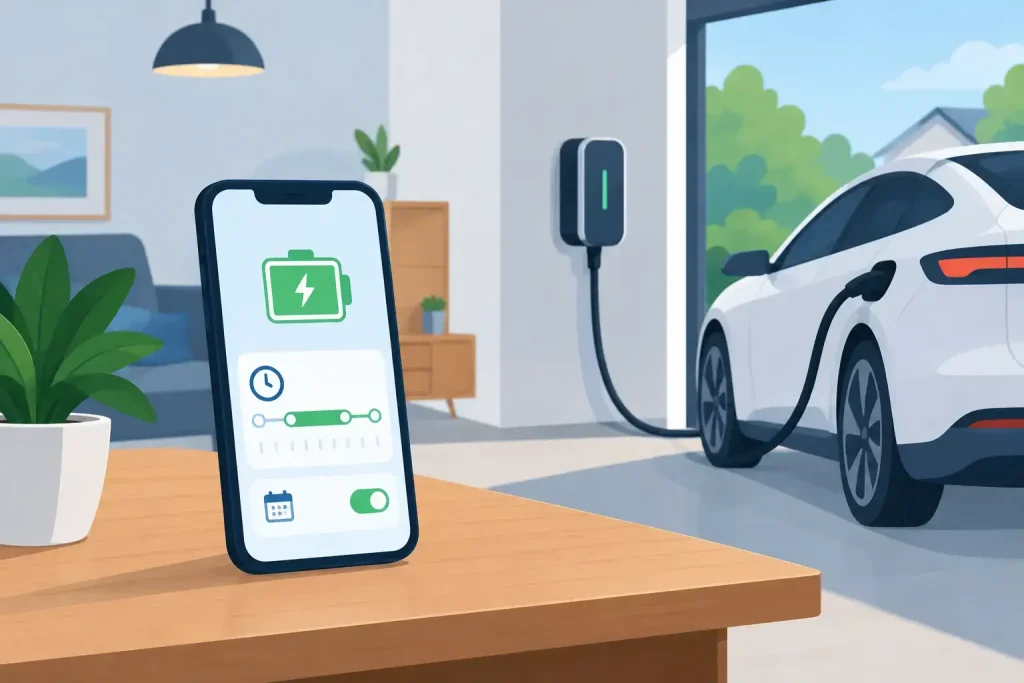
A home battery should not simply charge whenever electricity is available. The difference between a battery that quietly reduces bills and one that delivers disappointing results is often in the settings. Knowing how to schedule battery charging lets you buy electricity when it is cheaper, keep room for solar generation and retain enough stored power for the times you need it most.
The right schedule is not the same for every household. It depends on your electricity tariff, battery capacity, solar array, typical evening use and whether you charge an electric vehicle at home. A sensible approach starts with those practical details rather than copying settings from an online forum.
Start with your electricity tariff
If you are on a single-rate tariff, there may be little financial benefit in routinely charging your battery from the grid. In that case, the usual aim is to prioritise surplus solar energy, then use the battery after sunset before importing electricity.
Time-of-use tariffs are different. They offer electricity at lower prices during specified periods, often overnight, with higher prices at busier times. A battery can charge during the low-rate window and supply the home during the morning and evening, when electricity costs more. This is commonly called tariff shifting.
Before setting any schedule, check the exact start and finish times in your tariff. Do not assume every cheap period runs from midnight to 7am, or that the rate is the same every day. Some tariffs have multiple off-peak slots, while others use half-hourly prices that change daily. Your battery app may offer tariff templates, but they should still be checked against your supplier’s current terms.
Work out what the battery needs to cover
A larger charging window is not automatically better. Filling a battery from the grid every night may leave no capacity for valuable solar generation the following day. It can also mean cycling the battery more than necessary.
Look at your household’s normal electricity use after solar production falls away. For many homes, the main period is from late afternoon until bedtime, covering cooking, lighting, television, appliances and, in colder months, any electric heating demand. Your monitoring portal can show this pattern clearly after a few weeks of data.
For example, a household using around 5kWh between 4pm and midnight may not need to charge a 10kWh battery fully overnight. Charging enough to cover the expected evening demand, while retaining space for solar, can be the more efficient setting. On a dull winter day, however, a fuller overnight charge may make better financial sense.
How to schedule battery charging in the app
Battery systems vary, but most use a manufacturer app, inverter portal or installer configuration tool. The labels differ, yet the basic choices are similar: charging times, discharge times, charge limit, discharge limit and backup reserve.
Set the schedule to begin within your confirmed low-rate period. If the tariff gives you a four-hour cheap window, it is usually better to use that defined window than to allow unrestricted grid charging. The system may be able to calculate how quickly it can charge based on the inverter and battery rating.
Next, choose a realistic charge target. This may be shown as a percentage state of charge or as a stored-energy figure. A 100% target is appropriate when the next day is likely to be overcast, when household demand will be unusually high, or when the low-rate electricity is particularly favourable. In sunnier conditions, a lower target can preserve battery capacity for solar.
If your system permits scheduled discharge, make sure it is available during the expensive part of the day. Some systems use an intelligent or self-consumption mode that does this automatically. Others require discharge periods to be set manually. Avoid overlapping charge and discharge instructions, as conflicting settings can produce unexpected behaviour.
It is worth making one change at a time and watching the result for several days. Battery monitoring is useful, but it only becomes meaningful when the settings are simple enough to understand.
Keep a sensible backup reserve
Many battery systems allow a minimum state of charge, sometimes called a reserve or backup level. This setting keeps part of the battery unused for normal household consumption so it is available if there is a power cut, provided the system has been designed with backup capability.
The right reserve is a balance. A 5% reserve gives more usable stored energy each day but offers very limited protection in an outage. A 20% or 30% reserve gives greater reassurance, particularly in rural locations or homes where a fridge, heating controls, internet equipment or medical devices need continuity. It does reduce the amount of battery capacity available for daily bill savings.
Not every battery installation can power the home during a power cut. Backup operation depends on the equipment installed, the circuits selected and the system design. Do not assume a battery alone provides whole-house backup. This is a point to confirm before installation or with your installer when reviewing settings.
Make solar generation part of the plan
Solar should usually have priority over grid electricity, but the schedule must account for the season. In Kent, a clear June day can generate far more than a household needs, while December generation may be modest even on a bright day.
During spring and summer, set a lower overnight grid-charge target or disable scheduled charging if your solar forecasts and recent production support it. This leaves battery space for the free electricity generated on your roof. If the battery is full by mid-morning and you are paid for exported electricity, exporting may still be worthwhile, but that depends on your export rate and household priorities.
During autumn and winter, it is often sensible to charge more from a cheap overnight tariff. Solar energy can then top up the battery during the day, rather than being relied on to meet the entire evening demand. Weather forecasts are helpful, but use them as a guide rather than a promise. A forecast-based schedule can be convenient, yet a straightforward seasonal adjustment is often easier for homeowners to manage confidently.
Coordinate the battery with EV charging and larger loads
An EV charger, heat pump, immersion heater, electric shower or tumble dryer can change the calculation quickly. If an EV and battery are both charging during a short cheap-rate window, your property’s supply capacity and the equipment settings need to be considered.
Many smart EV chargers can schedule their own charging. Where possible, set the vehicle to charge during the same lower-cost period, but avoid making assumptions about what the battery will do. You may prefer the EV to take priority on nights when it needs a full charge for a longer journey, then reduce the battery charge target. On other nights, a modest EV top-up and a fuller battery may suit the household better.
For homes with solar diverters or hot-water heating controls, the sequence matters too. Surplus solar cannot be sent to every device at once. An installer can help set sensible priorities based on whether your main aim is lower bills, hot water, EV mileage or retaining energy for the evening.
Check results, not just settings
The best schedule is proven by real data. Review a few weeks of imports, exports, battery state of charge and household consumption. Check whether the battery is charging at the intended cheap rate, whether it is empty before the expensive evening period ends, and whether solar energy is being curtailed because the battery is already full.
Also compare your bills across similar periods rather than judging success from one unusually sunny or cold day. The goal is not necessarily to avoid all grid imports. It is to use electricity at the right time and cost without making the system unnecessarily complicated.
If the figures do not look right, common causes include a tariff window set incorrectly, a clock issue after British Summer Time changes, an overly high backup reserve, or an inverter operating mode that overrides the schedule. Do not alter advanced protection settings or battery limits unless you understand their purpose. Those parameters protect the equipment and should normally be left to a qualified installer.
When professional help is worthwhile
A good battery setup should be explained clearly at handover, including which app controls the system and what each setting does. If you have changed tariff, added an EV charger, installed a heat pump or found that your household routine has changed, it is reasonable to review the configuration.
At Baird And Brown LTD, the focus is on designing and commissioning systems around how a household actually uses energy, not simply fitting equipment and leaving customers to guess at the app. A short conversation about your tariff, expected usage and backup priorities can prevent a great deal of trial and error.
Treat your charging schedule as something to review with the seasons. A few sensible adjustments between a bright summer week and a dark winter spell will usually achieve more than one rigid setting left in place all year.


