

A solar quote can look straightforward until you reach the inverter specification. Panels are easy to see on a roof, but the inverter does the vital work of turning their DC electricity into usable AC power for your home. The choice between microinverters versus string inverters affects system cost, performance in shade, monitoring and how future changes may be handled.
Neither option is automatically better. A well-designed string inverter system can be an excellent, reliable choice for many Kent homes. Microinverters can be particularly worthwhile where a roof has complicated shading or several different roof aspects. The right answer starts with the property, not a sales script.
Microinverters versus string inverters: the basic difference
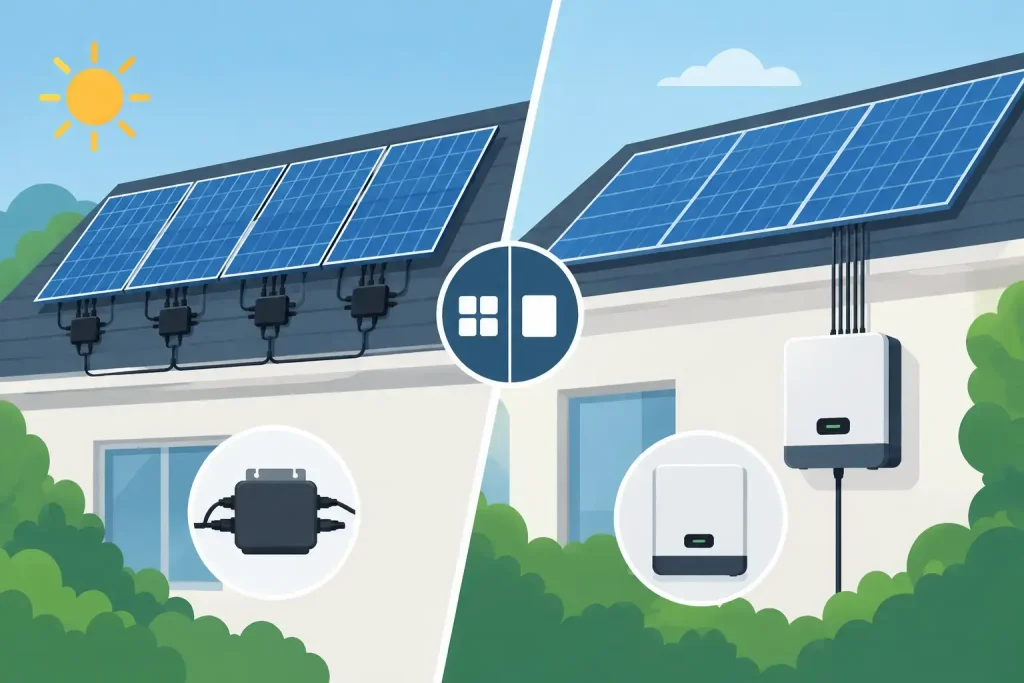
A string inverter is usually fitted in an accessible location, such as a garage, utility room or loft area where suitable. Solar panels are connected in groups, known as strings, and the inverter manages the output from each string before converting it to AC electricity.
A microinverter is a small inverter fitted beneath each individual solar panel. Rather than sending DC power from a whole group of panels to one central inverter, each panel converts its own output to AC at roof level.
This difference changes how the system responds when one panel produces less electricity than the others. It also changes where the main equipment is located and, in many cases, the initial installation cost.
How shade affects solar performance
Shade is one of the strongest reasons to consider microinverters. A chimney, dormer, nearby tree, TV aerial or neighbouring building can cast shade across part of a roof at certain times of day. Even light or moving shade can reduce a panel’s output.
With a conventional string layout, panels in the same string are electrically connected. Modern string inverters use maximum power point tracking, often shortened to MPPT, to manage panel output efficiently. If the panels have similar conditions, this works very well. However, substantial mismatch between panels can limit the performance of the affected string.
Microinverters allow each panel to operate independently. If one panel is shaded, the remaining panels can continue producing according to the light they receive. This does not make shade disappear, and a shaded panel will still generate less, but it can reduce the knock-on effect across the array.
That said, not every roof with a little shade needs microinverters. A proper survey should look at when the shade occurs, how much of the array it affects and whether thoughtful panel placement or a string inverter with separate MPPT inputs would deal with it effectively. Paying more for equipment is only sensible when it delivers a genuine benefit.
Different roof aspects and panel layouts
Homes do not always have one large, south-facing roof. It is common to install panels across east- and west-facing slopes, or on a main roof and a smaller extension roof. These areas receive sunlight differently throughout the day.
A string inverter with multiple MPPTs can often support separate strings for different roof aspects. For a straightforward east-west system with enough panels on each slope, this is frequently a practical and cost-effective design.
Microinverters offer more flexibility where there are several small roof sections, unusual angles, different panel orientations or a layout that would leave too few panels for a conventional string. They can make it easier to use otherwise awkward but productive spaces, provided the additional cost makes sense against the expected generation.
Cost and value over the life of the system
String inverters are generally less expensive to buy and install. There is one main inverter rather than an inverter beneath every panel, and the design can be simpler on a regular, unshaded roof. For homeowners working to a fixed budget, this can leave more room for additional panels or battery storage, both of which may have a greater impact on overall savings.
Microinverter systems typically cost more upfront because there is more equipment and more roof-level installation work. Their value lies in panel-level optimisation, detailed monitoring and flexibility, rather than in an automatic promise of higher generation on every home.
It is worth looking beyond the headline quote. Ask what inverter model is proposed, how long its product warranty lasts, whether monitoring is included and what access will be needed if equipment requires attention later. A cheaper system is not always better value if its design does not suit the roof, but neither is a premium option worthwhile simply because it sounds more advanced.
Monitoring and finding faults
Most modern solar systems provide an app or online portal showing generation, household consumption and battery activity where compatible monitoring equipment is installed. This is useful for checking that the system is behaving as expected and for understanding when your home uses the most electricity.
String inverter monitoring usually reports the performance of the overall system, and sometimes each string. That is enough for many homes. If total generation is where it should be, there may be little need to view every panel individually.
Microinverters normally provide panel-level monitoring. This can identify a single underperforming panel more clearly, which can be helpful on complex roofs or where a homeowner wants detailed visibility. It is a useful feature, but it should not be the deciding factor on its own. Solar is intended to be a low-maintenance home improvement, not another app that demands daily attention.
Reliability and future servicing
With a string system, the inverter is normally installed somewhere accessible. If it needs replacement after many years, the work can often be completed without disturbing the roof array. Inverters do not last forever, so this practical point matters.
Microinverters remove the single central inverter but place electronic equipment beneath the panels. They are designed for outdoor use and are commonly supplied with long warranties. However, if a unit fails, access to the roof and removal of the relevant panel may be required. The likelihood of this should be balanced against the fact that a fault would usually affect one panel rather than the whole system.
For either approach, quality installation is central to long-term reliability. Cable routing, roof fixings, earthing, protection devices, ventilation and commissioning all matter. The equipment choice is only one part of a safe, productive solar installation.
Battery storage and backup considerations
Both microinverter and string inverter systems can work with battery storage, but compatibility should be confirmed before installation. Some batteries are AC-coupled, meaning they can connect to the home electrical system independently of the solar inverter. Others are designed to work with particular hybrid inverters and may be more closely integrated with the solar array.
If a battery is part of the plan from the start, it is sensible to design the full system together. This helps avoid unnecessary conversion losses, duplicated equipment or limits on future expansion. It also gives a clearer picture of what the battery is expected to do: increase self-consumption, charge overnight on a lower tariff, support an electric vehicle routine or provide limited backup during a power cut.
Backup power deserves particular care. A battery does not automatically keep the house running when the grid fails. Backup capability requires suitable equipment, dedicated design and safe isolation from the grid.
Which inverter is likely to suit your home?
A string inverter is often the sensible choice for a simple roof with panels facing the same direction, little meaningful shade and enough space for a well-sized array. It is proven technology, usually more economical and straightforward to service.
Microinverters are often worth considering for roofs with recurring partial shade, multiple orientations, small separate roof areas or layouts where individual panel control provides a clear advantage. They may also appeal if detailed panel-level monitoring is a priority.
The best decision should be based on a site assessment, not a standard package. At Baird And Brown LTD, that means considering the roof structure, orientation, shading, expected household use, future battery plans and the practical location of electrical equipment before recommending a design.
A good solar system should fit the home you have now while leaving sensible options for the years ahead. Ask to see the reasoning behind the proposed inverter, not just the projected generation figure. A clear explanation is often the best sign that the system has been designed properly.


