

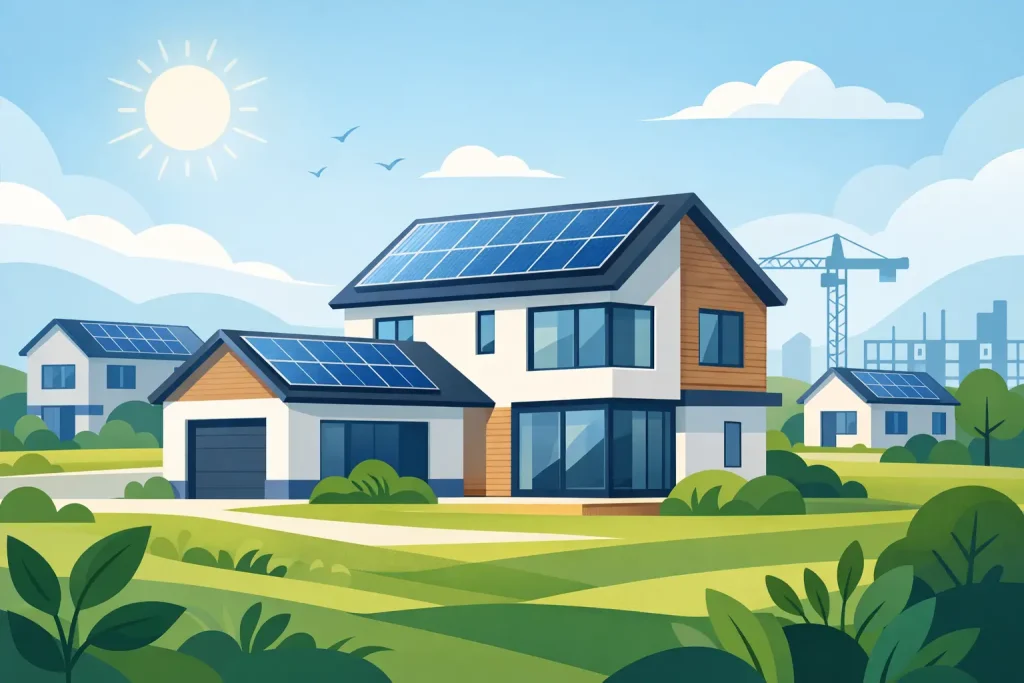
If you are planning solar panels for new build homes, the best time to make good decisions is before the roof is finished and the handover pack is printed. Solar works well as a retrofit, but on a new build you have the rare advantage of being able to design the property around the system rather than squeezing the system around the property.
That early advantage matters. It can affect how many panels fit, how clean the installation looks, how future battery storage is handled and how much value you get from the system over the next twenty years. For homeowners and self-builders, it is often one of the simplest ways to make a new home more efficient from day one.
Why solar panels for new build homes make sense
A new build is already focused on long-term performance. You are making decisions about insulation, glazing, heating, ventilation and running costs, so solar naturally belongs in that conversation. It gives you a way to generate some of your own electricity on site, reduce reliance on imported grid power and improve the overall efficiency of the home.
There is also a practical point that often gets missed. Installing solar during the build stage is usually easier than coming back to it later. Scaffold may already be in place, cable routes can be planned neatly, consumer unit arrangements can be considered early and plant space can be allocated properly. That does not mean every new build should have the biggest system possible, but it does mean the project can be designed with fewer compromises.
For many households, the appeal is straightforward. Lower daytime electricity costs, better use of battery storage if added, support for an EV charger later on and a home that is better prepared for rising energy prices. None of that removes your electricity bill entirely, and anyone promising that is overselling it, but it can make a noticeable difference.
What to plan before the build is complete
The most important questions are not just about panel count. They are about the house as a whole.
Roof orientation is one of the first things to review. A south-facing roof often gives the strongest generation, but east and west roof slopes can still work very well, especially if your electricity use is spread across the morning and late afternoon. A poorly positioned roof is not always a deal-breaker, but shading from trees, neighbouring buildings or chimneys needs proper assessment.
Roof design matters too. Large uninterrupted roof areas are easier to work with than roofs broken up by dormers, rooflights and multiple changes in pitch. If the roof is still at drawing stage, small design choices can make a real difference to usable panel space.
Inside the property, the electrical layout should be thought through early. The inverter needs a suitable location, and if battery storage is likely now or later, that space should be practical, accessible and compliant. It is far better to plan this properly than to end up with equipment placed somewhere awkward simply because no one allowed for it during the build.
If you are also considering an air source heat pump or EV charger, these decisions should not sit in separate boxes. A good installer will look at the whole picture – likely household demand, how and when energy is used, and whether battery storage would improve self-consumption rather than simply adding cost.
Sizing the system properly
One of the most common mistakes with solar panels for new build homes is either undersizing through caution or oversizing because bigger sounds better. The right system size depends on the property, your electricity usage and what you want the system to do.
If the house will be occupied by a couple out at work most weekdays, the usage pattern may be very different from a family home with someone in during the day, an electric vehicle on the drive and high appliance use. New builds with electric heating or heat pumps may also have a stronger case for a well-planned solar and battery setup.
This is where honest advice matters. Not every roof should be filled edge to edge, and not every household needs battery storage on day one. Sometimes it makes sense to install the solar array and prepare the wiring and space for a battery later. In other cases, battery storage is worthwhile from the start because it allows more of your generated electricity to be used in the home rather than exported.
Solar panels, batteries and EV charging
For many new build projects, solar is only one part of a wider setup. Battery storage and EV charging often come into the picture quickly, even if they are not installed at the same time.
A battery can store surplus electricity generated during the day and make it available later, which is particularly useful for households that are empty for much of the daylight period. That said, batteries are not a universal answer. The payback depends on your usage pattern, your tariff and how much energy you would otherwise export.
An EV charger changes the conversation again. If you expect to charge a vehicle at home, solar can help offset part of that demand, particularly during daylight hours. It will not cover every mile you drive, but it can reduce the cost of charging and improve the value of the wider system.
The main point is that these technologies work best when planned together. A disconnected approach often leads to extra cost and unnecessary alterations later.
Building regulations, standards and paperwork
New build projects involve enough paperwork without adding confusion around solar. The technical side needs to be handled properly, from system design and installation standards through to testing, certification and notification.
That is one reason many homeowners prefer a specialist installer rather than treating solar as an add-on electrical extra. The details matter. Cable routes, generation meter arrangements where relevant, inverter specification, roof fixing methods, battery compatibility and commissioning all need to be right.
Accreditation matters too, not as a badge for the sake of it, but because it gives homeowners confidence that the work is being carried out to recognised standards. Clear documentation also makes life easier later if you sell the property, make alterations or need service support.
What affects cost and value
There is no single price for solar on a new build because every roof and household is different. System size, roof type, access, panel specification, inverter choice and whether battery storage is included all affect the final cost.
The better way to look at it is value rather than headline price alone. A cheaper system is not always the better buy if it is poorly designed, badly installed or difficult to expand. Likewise, the most expensive option is not automatically the most sensible. Good design should match the system to the home and avoid both waste and unnecessary compromise.
On a new build, some costs can compare favourably with retrofit work because access and planning are often easier. Even so, it is worth being realistic. Solar is a long-term investment. It can reduce running costs and improve energy performance, but the result depends on installation quality, how the home is used and whether the system has been designed for real life rather than best-case assumptions.
Choosing the right installer for a new build
A new build needs more than someone who can fit panels to a roof. It needs an installer who can coordinate with the wider project, communicate clearly and get the details right first time.
That means turning up when agreed, understanding site conditions, keeping work areas tidy and providing straightforward answers when you ask what is being installed and why. It also means being honest if a particular idea is not the best fit for the property.
For homeowners in Kent, working with a local specialist can make this process simpler. Companies such as Baird And Brown LTD are able to look at the site, discuss the wider electrical setup and provide a complete service from design through to installation and documentation, without the hard sell that often puts people off the industry.
Is it worth doing now rather than later?
In most cases, yes. If you already know you want solar, a new build is usually the right moment to plan it properly. You can create a cleaner installation, avoid future disruption and make sure the property is ready for battery storage or EV charging if those are part of your plans.
There are still situations where waiting makes sense. If budgets are tight, it may be better to prepare the property properly and install part of the system later rather than making rushed decisions. What matters is not being forced into a poor setup because no allowance was made during the build.
A well-planned new home should be ready for the way people actually live now – higher electricity use, electric vehicles, smarter heating and more attention to running costs. Solar is not the answer to everything, but when it is designed properly from the outset, it gives you a stronger, more efficient starting point and far fewer regrets once the house is finished.
