

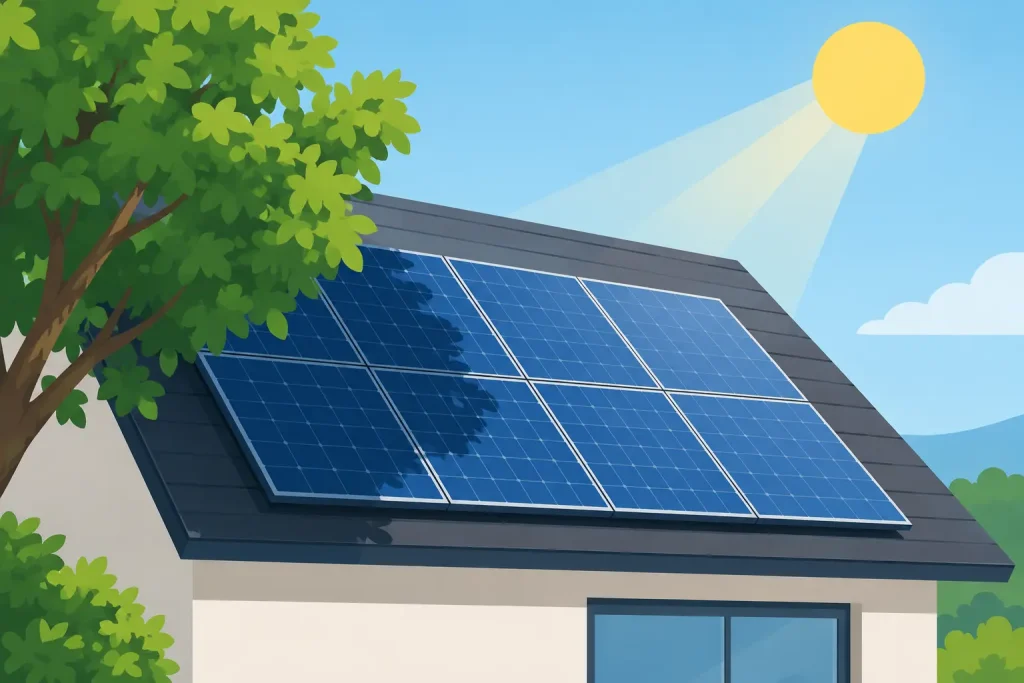
What is solar panel shading? Put simply, it is when anything blocks sunlight from reaching part or all of a solar panel. That obstruction might be obvious, such as a neighbouring tree, or more easily missed, such as a chimney casting a shadow across the roof at certain times of day. For a homeowner investing in solar, shading matters because it can reduce the amount of electricity your system produces and affect how the system should be designed.
A roof can look clear when viewed from the ground but behave very differently across a full year. The sun sits lower in winter, higher in summer, and moves across the sky throughout the day. A good solar design therefore considers more than the direction and pitch of the roof. It considers what happens at 9am in January, at lunchtime in July, and as nearby trees grow over the years.
What is solar panel shading in practice?
Solar panels are made up of many individual cells connected together. When direct sunlight reaches them, they generate electricity. If a section of a panel is shaded, those cells produce less energy than the cells in full sunlight.
The effect is not always limited to the small patch of shade itself. In a conventional string of panels, the performance of one affected panel can influence the output of other panels connected in the same string. Modern panels include bypass diodes to reduce the impact, but they do not make shading irrelevant. They simply help the panel continue working more effectively when part of it is covered.
This is why a narrow shadow from a chimney, aerial or overhead cable can deserve proper attention. It may move across several panels during the day, reducing generation when household demand is high or when the system would otherwise be producing well.
Common causes of shading on Kent homes
In Kent, the most frequent cause is often mature trees. A tree that is well away from the house can still cast a long shadow in autumn and winter, when the sun is low. Deciduous trees may have less impact once their leaves have fallen, but branches and trunks still block direct light. Evergreen trees can affect production throughout the year.
Chimneys are another common factor, particularly on older properties. Even a modest chimney can create a moving shadow that crosses the lower or upper edge of a panel array. Dormer windows, rooflights, satellite dishes, soil pipes and neighbouring buildings can have a similar effect.
For new-build projects, the roof itself may initially be clear but future shading should be considered. Planned landscaping, nearby plots, boundary trees and extensions can all change the picture. It is sensible to design for the property as it will be used, not just as it appears on installation day.
Not all shading has the same effect
There is a major difference between occasional light shade and regular, dense shade. A leafless branch briefly passing across a panel on a bright summer morning is not the same as a large evergreen tree blocking the roof for several hours every day.
The timing is also important. Shade early in the morning or late in the afternoon may have a smaller effect on annual output than shade over the middle of the day, when the sun is stronger. Equally, a roof that is shaded mostly in winter may still be a worthwhile solar prospect, but its predicted annual generation should reflect that reality.
This is where honest advice matters. No installer should promise a fixed level of generation without looking carefully at the property. Solar is often an excellent investment even where there is some shading, but the design, equipment and expected return need to be based on the actual site.
How a proper solar survey identifies shading
A professional survey starts with the obvious features around the property, but it should go further. The installer will assess roof orientation, pitch, usable space, chimney positions, nearby buildings and vegetation. They should also consider the likely path of the sun across different seasons.
Shading analysis tools can model obstructions and estimate their effect on generation. This supports a system proposal with realistic assumptions rather than a broad estimate based solely on postcode data. The survey is also the right time to discuss whether trees belong to you or a neighbour, whether pruning is permitted, and whether there are any likely changes planned for the property.
At Baird And Brown LTD, this kind of on-site assessment is central to designing a system that suits the home rather than forcing a standard package onto every roof. It gives homeowners a clearer view of what the proposed system can reasonably deliver.
Can solar panels still work in shade?
Yes, but output falls when direct sunlight is blocked. Panels can still produce some electricity in bright, overcast conditions because they use daylight rather than heat. However, heavy or direct shade is more problematic than ordinary cloud cover.
A partly shaded roof does not automatically mean solar is unsuitable. In some cases, panels can be positioned away from the shaded area. A smaller, well-positioned array may perform better than filling every available part of the roof. Where the shade affects only certain panels, the electrical layout can sometimes be adjusted to limit the impact.
The right approach depends on the roof, the pattern of shade and the household’s energy use. A home with a battery, for example, may benefit from storing the generation it does achieve for use later in the evening. That does not replace lost generation, but it can improve how much of the electricity produced is used at home.
Equipment that can help with solar panel shading
For roofs with more complex shading, installers may recommend panel-level electronics. The two main options are power optimisers and microinverters.
Power optimisers are fitted to individual panels and help each panel operate more independently before the electricity is sent to a central inverter. Microinverters are installed at panel level and convert the power from each panel directly. Both can reduce the way one shaded panel affects the rest of the array.
These options are not automatically necessary for every installation. They add cost and should be selected because they solve a genuine design issue, not because they sound more advanced. On a clear, simple roof, a conventional string inverter may be the sensible and cost-effective choice. On a roof with multiple orientations, chimneys or recurring tree shade, panel-level equipment can be worth considering.
There are trade-offs beyond price. Roof access, system monitoring preferences, warranty arrangements and future maintenance should all be discussed before a decision is made. A clear explanation of why a particular system has been specified is more useful than being offered the most expensive option by default.
Can you reduce shade before installation?
Sometimes the practical answer is to remove or manage the obstruction. Pruning an overgrown tree on your own land may improve solar performance, but it should be done responsibly and with the right permissions where applicable. Trees covered by preservation orders or located in conservation areas may require consent before work takes place.
Do not assume a neighbour will agree to cut back a tree, even if it affects your roof. A solar system should generally be designed around the shade that is likely to remain. Depending on a future agreement that may never happen is not a sound basis for predicted performance.
Moving a satellite dish or avoiding a roof vent may be simple, provided it is safe and does not compromise other services. Altering or removing a chimney is a much larger building decision and is rarely justified solely to create more panel space.
Why shading should shape the design, not end the conversation
A shaded roof needs better planning, not a quick yes or no. Sometimes the best answer is a carefully positioned array with realistic expectations. Sometimes it is optimisers or microinverters. Occasionally, the honest answer is that solar will offer less value until a major source of shade is addressed.
The useful question is not whether your roof is perfectly shade-free. Very few are. It is whether the likely generation, system cost and way your household uses electricity add up to a sensible investment. A thorough survey gives you the information to make that decision with confidence, before panels are fitted and not after.


