

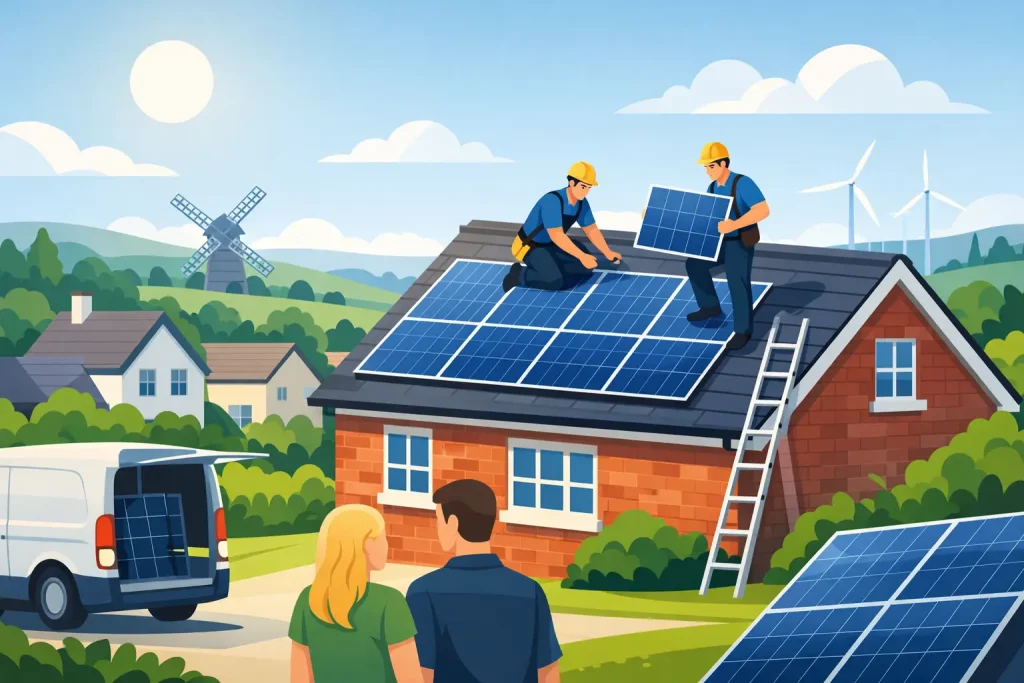
A solar quote can look simple: a panel number, a battery size and a price. The decisions behind it are not. This domestic solar installation guide is for Kent homeowners who want to understand what a properly designed system involves before work begins – and what good installation should look like once the van arrives.
Solar is a long-term improvement to your home, not an off-the-shelf purchase. The best outcome comes from matching the system to your roof, electricity use and future plans, then fitting it carefully and leaving the paperwork in order.
Start with your home, not a standard package
A sensible solar project begins with a site survey. Your installer should assess the roof’s direction, pitch, usable area, shading and condition. A south-facing roof often produces the most generation across a year, but east and west-facing arrays can also be very worthwhile. They may generate more evenly through the morning and afternoon, which can suit households that use electricity around breakfast and after work.
Shading deserves particular attention. Chimneys, neighbouring buildings, trees and roof features can all affect output. A small shadow at certain times of day does not automatically rule solar out, but it should be considered in the design. Depending on the layout, optimisers or microinverters may help reduce the effect of shade on individual panels. They add cost and are not necessary on every roof, so the right answer depends on the survey rather than a sales script.
Your roof must also be in suitable condition. If it is nearing the end of its life, it is usually better to deal with repairs or replacement first. Removing and refitting panels later is possible, but it creates extra cost and disruption.
The survey should also cover practical electrical matters: the consumer unit, earthing, cable routes, meter arrangement, internet signal where monitoring is required, and a suitable location for an inverter and battery. These details affect both safety and the finished appearance of the work.
Work out how you use electricity
Solar panels generate electricity during daylight hours. The value you get is therefore linked not only to annual generation but also to how much of that power your household can use as it is produced.
Look at a full year of electricity bills if possible. This gives a more realistic view than one winter bill or a recent estimate. Then consider the pattern behind the numbers. Are people at home during the day? Is there an electric vehicle? Do you use a heat pump, immersion heater or electric cooking? Are you planning an extension, loft conversion or a move away from gas heating?
A household with modest daytime use may still benefit from solar, but it may use a smaller proportion of generation directly. A family working from home, or one charging an EV during the day, may have a very different case for a larger array. Future demand matters too. Designing only around today’s consumption can be short-sighted if you know an EV or heat pump is likely within a few years.
It is also worth being realistic about seasonal performance. A system will normally generate far more in bright summer months than it does during a dull Kent winter. Solar reduces the amount of electricity you need to buy from the grid; it does not make a typical home completely independent of it year-round.
Choosing panels, an inverter and battery storage
Panels are only one part of the system. The inverter converts the panels’ direct current into usable alternating current for your home. Its location, capacity and warranty should be considered alongside the panel specification. A good design balances the panels and inverter rather than simply selecting the highest headline figures.
Battery storage can increase the proportion of solar energy you use at home by holding surplus generation for later. It can also be useful on time-of-use tariffs, where electricity is cheaper overnight and more expensive at peak times. However, a battery is not automatically the best financial choice for every household.
Battery capacity should reflect your likely surplus generation, evening usage and tariff. An oversized battery may spend much of the year underused. A smaller, well-matched battery can be more practical. Ask whether the proposed system can be expanded later, especially if you expect your electricity use to grow.
Some homeowners also want backup power in a cut. This needs to be discussed at design stage. Most standard solar systems switch off during a power cut to protect network engineers. Backup capability requires specific equipment and a properly planned solution. It may supply selected circuits rather than every appliance in the house.
Understand the permissions and paperwork
Many domestic solar installations in England fall within permitted development rights, but there are exceptions. Listed buildings, conservation areas, unusual roof positions and certain planning conditions can all require additional checks. Your installer should raise this early, not after equipment has been ordered.
The electricity network also has a role. Your local Distribution Network Operator, or DNO, needs to be notified about generation connected to the grid. In some cases approval is needed before installation, particularly where the proposed export capacity is above standard limits or the local network has constraints. This process should be handled properly, as it is part of making the installation compliant and ready to operate.
For homeowners who want to receive payments for exported electricity, certification matters. An MCS-certified installation provides the documentation normally required to access the Smart Export Guarantee through participating energy suppliers. Export rates, tariff terms and eligibility can change, so they should be checked at the time you choose a supplier rather than treated as a fixed promise.
At completion, you should receive clear handover information. This normally includes electrical certification, MCS documentation where applicable, DNO paperwork, equipment warranties and instructions for monitoring the system. Keep it safely with your property documents. It is useful for servicing, insurance and any future house sale.
What a professional installation day should involve
Before the installation, agree access arrangements, parking, working hours and where equipment can be stored. There will be some unavoidable activity around the property, particularly when roof equipment is being lifted into place, but a considerate team will protect work areas and keep disruption to a sensible minimum.
On the roof, mounting rails are fixed to the structure using suitable roof hooks or fixings, then panels are secured and wired. Inside, the inverter, isolators and, where included, battery equipment are installed in an agreed location. Cables should be routed thoughtfully, with safety and neatness both considered. The electrical work must be tested before the system is commissioned.
Do not judge an installation solely by how quickly it is completed. A straightforward roof may be finished promptly; a more complex property may take longer because safe access, cable routes or network requirements need more care. What matters is that the system is installed to the design, the site is left tidy and you are shown how it works.
At Baird And Brown LTD, that means treating the technical side and the customer experience as equally important: turning up when agreed, respecting the home, explaining the work plainly and providing the documents needed after completion.
Questions worth asking before you accept a quote
A clear quotation should explain the proposed panel capacity in kilowatts peak (kWp), the expected annual generation, inverter model, battery capacity where relevant, warranty terms and assumptions used in the design. It should also make clear whether scaffolding, electrical upgrades, bird protection, monitoring and DNO applications are included or priced separately.
Ask how shading has been assessed and whether the predicted generation is specific to your roof. Ask where the inverter and battery will be fitted, how visible cabling will be managed, and what happens if an issue is found with the roof or consumer unit. These are practical questions, not awkward ones.
Be cautious of guarantees about savings or claims that a system will pay for itself by a precise date. Electricity prices, household habits, weather and export tariffs all affect the result. A good installer can provide reasoned estimates and explain the assumptions behind them, but should not pretend that the future is certain.
Getting value from the system after installation
Once the system is live, the monitoring app can help you understand generation, household demand, imports and exports. Use the first few months to spot patterns rather than checking it obsessively each day. You may find that setting appliances to run during sunny periods improves self-consumption, or that an EV charging schedule needs adjusting.
Panels generally require little routine maintenance in the UK. Rain usually removes ordinary dust, although a visual check from ground level after storms is sensible. If output changes unexpectedly, an installer can help assess whether it is seasonal variation, temporary shading, a connectivity issue or something that needs attention.
The right solar installation is one that suits your home now and gives you options later. Take the time to get the survey, design and paperwork right, and you will have a system that feels like a well-planned part of the house rather than another complicated appliance to manage.
