

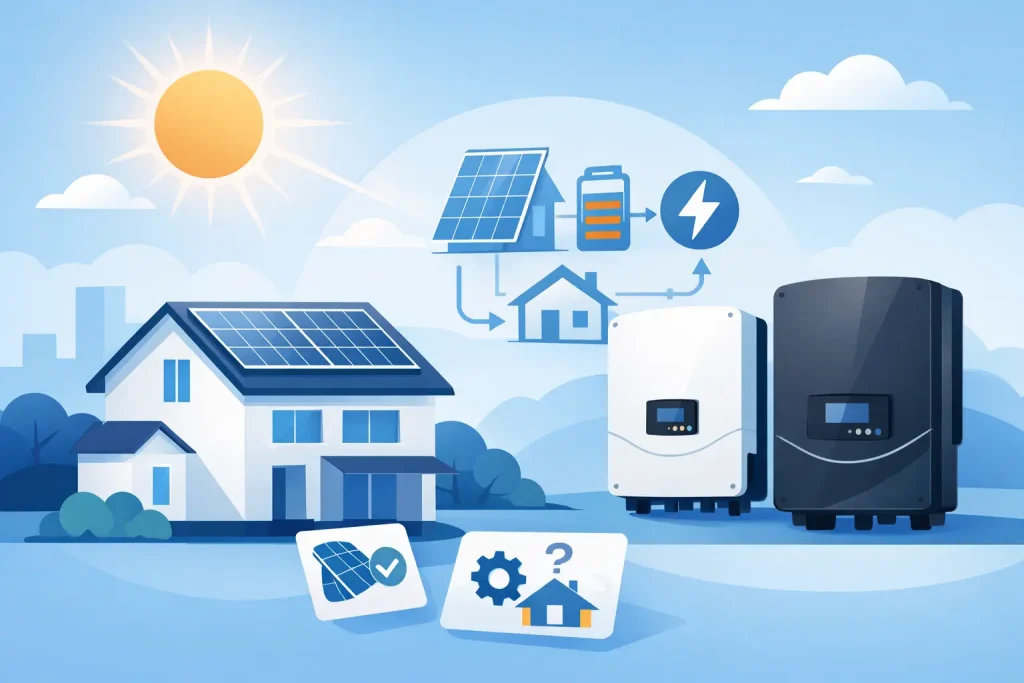
A solar inverter may be a relatively small part of a solar PV installation, but it does a major job. It turns the electricity generated by your panels into usable power for your home, manages how that power is used and, in many systems, communicates with a battery. Knowing how to choose solar inverter equipment properly can make a real difference to performance, future flexibility and the value you get from your investment.
The right answer is rarely the most expensive model or the one with the longest feature list. It depends on your roof, your household’s electricity use, whether you want battery storage, and what you may add in the years ahead.
Start with the type of solar inverter you need
For most homes in Kent, the main choice is between a standard string inverter, a hybrid inverter and, in some cases, microinverters or optimisers.
A string inverter is the traditional option. Panels are connected together in one or more strings, with a single inverter converting the power. It is a reliable, cost-effective approach where panels face the same direction and receive similar levels of sunlight throughout the day. A straightforward south-facing roof with little shading is often well suited to this design.
A hybrid inverter can manage both solar generation and a compatible battery. It is usually the sensible choice for homeowners who know they want battery storage from the outset, or who are very likely to add it soon. Choosing a hybrid model early can avoid the extra work and cost of changing equipment later. However, it is not automatically the best option for every property. If a battery is several years away, a standard inverter and a separate AC-coupled battery may be more appropriate.
Microinverters are fitted at individual panels rather than in one central unit. They can be useful on complicated roofs, particularly where different sections face different directions or partial shade affects only some panels. Their main advantage is that each panel operates independently, so the performance of one shaded panel has less impact on the rest. The trade-off is a higher upfront cost and more equipment located on the roof.
Power optimisers sit somewhere between these options. They are fitted to panels but work with a central string inverter. They can help where shading or different roof orientations would otherwise reduce output. Whether they are worthwhile should be based on a proper site assessment, not added as a standard upgrade.
Size the inverter around the system, not just the roof
Inverter sizing is one of the most commonly misunderstood parts of solar design. It is tempting to assume that a larger inverter is always better, but this is not necessarily true.
Solar panels are rated in kilowatts peak, or kWp, under ideal test conditions. In real British weather, panels rarely operate at their headline rating for long. For that reason, it is often entirely sensible for the combined panel capacity to be slightly larger than the inverter’s AC output rating. This is known as DC oversizing.
For example, a 5 kWp array may be paired with a 4 kW inverter, depending on the panels, roof orientation and expected generation profile. On the brightest days, the inverter may limit a small amount of peak output. Over the course of the year, though, the larger panel array can produce more useful energy during lower-light mornings, evenings and winter months.
The right ratio depends on the design. A roof split east and west produces a broader, flatter generation curve than a south-facing roof, so it may suit a different approach. Your installer should use generation estimates and electrical design calculations rather than simply matching one number to another.
It is also worth considering your home’s electricity supply. Many homes have a single-phase supply, while some larger properties and new builds have three-phase power. The inverter must suit the supply arrangement and comply with the relevant network requirements. Depending on the export capacity, your installer may need to notify the Distribution Network Operator under G98 rules or apply for approval under G99 before installation.
Think carefully about battery storage and backup power
Battery storage changes the question of how to choose a solar inverter because compatibility matters. Not every battery works with every hybrid inverter, and manufacturers may limit which products can be connected together. A system designed around approved equipment is more likely to perform as intended and maintain its warranty cover.
Before choosing a hybrid inverter, be clear about what you want the battery to achieve. Some households want to store daytime solar for use after work and reduce electricity bought during the evening peak. Others are looking to charge on a lower overnight tariff and use that stored energy at more expensive times. Both can work well, but the battery size, inverter capability and control settings need to reflect your actual usage.
Backup power needs particular care. Many people assume that solar panels and a battery will keep the whole house running during a power cut. In most standard installations, they will not. Grid-connected solar systems are designed to shut down during an outage unless they have specific backup capability and the necessary changeover equipment.
A backup-enabled system can supply selected circuits, such as lighting, the fridge, broadband and some sockets. Running every electrical load in the property, including an electric shower, induction hob or heat pump, requires much more design work and often a larger battery. It is possible in the right circumstances, but it should be specified from the start rather than assumed.
Check performance features that affect daily use
A good inverter should do more than convert electricity. It should give you clear information about what your system is producing and where that energy is going.
Most modern models offer app-based monitoring. This can show solar generation, household consumption, grid import and export, and battery charge level where fitted. Useful monitoring helps you understand your habits. You may find, for example, that the washing machine is best run late morning, or that your battery is routinely full before midday in summer.
Look for an inverter with enough maximum power point trackers, usually called MPPTs, for your roof layout. Separate roof aspects often need separate MPPT inputs. If you have panels on an east-facing roof and a west-facing roof, treating them as one string can reduce performance. The same issue can arise with panels installed at noticeably different pitches.
The inverter’s operating temperature range and installation location also matter. Inverters create some heat and may make a low level of noise when working hard. A garage, utility room or suitable external wall can be practical, but the location should be accessible for servicing, protected from avoidable heat and selected with the manufacturer’s clearance requirements in mind.
Compare warranties, support and expected lifespan
Solar panels may have performance warranties lasting 25 years or more, while an inverter will usually have a shorter product warranty. Ten to 12 years is common, although extensions may be available. This does not mean the inverter will definitely fail at the end of its warranty, but it is sensible to allow for replacement at some point during the life of the solar array.
The detail behind the warranty is as important as the length. Check who provides it, whether labour is included, what happens if the manufacturer changes its product range, and whether the installer can provide support if a fault occurs. A low-cost inverter is not a bargain if replacement parts, technical help or warranty claims are difficult to obtain.
For a home energy system, proven UK support and clear documentation are often worth more than a long list of headline features. You should receive the equipment details, commissioning records, handover information and the certificates needed for your installation.
Choose the installer before choosing a brand
The best inverter on paper can still underperform if it is poorly designed, incorrectly installed or matched to the wrong equipment. A site visit should consider roof condition, shading, cable routes, consumer unit capacity, existing electrical demand and your plans for an EV charger, heat pump or extension.
Be wary of fixed packages that recommend the same inverter size for every property. A good installer will explain why a particular design suits your home, what alternatives were considered and where the compromises sit. They should also be clear about projected generation, export arrangements and whether the system can be expanded later.
For homeowners, MCS certification is an important check. It supports the quality and compliance of solar PV work and is normally required if you want to access the Smart Export Guarantee through an eligible energy supplier. At Baird And Brown LTD, this design-led approach means starting with the property and the household, rather than trying to fit every home into one package.
A well-chosen inverter should quietly do its job for years: converting your solar generation safely, helping you use more of your own electricity and leaving room for the way your home may change. The most useful next step is a proper on-site assessment, where the decisions can be based on your roof and your routine rather than a sales script.




