

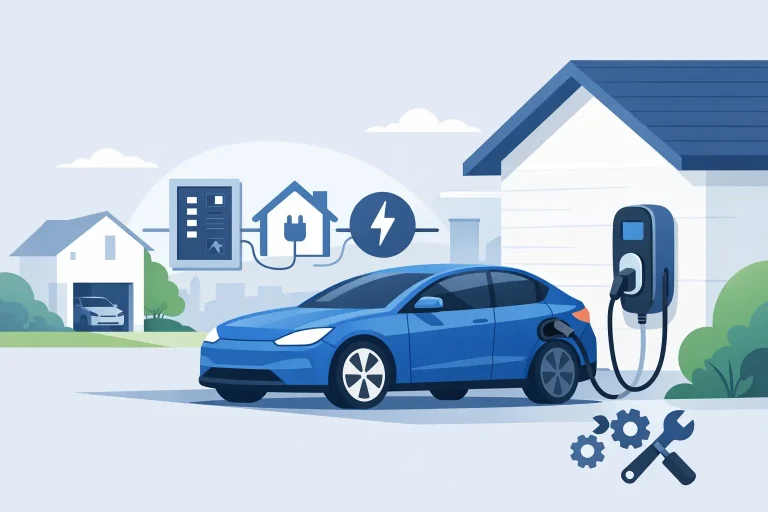
Buying an electric vehicle is often the easy part. The real question starts when you look at your driveway, your consumer unit and the side of your house and ask what the EV charger installation requirements at home actually look like in practice.
For most homeowners, the answer is not complicated, but it is specific. A proper installation depends on the capacity of your existing electrical supply, the route for cabling, where the charger will sit, and whether the charger can be installed safely and in line with current regulations. There is no sensible one-size-fits-all answer, which is why a site survey matters.
What are the main EV charger installation requirements at home?
At a basic level, a home EV charger installation needs a suitable electrical supply, a compliant charger unit, safe cable routing, proper protective devices and testing by a qualified installer. The charger also needs to be positioned where it can be used conveniently without creating a trip hazard or leaving cables stretched across paths or public areas.
Most domestic properties in the UK have a single-phase supply, and that is perfectly suitable for the majority of home chargers. A 7kW charger is the most common choice because it offers a practical balance between charging speed and compatibility with standard domestic electrical infrastructure. For many households, that means charging overnight rather than relying on slower three-pin plug charging.
The property itself also matters. Off-street parking makes installation much simpler. If your vehicle is parked on a driveway or in a garage, there is usually a clear case for a fixed charger. If you park on the road, things become more complicated because trailing a cable over a pavement is not generally acceptable and may create both safety and legal issues.
Your electrical system matters more than the charger brand
Homeowners often start by comparing charger models, but the first thing any decent installer will check is the existing electrical setup. That includes the consumer unit, earthing arrangement, main fuse rating and the general condition of the installation.
If your consumer unit is modern and has spare capacity, the work may be fairly straightforward. If it is older, overloaded or lacks the right protection, remedial work may be needed first. That does not always mean a full consumer unit replacement, but it can mean upgrades are necessary before a charger can be signed off safely.
Earthing is another area where experience counts. Some installations require additional protection arrangements depending on the supply type and the charger specification. This is one of those jobs where proper design and testing matter. It is not just about getting the charger on the wall. It is about making sure it performs safely under fault conditions too.
Load management may also be required. If your house already has high electrical demand from items such as an electric shower, heat pump, induction hob or battery storage system, the charger may need dynamic load balancing. That allows the charger to adjust output in line with household demand, helping avoid overloading the supply.
Location, cable runs and practical access
The best charger position is usually the one that works both electrically and practically. That sounds obvious, but it is where many installations either go smoothly or become needlessly awkward.
A charger should be close enough to the parking position that the tethered lead or charging cable reaches the car comfortably. It should also be mounted at a suitable height and fixed to a sound surface. Brick walls are typically straightforward. Detached garages, timber structures and outbuildings can still work, but they may need a different fixing method or a more involved cable route.
Cable run length affects labour, materials and appearance. A charger installed next to the consumer unit on the same side of the property is usually simpler than one that needs cabling taken through loft spaces, under floors or around extensions. A neat installation is not just about looks. Good routing protects the cable, reduces future issues and keeps the outside of the property tidy.
For new-build homes or renovation projects, it is worth planning the charger location early. It is far easier to include suitable cabling routes and electrical capacity before external finishes and landscaping are complete.
Do you need permission to install a home EV charger?
In many cases, a domestic EV charger can be installed without full planning permission, but there are exceptions. If your property is listed, in a conservation area, or the charger position affects a public-facing elevation in a sensitive setting, it is sensible to check before work starts.
There are also building and electrical regulations to comply with, regardless of whether planning applies. The installation must meet the relevant wiring regulations, and the work should be properly tested and certified. Depending on the charger and installation type, there may also be notification requirements to the local distribution network operator.
A good installer will deal with this as part of the process rather than leaving you to work it out yourself. That is especially valuable if your property has any unusual features or if there are concerns around supply capacity.
EV charger installation requirements at home for different property types
A detached house with a driveway is usually the most straightforward scenario, but plenty of homes in Kent are not that simple. Terraced houses, flats with allocated bays, converted properties and older homes each bring different considerations.
With terraced homes, access for cabling can be more limited and parking may not always be directly outside the property. For flats and leasehold properties, landlord consent or freeholder approval may be needed, and the route from the electrical supply to the parking bay may be more complex than the charger itself.
Older properties can be perfectly suitable for EV charging, but their electrical systems sometimes need more attention. An installer needs to look at the installation as a whole, not just the new equipment being added. That is one reason homeowners are often better served by an experienced electrical specialist than a volume-driven installer working to a standard template.
How solar panels and batteries affect the setup
If you already have solar PV or are planning it, your home charger should not be treated as a separate purchase. The charger, inverter, battery and household demand all interact.
Some chargers can prioritise surplus solar generation, allowing you to charge your car using excess daytime output rather than exporting it. That can improve the value of your solar system, but it depends on your generation profile, when the car is parked at home and how much charge you need. For someone who commutes and takes the car away all day, solar-only charging may be less useful than expected. For someone who works from home, it can make excellent sense.
Battery storage adds another layer. In some homes, the battery can help cover charging demand during higher tariff periods. In others, the priority may be to reserve battery capacity for evening household use. The right setup depends on how you use your home and vehicle, not just what technology sounds good on paper.
This joined-up thinking is where a specialist installer adds real value. Companies such as Baird and Brown Ltd work across solar, battery storage and EV charging, which means the advice can be based on the whole system rather than a single product.
What can affect cost?
The charger unit itself is only part of the cost. Installation pricing is shaped by cable length, ease of access, any groundwork or chasing required, consumer unit upgrades, load balancing equipment and whether the property needs remedial electrical work first.
That is why very cheap headline prices can be misleading. A straightforward installation may be quick and cost-effective, but not every property is straightforward. Honest quoting should reflect the actual job, including the finish, testing and certification. It is better to know that upfront than to be presented with extras halfway through.
It is also worth thinking beyond the initial bill. A well-installed charger that suits your vehicle, tariff and home energy setup is usually better value than a cheaper unit that is awkward to use or poorly matched to the property.
Choosing the right installer
Home charging is not an appliance delivery. It is an electrical installation attached to your property and your daily routine, so workmanship matters.
Look for an installer who carries out a proper survey, explains any limitations clearly and talks you through options without pushing the most expensive model by default. You should expect clear documentation, tidy cable runs, testing, certification and straightforward aftercare if you have questions once the charger is in use.
Just as important is how the company treats your home. Punctuality, cleanliness and respectful work are not extras. They are part of a proper installation service, especially when the work is happening around your family, driveway or garage.
If you are planning a charger at home, the best starting point is not a brochure or a sales offer. It is an honest assessment of your property, your electrical system and how you actually use your car. Get that right, and the charger becomes one of the simplest improvements you can make to the way your home works.
