

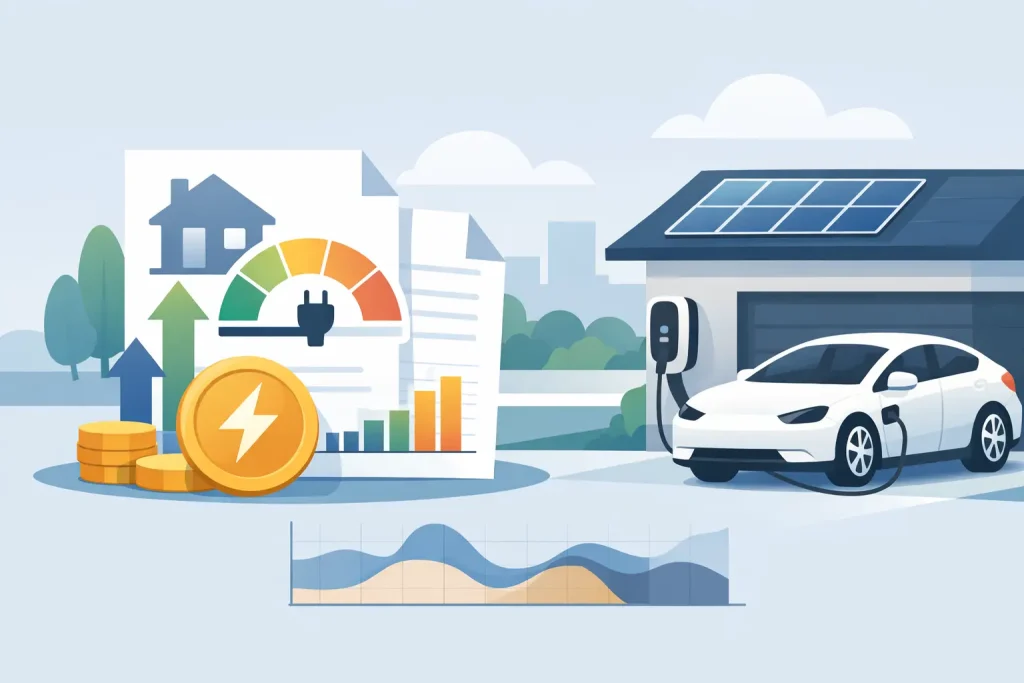
A home EV charger gives you control over where you charge. Your electricity tariff determines much of what that convenience costs. Understanding how EV charging tariffs work helps you choose a charging routine that suits your car, household energy use and daily mileage, rather than simply plugging in whenever you arrive home.
For many Kent households, the biggest saving comes from charging overnight on a time-of-use tariff. But it is not automatically the best answer for every property. The right tariff depends on when you use electricity elsewhere in the home, whether you have solar panels or battery storage, and how much flexibility you have over charging times.
How EV charging tariffs work at home
An EV tariff is usually an electricity tariff with lower unit rates during specific off-peak hours. These hours are often overnight, when demand on the wider electricity network is lower. In return, electricity may cost more at other times of day than it would on a standard single-rate tariff.
Rather than paying one price per kilowatt-hour (kWh) all day, you pay different rates depending on the time electricity is used. The off-peak window might be fixed, such as midnight to 5am, or it may vary from day to day under a more flexible tariff. Suppliers set their own rates, time windows and terms, so there is no single EV tariff that works in exactly the same way for every household.
The key figure is the unit rate in pence per kWh. If your car needs 40kWh to replenish the energy used over several days, charging at 8p per kWh costs £3.20 for that energy. At 30p per kWh, the same 40kWh costs £12. The difference can be significant over a year, especially for higher-mileage drivers.
Your electricity bill also includes a standing charge. This is a daily fixed charge for being connected to the electricity supply. It is worth comparing, but for most regular EV drivers, the off-peak unit rate and the hours it applies are likely to have the greater effect on charging costs.
You normally need a smart meter
Most time-of-use EV tariffs require a compatible smart meter. The meter records when electricity is used, allowing your supplier to bill peak and off-peak consumption at different rates.
A smart meter does not control your charger by itself. It simply provides the usage information needed for time-based billing. To make the most of the tariff, your EV charger, vehicle app or charger app needs to be set to charge during the lower-cost period.
Many modern home chargers include scheduling. You can tell the charger to begin at a set time and stop by a set time, provided the car is plugged in. Some chargers can also work with selected electricity suppliers to respond automatically to tariff information. This can be useful, but it is sensible to understand the settings rather than assuming everything is optimised from day one.
Fixed off-peak periods versus flexible tariffs
A fixed off-peak tariff is straightforward. You know the cheap hours in advance and can schedule the charger accordingly. This suits drivers who usually return home in the evening and do not need to leave again until morning.
Flexible or dynamic tariffs can offer lower prices when wholesale electricity is particularly cheap, but rates may change regularly. They can reward households that are comfortable monitoring prices or allowing compatible equipment to schedule charging automatically. The trade-off is less certainty. A cheap rate today does not guarantee the same rate tomorrow.
Some suppliers offer tariffs where the EV charging rate is lower than the rate for the rest of the home, provided charging is managed through an approved charger or app. Others apply the off-peak rate to all electricity used during the overnight window. The latter can benefit households that run appliances, heat a hot water cylinder or charge a home battery overnight, but it can also mean a higher daytime rate.
Before switching, look beyond the headline price. Check the off-peak hours, peak unit rate, standing charge, exit terms, smart-meter requirement and whether your chosen charger or vehicle is compatible with any smart charging arrangement.
What does charging actually add to your bill?
It helps to separate battery size from everyday charging use. A vehicle may have a 60kWh battery, but you will not necessarily charge it from empty to full each night. Most drivers replace only the energy used during normal journeys.
As a simple guide, an EV may use around 3 to 4 miles per kWh in real-world driving, although this varies with the vehicle, weather, driving style and route. A 30-mile round trip might therefore use roughly 8 to 10kWh. Charged at a low overnight rate, that could cost well under £1. Charged at a higher daytime rate, it will cost more.
There are also small charging losses. Electricity is used by the charger and vehicle electronics, and some energy is lost as heat. Your supply meter records what is drawn from the grid, so the amount billed may be slightly higher than the energy added to the car battery. This is normal and should be allowed for when comparing costs.
Smart charging prevents expensive mistakes
The simplest approach is often to plug in when you get home and let the charger wait for the off-peak period. A scheduled charge gives you the benefit of being ready for the morning without paying peak rates unnecessarily.
However, schedules need occasional checking. If your tariff changes its cheap hours, clocks change, or you have an early journey planned, the usual settings may no longer suit. It is also worth setting a sensible charge limit in the vehicle where appropriate. Many drivers do not need a full battery every day, and charging only what you need can make routines easier to manage.
For households with more than one large electrical load, such as a heat pump, electric shower, home battery or second EV, the installation and charging settings should be considered together. A properly specified charger and electrical installation help manage demand safely, particularly in older properties where the existing consumer unit or supply arrangement may need attention.
Solar panels, batteries and EV tariffs
Solar panels can reduce the electricity bought from the grid, but they do not always provide the cheapest way to charge an EV. Solar generation is strongest in daylight hours, while many cars are away from home during the day. In winter, available generation is also lower just when household electricity demand often rises.
If your car is at home during sunny periods, charging from surplus solar can be a good use of generation that might otherwise be exported. A compatible charger can adjust charging to follow surplus solar production, although this will usually charge the vehicle more slowly and less predictably than a fixed overnight schedule.
Battery storage adds another decision. You may be able to charge a home battery overnight at a low rate and use that energy later in the day. But repeatedly charging a car from a home battery can create extra conversion losses and may use stored energy that is more valuable for evening household demand. It is usually better to assess the whole system – solar generation, export payments, battery capacity, driving patterns and tariff hours – rather than treating each part separately.
Choosing a tariff that fits your household
The lowest advertised overnight rate is not automatically the lowest overall bill. A household that uses substantial electricity during expensive daytime hours may pay more overall, even if EV charging becomes cheaper. Equally, a household with solar, battery storage and a predictable overnight charging routine may benefit greatly from a time-of-use arrangement.
Start with your actual habits. Consider how many miles you drive each week, when the car is usually parked at home, how much electricity your household uses in the evening, and whether you can shift some demand overnight. Review a few months of electricity bills where possible, then compare tariffs using your likely charging pattern rather than the supplier’s headline example.
A home charger should support the way you live, not create another daily task to manage. With the right tariff, a sensible charging schedule and an installation designed for your property, charging can become one of the most predictable parts of running an electric vehicle. If you are planning a charger alongside solar or battery storage, Baird And Brown LTD can help you consider the full picture before the work begins.
