

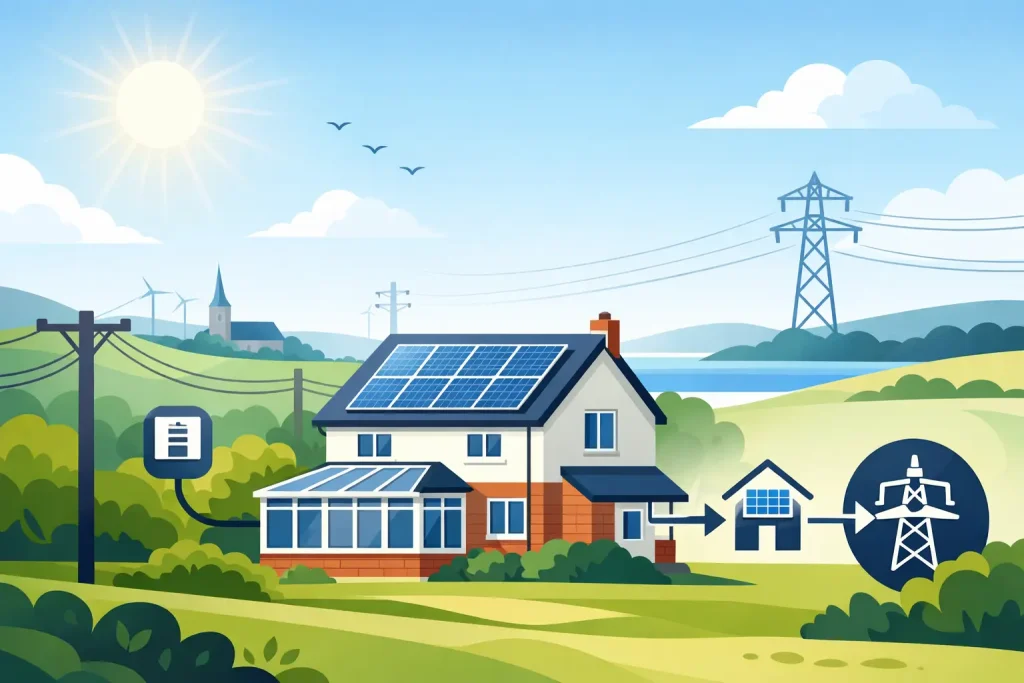
Your solar panels may produce more electricity than your home can use at certain times of day. Rather than letting that surplus go unpaid, the Smart Export Guarantee gives eligible households a way to be paid for electricity exported to the grid. This smart export guarantee solar guide explains how it works, what you need in place, and where battery storage can make a real difference.
For homeowners in Kent, SEG is best viewed as one part of the financial picture, not the sole reason to install solar. The bigger saving usually comes from using your own generation instead of buying electricity from the grid. Export payments add value, particularly during brighter months, but tariff rates and terms vary between suppliers.
What is the Smart Export Guarantee?
The Smart Export Guarantee, usually shortened to SEG, requires larger electricity suppliers to offer at least one tariff that pays small-scale generators for renewable electricity exported to the grid. Solar PV is the most common example for domestic properties, although other eligible technologies can qualify.
There is no single national SEG rate. Each supplier sets its own tariff, payment rate and conditions. Some offer a straightforward fixed rate per kilowatt-hour exported. Others offer rates that change by time of day, which can suit households with batteries and a willingness to monitor their energy use more closely.
The payment is for measured export, not for all electricity your panels generate. If your home uses the solar power as it is produced, that electricity is not exported and does not attract an SEG payment. It still has value, because you have avoided purchasing that unit from your electricity supplier.
Smart Export Guarantee solar guide: what you need
Eligibility is not just about having panels on the roof. Your installation, meter and paperwork all matter. Most homeowners will need an MCS-certified solar installation, or an equivalent recognised certification route, along with a smart meter capable of recording half-hourly export readings.
Your installer should also complete the relevant grid notification or application with the local Distribution Network Operator. For many standard domestic systems, this is handled under the G98 process. Larger or more complex systems may require approval under G99 before they are connected. This is not merely administration: it confirms that the system can operate safely alongside the local electricity network.
When applying for an SEG tariff, suppliers commonly ask for your MCS certificate, export MPAN, meter details and bank information. They may also require that you receive electricity from them, although this is not universal. Terms can change, so it is sensible to check the current tariff conditions rather than choosing solely on a headline rate.
A good installation handover should leave you with clear documentation and an explanation of what each item means. It is much easier to arrange SEG payments when certificates, commissioning records and meter details are properly organised from the outset.
Export payments versus self-consumption
It is tempting to focus on the highest export rate available. In practice, the best outcome depends on when your household uses electricity.
If someone is regularly at home during the day, solar generation can directly support appliances, cooking, home working and heat-pump use. That reduces imported electricity immediately. A household that is empty from morning until evening may export more power, especially in summer, unless it can shift some demand to daylight hours.
The comparison is straightforward. A unit of solar electricity used in your home avoids paying your normal import rate. A unit sent to the grid earns your SEG export rate. Import prices and export prices are not always the same, so using power on site often remains the stronger financial choice. However, a favourable time-based export tariff can change that calculation at certain times.
This is why realistic system design matters. Panel capacity, roof orientation, shading, household demand and future plans such as an electric vehicle should be considered together. A larger system can generate more surplus, but it should still be designed around the property and the connection available.
How battery storage affects SEG payments
Battery storage gives you more control over when solar energy is used. Instead of exporting a midday surplus straight away, you may store it for the evening, when the household would otherwise be importing electricity at a higher price.
That does not automatically mean a battery will improve SEG income. In fact, storing solar power often reduces exported units because more generation is kept for use at home. The value is in reducing imports and improving self-sufficiency, rather than simply increasing the export payment.
Some households use a battery with a time-of-use tariff. The battery may charge from low-cost grid electricity overnight, supply the house later, or export at periods when rates are higher. This can be worthwhile, but it needs careful tariff selection and a system set-up that follows the supplier’s rules. Not every SEG tariff pays for electricity exported from a battery, particularly where the supplier cannot distinguish stored solar energy from energy imported from the grid.
Battery controls should also be configured thoughtfully. An overly aggressive export setting could send stored energy out of the house before the evening demand arrives. Equally, reserving too much battery capacity for a possible power cut may reduce day-to-day savings. The right settings depend on the household’s priorities.
Choosing an SEG tariff without chasing the headline figure
A tariff with the highest advertised rate is not automatically the best choice. Look at how and when it pays, whether you must take your import supply from the same company, the frequency of payments, minimum export thresholds and whether the rate is fixed or variable.
For a simple solar-only home, a fixed export tariff can be easy to understand and predict. For a home with a battery, EV charger or flexible electricity use, a time-based tariff may offer more opportunity but requires closer attention. Variable tariffs can change, and household routines can change too, so a tariff that works well this year may not always be the right fit.
It is also worth checking the practical side. Is the account manageable? Are meter readings being received correctly? Can you see clear export figures on your bill or app? A tariff is only useful if the supplier can process your payments accurately.
Common issues that delay SEG payments
The most common delays are administrative rather than technical. Missing certificates, an unregistered export MPAN, an incompatible meter configuration or incorrect personal details can all hold up an application.
A smart meter is particularly important. Older meters may only record imported electricity, or may not provide the half-hourly export data a supplier needs. If you have recently changed supplier, installed a battery or altered your solar system, it is sensible to check that export readings are still being recorded correctly.
New-build homeowners should be especially careful to establish who owns the solar system and whether the installation paperwork will be handed over at completion. A property can have panels installed, but obtaining SEG payments is far easier when the certificates and connection details are available from day one.
Getting the design right before thinking about export
SEG is a useful income stream, but it should sit behind the fundamentals: safe installation, sound roof assessment, suitable equipment, a correctly sized inverter and proper network paperwork. These details protect both the performance of the system and your ability to make use of export tariffs later.
At Baird And Brown LTD, the aim is to make sure homeowners understand what their system is expected to do before installation, including how solar generation, battery storage and export payments work together. There is no benefit in a complicated arrangement that does not suit the way your household actually lives.
A well-designed solar system should make everyday electricity use feel simpler, not more demanding. Once the paperwork is in place and the system is producing reliably, SEG payments can quietly reward the surplus you do not need, while the real day-to-day benefit comes from making more of your own clean electricity.




