

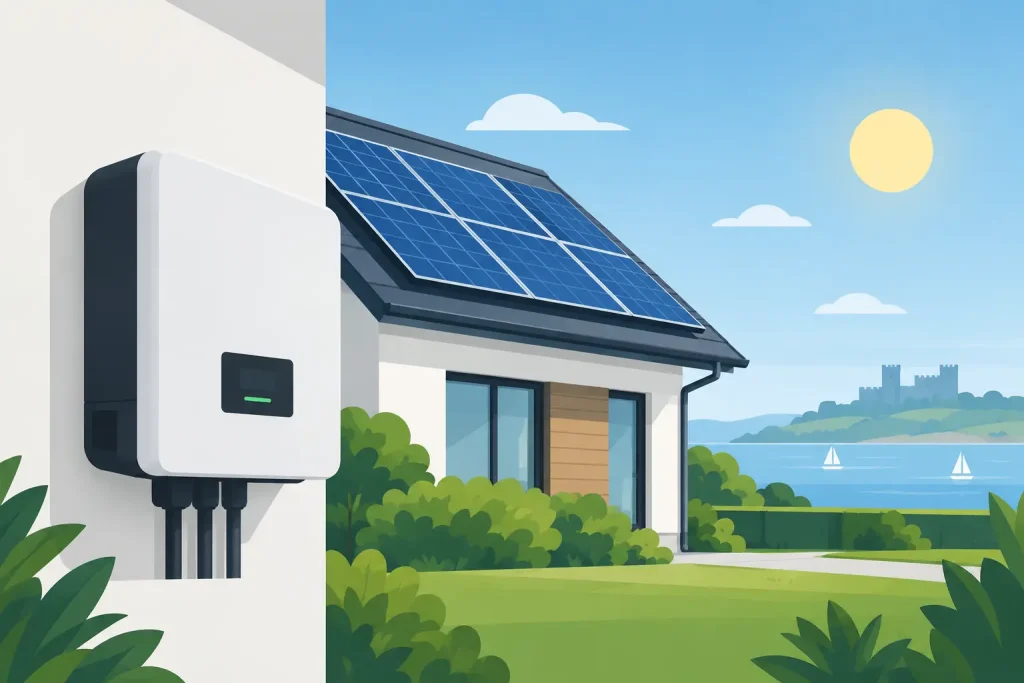
A solar inverter rarely gets the attention given to panels, yet it is the part of the system that decides how effectively your home can use the electricity those panels produce. A useful solar inverter review is therefore not about picking the biggest name on a brochure. It is about matching the inverter to your roof, household demand, future battery plans and the way you want to manage energy day to day.
For homeowners in Kent, that decision can make a noticeable difference over the life of a solar PV system. The right inverter should work quietly in the background, provide clear generation data and give you sensible options if you later add battery storage, an electric vehicle charger or more panels.
What a solar inverter does
Solar panels generate direct current (DC) electricity. Your home and the grid use alternating current (AC), so the inverter converts one into the other. It also manages the system’s safety functions, monitors performance and controls how power is shared between your panels, home, battery and the grid.
That is why inverter choice is not simply a question of panel capacity. An undersized unit can limit output at the brightest times of year, while an unnecessarily large one may cost more without delivering a worthwhile benefit. The correct size depends on the total panel capacity, roof orientation, local network permissions and how the system is expected to operate.
In the UK, your installer should also handle the relevant Distribution Network Operator notification or application. Smaller systems commonly fall under G98 requirements, while larger or more complex installations may require G99 approval before connection. This is one reason a proper site survey matters more than an online quote based only on your postcode and electricity bill.
Solar inverter review: the main types compared
Most domestic systems use one of three approaches. Each has a sensible place, and none is automatically best for every property.
String inverters
A string inverter is the standard choice for many homes. Panels are connected in groups, known as strings, and the inverter is usually fitted in a loft, garage or other suitable location. It is a cost-effective, proven arrangement for a straightforward roof with similar panel orientations and little shading.
The limitation is that panels within the same string influence one another. If one panel is regularly affected by a chimney, tree or neighbouring building, it can reduce the output of that group. Modern inverters use maximum power point tracking, often shortened to MPPT, to manage changing conditions, but the layout still needs careful design.
A string inverter can be an excellent answer for a clear south-facing roof. It may be less suitable where panels are split across east and west elevations, or where intermittent shade is a regular feature.
Hybrid inverters
A hybrid inverter combines solar conversion with the ability to connect a compatible battery. For households that expect to add storage soon, it can be a practical way to avoid replacing equipment later.
However, “battery ready” does not always mean every battery will work with every inverter. Some manufacturers use high-voltage batteries from their own range, while others support selected third-party products. Battery capacity, backup capability and charging rates should all be considered before committing to a system.
A hybrid inverter is often a strong choice for homes using a good share of electricity in the evening, particularly where time-of-use tariffs make overnight battery charging attractive. If battery storage is unlikely ever to be needed, a standard string inverter may be the simpler and more economical option.
Microinverters and optimisers
Microinverters are fitted behind individual panels, converting electricity at roof level. Power optimisers are also fitted per panel but work with a central inverter. Both approaches can help where shading, several roof directions or awkward roof shapes would make a conventional string layout less efficient.
They offer more panel-level visibility, which can be useful when diagnosing a performance issue. The trade-off is a higher upfront cost and more equipment on the roof. A good design should not use optimisers simply because they sound advanced. They should solve a genuine problem identified during the survey.
| Inverter approach | Often suited to | Main consideration | | — | — | — | | String inverter | Clear, simple roof layouts | Less flexible where shading affects one part of a string | | Hybrid inverter | Homes planning battery storage | Check exact battery compatibility and backup functions | | Microinverters or optimisers | Complex roofs or recurring partial shade | Higher initial cost may not be justified on an unshaded roof |
Sizing matters, but not in isolation
It is common to see a solar array rated at a higher DC capacity than its inverter’s AC rating. This is called DC oversizing and can be entirely appropriate. Panels rarely produce their stated maximum output in normal British weather, so a modestly smaller inverter can still make good use of the array across most of the year.
There is a balance to strike. If the inverter is too small, it may clip some generation during very bright periods. If it is too large, it can be less efficient at low output and needlessly increase the project cost. Roof direction makes a difference here: an east-west array spreads production across the day, whereas a south-facing array can produce a higher midday peak.
The question is not simply, “What size inverter do I need?” It is, “What will this system produce on this roof, and how will our household use it?” A family working from home may prioritise daytime self-consumption. A household that is out all day may see greater value in a battery, load shifting or diverting surplus energy to hot water.
Battery and backup expectations
Battery storage can increase the amount of solar electricity used at home, but it does not guarantee power during a cut. Most grid-connected solar systems switch off during an outage for safety reasons, even if the sun is shining and a battery is fitted.
If backup power is important, ask specifically about emergency power supply, whole-home backup and what loads can run. These are different arrangements. Some systems provide a single emergency socket; others can power selected circuits; a properly designed whole-home backup setup may require additional equipment, installation work and a larger battery.
The inverter’s battery charging and discharge rate is just as relevant as battery capacity. A large battery with a limited discharge rate may not cover several high-demand appliances running at once. Equally, a smaller battery can be effective if the household’s evening demand is modest and the system is designed around realistic usage.
Monitoring, warranties and the details that show quality
Most modern inverters include an app or web portal showing generation, household consumption and export. The quality of monitoring varies. Ask whether the proposed system includes a consumption meter or CT clamp, as without one the app may show what the panels generate but not what your home is actually using.
Clear monitoring helps you spot changes in performance and adjust habits. Running a dishwasher, washing machine or EV charge when solar production is high can improve self-consumption without any complicated intervention.
Warranty length is worth reading carefully, but it should not be the only deciding factor. Check whether the warranty is standard or requires registration, whether labour is covered, who handles a fault claim and whether the manufacturer has an established UK support route. An inverter is an electronic device expected to work for many years, so a good installer should explain what happens if it needs attention after commissioning.
Location also matters. Inverters generate a small amount of heat and may make a low operational sound. They need suitable ventilation, sensible cable routes and safe access for maintenance. A tidy installation is not just about appearance – it usually reflects care in the wider design and commissioning process.
Questions worth asking before you agree
Before accepting a proposal, make sure you understand the expected annual generation, the inverter rating, whether the design accounts for shading, and how much electricity you are likely to use rather than export. If a battery is included or planned, ask which models are compatible and whether the installation can provide backup power.
You should also receive clear documentation after installation, including commissioning information, warranties, electrical certification and the paperwork needed for Smart Export Guarantee applications where applicable. For MCS-certified systems, accurate handover documents are part of a professional installation, not an optional extra.
At Baird And Brown LTD, the starting point is always the property and the household using it, rather than a one-size-fits-all equipment package. A survey provides the opportunity to look properly at roof layout, shading, consumer unit arrangements and future plans such as EV charging.
The best inverter is usually the one you barely think about: correctly sized, properly installed, easy to monitor and capable of supporting the next sensible step for your home. Take the time to ask how the proposed design reaches that point, and you will be in a far better position to invest with confidence.


