

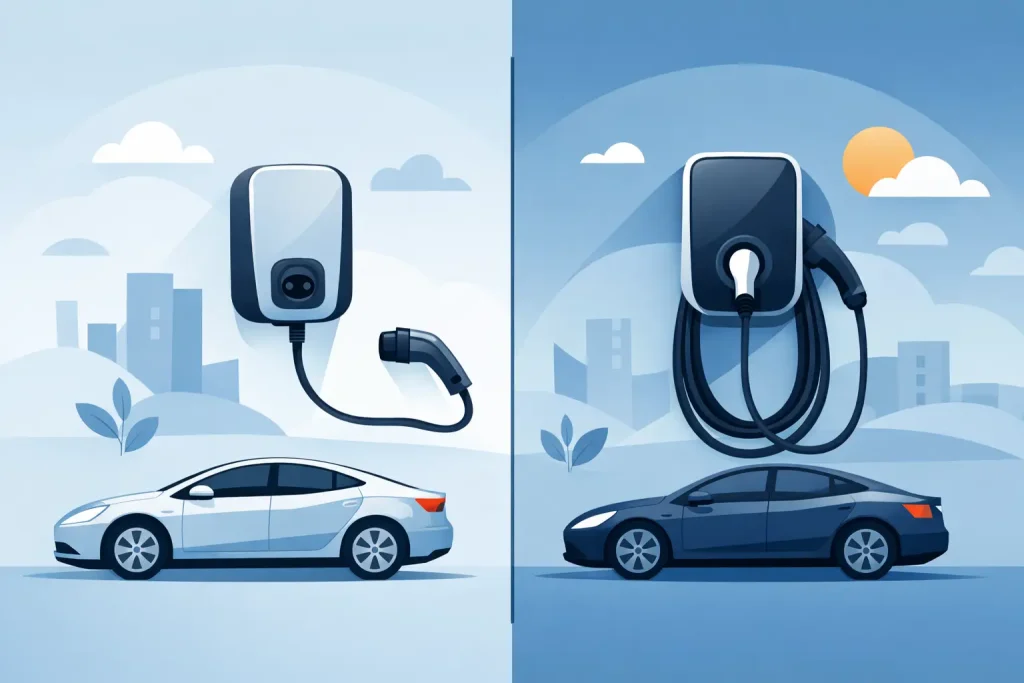
Pulling onto your drive in the rain is when the untethered vs tethered EV charger question stops being theoretical. One option lets you grab the cable and plug in straight away. The other keeps the charger looking tidier and gives you more flexibility, but it does mean getting a cable out of the boot each time.
For most homeowners, this choice is less about right or wrong and more about how you use your car, where you park, and what sort of setup you want on the outside of your home. A charger is something you will live with for years, so it is worth getting past the brochure language and looking at the practical differences.
Untethered vs tethered EV charger – what is the difference?
A tethered EV charger has a charging cable permanently attached to the unit. You park up, take the connector from its holster, plug in, and charge. It is the more straightforward option for day-to-day use and is often the one people picture when they think of home charging.
An untethered EV charger has a socket on the unit rather than a fixed cable. You use a separate charging lead, usually the one supplied with the vehicle or a compatible lead purchased separately. When you finish charging, the cable is removed and stored away.
That sounds like a small difference, but it affects convenience, appearance, future compatibility and, in some cases, cost.
Why many homeowners choose a tethered charger
If convenience is your main priority, a tethered charger usually comes out ahead. There is less to think about. The cable is already there, the connector has its place, and charging becomes part of your normal routine rather than something that needs an extra step.
That matters more than people sometimes expect. If you are charging most evenings, especially through autumn and winter, having the cable ready to go is simply easier. It is also useful for households where different family members may use the car. The simpler the process, the more likely it is to be used properly every time.
Tethered units can also feel neater in use. The cable lives with the charger rather than sliding about in the boot alongside shopping bags, tools or muddy pushchairs. For homes where the charger is installed on a driveway close to the parking position, it often feels like the most user-friendly solution.
The trade-off is visibility. Even when the cable is wrapped neatly, a tethered charger tends to look more obvious on the wall. Some homeowners do not mind that at all. Others would rather keep the front of the property as uncluttered as possible.
Where an untethered charger makes more sense
An untethered charger is usually chosen for flexibility and appearance. Without a fixed cable hanging on the unit, the charger looks cleaner and more discreet. If the charger is on the front elevation of the house or in a very visible location, that can be a genuine benefit.
It can also be the better option if you are thinking ahead. Different EVs use different cable lengths more effectively depending on where the charge port sits on the car and how you park. With an untethered charger, you can choose the lead that suits your current vehicle and change it later if needed.
That can be helpful in households likely to change cars over the next few years, or in new-build settings where the charger is being installed before the final vehicle choice is known. You are not tied to one attached lead in one fixed length.
There is also a practical point for some drivers who regularly use public charging. If you already carry your own cable and are used to handling it, an untethered home charger may not feel inconvenient at all. In that case, the cleaner look may outweigh the extra step.
Cost, cable length and daily use
People often assume untethered is always cheaper and tethered is always dearer. In practice, it depends on the charger model and what is included. An untethered unit may have a lower upfront price, but once you add a good-quality cable, the difference can narrow or disappear.
Cable length matters too. A fixed tethered lead might be 5 metres or 7.5 metres depending on the model. That may be ideal for one parking arrangement and awkward for another. Too short, and you have to park in exactly the right place. Too long, and you have more cable to manage.
With an untethered setup, you can select the cable length that suits your driveway. That flexibility is useful, but it comes with the need to store the cable properly and keep it clean. If the lead spends much of its life in the boot, you will notice dirt and water more than you would with a fixed cable on a wall holster.
Which is better for looks and tidiness?
This is often the deciding factor, especially on well-kept properties. An untethered unit is usually the tidier-looking option when not in use. It is compact, simple and less visually dominant.
A tethered charger can still be installed neatly, particularly with careful cable management and a sensible position on the wall, but it will always be a little more visible. Whether that matters depends on the property and the customer. On a side wall or inside a garage, appearance may barely register. On the front of a period home, it may matter a great deal.
Good installation design helps either way. Positioning, cable routing and the overall finish make a real difference. A charger should feel like part of the home, not an afterthought.
Future-proofing and changing vehicles
When comparing untethered vs tethered EV charger options, many homeowners ask which one is more future-proof. In general, untethered has the edge for flexibility because the cable is separate from the unit. If your next vehicle needs a different cable length, or if household charging habits change, swapping the lead is simple.
That said, tethered chargers are not automatically a poor long-term choice. Most UK domestic EVs use Type 2 connectors, so for many households a tethered unit will remain suitable for years. If you know what you drive, expect to keep charging in the same parking position, and value ease of use, tethered can still be the most sensible long-term option.
The key is not to overcomplicate future-proofing. It is useful to think ahead, but not at the expense of choosing a setup that is less convenient for your actual day-to-day use now.
What suits different types of household?
A tethered charger usually suits busy households, daily drivers, and anyone who wants the quickest possible charging routine. If you leave early, get home late, or simply prefer equipment that is ready to use with minimal effort, tethered is often the better fit.
An untethered charger tends to suit homeowners who care strongly about appearance, want flexibility between vehicles, or have a more occasional charging pattern. It is also a good choice where the charger is going in a very visible location and you want it to blend in as much as possible.
There are also cases where parking layout becomes the deciding factor. If cars park in different positions, or if there is more than one likely vehicle to charge over time, choosing the right cable arrangement matters as much as the charger itself.
Installation matters as much as the charger type
The charger you choose is only part of the job. The best option on paper can still be disappointing if it is installed in the wrong place or without enough thought about how you actually park and charge.
A proper site assessment should consider cable run, consumer unit location, Wi-Fi or mobile signal if the charger relies on smart features, and the route from charger to vehicle. It should also look at whether solar or battery storage may be part of the property setup now or later.
That is where practical advice matters. A good installer will not just ask which charger brand you want. They will ask where the car parks, who uses it, how often you charge, and whether the visual finish of the installation matters to you. That kind of advice tends to lead to better decisions than simply choosing whatever looks cheapest online.
At Baird And Brown LTD, that is usually how these conversations go. The aim is not to push one charger style over another, but to match the equipment to the home and the people using it.
So, should you choose tethered or untethered?
If you want the easiest day-to-day charging experience, choose tethered. If you want the neatest appearance and more flexibility around cables, choose untethered.
That is the short answer, but the better answer is to look at your driveway, your car, and your routine. The right charger is the one that feels straightforward on a wet Tuesday evening, still looks right on your home a year later, and does not leave you wishing you had thought a little more carefully at the start.
A home EV charger should make life simpler, not give you another small irritation to work around every day.
