

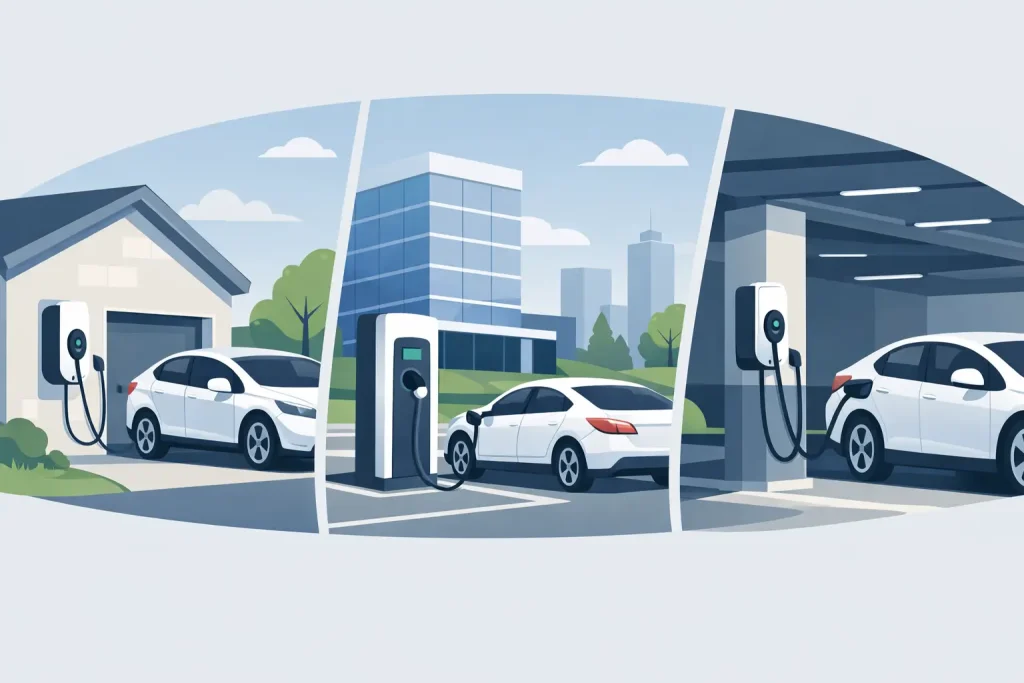
The best answer to “where should an EV charger be installed” is usually the place where your car is parked most often, but that is only the starting point. A charger needs to be convenient on a wet Tuesday evening, safe for everyone using the property, and practical to connect to your electrical supply. The shortest cable route is not always the best route, and the nearest wall is not always the right wall.
For most Kent homeowners, a proper site assessment turns what looks like a simple choice into a clear, sensible installation plan. It considers how you arrive and park, where cables will run, the capacity of the existing consumer unit, and whether solar panels, battery storage or a second electric vehicle may be part of your plans later.
Where should an EV charger be installed at home?
In many homes, the ideal position is on an external wall beside the driveway, close enough to the vehicle’s charging port for the tethered lead to reach without stretching across a path. This keeps daily charging straightforward and helps avoid loose cables becoming a trip hazard.
That said, the charging port is not in the same place on every vehicle. Some are at the front, others at the rear, and some sit on the left or right side. Before choosing a location, think about how you normally park, not just how the vehicle is positioned on the day of installation. If you regularly reverse onto the drive, a charger placed near the front of the house may be less convenient than one further down the side wall.
A garage can also be an excellent location, particularly where the car is stored inside overnight. A charger fitted inside should be positioned where the cable can reach the vehicle without obstructing access, shelving, garage doors or the route to the house. If the garage is used mainly for storage and the vehicle remains outside, an external installation will often make more sense.
The aim is to create a charging point that feels like part of the property, rather than an awkward addition you have to work around.
Start with the parking space, not the charger
The charger should serve the parking arrangement you genuinely use. A dedicated driveway or garage is usually simple. A shared drive, narrow side access or changing parking arrangement needs more thought.
Try to avoid a setup that requires a cable to cross a public pavement, shared accessway or neighbour’s land. Aside from the safety concern, this can create legal and practical problems. A home charger works best when your vehicle can be charged entirely within your own boundary.
Consider the distance from the charger to the car, too. A longer tethered cable may offer flexibility, but it should not be used as a substitute for good positioning. Excess cable still needs somewhere clean and secure to sit when the charger is not in use. A well-placed unit reduces clutter and makes it easier to keep the area tidy.
Where two cars use the drive, allow room for doors, pedestrians and future changes in parking habits. It may be worth placing the charger where either vehicle could reach it, rather than designing the installation around one car alone.
Choose a safe route back to the electrical supply
The visible charger is only one part of the job. It needs a dedicated electrical circuit, suitable protection and a safe cable route back to the consumer unit or supply equipment. This route often has more influence on the final location than people expect.
A charger on the opposite side of the property may still be possible, but longer cable runs can require additional containment, careful routing through the building or underground work outside. There is nothing inherently wrong with this when it is designed correctly. It simply needs to be allowed for from the outset, rather than treated as an afterthought.
External cables should be protected from accidental damage and installed neatly. On driveways, installers may need to consider armoured cable, suitable depths for buried routes, and how the surface will be reinstated. On walls, cable containment should follow a sensible line and avoid making the front of the property look untidy.
A qualified installer will also assess the condition and capacity of your existing electrical installation. Older consumer units, limited supply capacity or previous alterations do not automatically prevent an EV charger being installed, but they can affect the work required. Honest advice at this stage helps prevent surprises later.
Keep clear of everyday hazards
A charging unit should be mounted at a practical height and positioned away from likely impact points. For example, placing it directly beside where a car’s door swings open, or where wheelie bins are regularly moved, can lead to avoidable damage.
Think about water, too. Purpose-designed home chargers are built for outdoor use, but the installation still needs to account for drainage, exposed wall conditions and areas where water may collect. A sheltered position can be useful, though it is not essential for a correctly rated outdoor charger.
The unit should also remain accessible. Avoid placing it behind locked gates, dense planting or stored items if that will make regular use difficult. Accessibility matters for maintenance, visual checks and any future upgrades.
Consider Wi-Fi, smart charging and signal strength
Most modern home chargers include smart functions. These can allow scheduled charging, energy monitoring and, where suitable, better use of off-peak electricity tariffs. Some units use Wi-Fi, while others have mobile connectivity, but signal should be checked as part of the design.
A charger at the far end of a long driveway or in a detached garage may have weak Wi-Fi coverage. This does not necessarily rule out that location. It may mean choosing a charger with an alternative connection method, improving coverage, or selecting settings that suit the available signal.
It is worth discussing how you expect to use the charger. Someone who plugs in every evening and wants low-cost overnight charging may value smart scheduling highly. Another household may place more emphasis on solar charging during the day. The right location and equipment should support that routine.
Solar panels and battery storage can affect the best position
If you already have solar PV or are considering it, the EV charger should be planned as part of the wider home energy system. Charging an electric car from surplus solar generation can be a useful way to use power generated at home, especially when the car is present during daylight hours.
This does not always mean the charger must be physically close to the solar inverter or battery. Electrical design, monitoring equipment and cable routes all need to be considered together. In some homes, a slightly different charger position can save disruption while still allowing smart solar integration.
Battery storage adds another consideration. A battery may help manage household demand at certain times, but it is not sensible to assume it will always supply vehicle charging. The system should be designed around your tariff, battery size, typical driving pattern and household electricity use. Clear expectations matter more than impressive claims.
For new-build projects, it is particularly worthwhile to make provision early. Installing suitable ducting, allowing space in the consumer unit and planning the parking layout before landscaping or paving is finished can reduce cost and disruption later.
Do not overlook lighting and day-to-day use
A charger may be technically well located but still frustrating to use if the area is poorly lit. Good external lighting makes plugging in safer and more comfortable during dark winter evenings. It also makes it easier to see the cable, charging connector and any display on the unit.
Where possible, keep the charger away from spots where it will be struck by gates, vehicles or garden equipment. If the driveway is tight, protective bollards or careful positioning may be worth considering. The right solution depends on the property – extra protection is helpful in some locations and unnecessary in others.
Appearance also matters. A charger is a permanent feature of your home. A neat cable route, sensible mounting position and equipment that suits the building can make a noticeable difference, particularly on the front elevation of the property.
Why an on-site assessment is worthwhile
Photographs and measurements can provide a useful first indication, but they cannot always show supply arrangements, construction details, cable routes or the way a household uses its drive. An on-site assessment allows these points to be checked properly before work begins.
At Baird And Brown LTD, the focus is on recommending a location that is safe, practical and proportionate to the property, rather than pushing a one-size-fits-all installation. That includes discussing future needs honestly. If a modest adjustment now could make a second charger, solar integration or a new vehicle easier later, it is worth knowing before the work is complete.
The best charger location is the one you will barely have to think about: you park, plug in, and get on with your evening. A well-planned installation makes that routine easy while keeping your home safe, tidy and ready for what comes next.
