

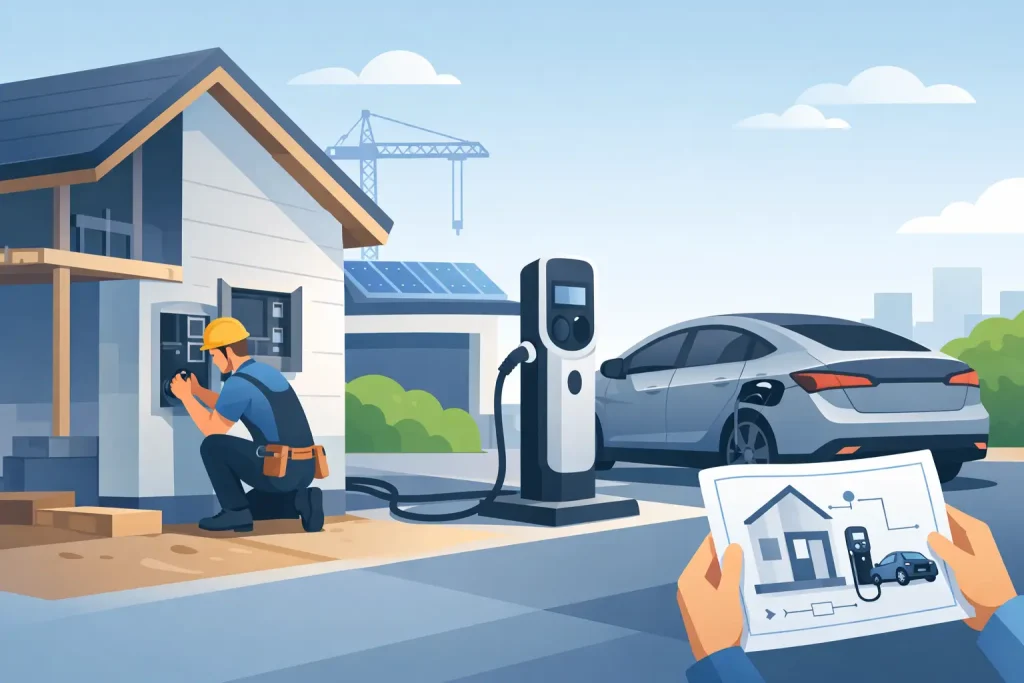
When an EV charger is planned at the same time as a new home, the job is usually simpler, tidier and better value than trying to add one later. A well-designed new build EV charger installation gives you the charging speed you need, keeps cabling discreet, and leaves room for future upgrades such as solar PV or battery storage.
That early planning matters more than many homeowners realise. Once driveways are finished, walls are decorated and consumer units are already loaded with other circuits, changes become more awkward and more expensive. In a new build, there is a chance to get the charging point in the right place, size the supply properly and avoid the sort of compromises that often come with retrofit work.
Why planning the charger early makes a difference
The biggest advantage of installing during construction is access. Electricians can route cables before plastering, set ducting under driveways and position the charger where it will actually be practical to use every day. That sounds obvious, but plenty of chargers end up on the wrong wall or too far from where the car is parked because the charging point was treated as an afterthought.
There is also the wider electrical design to think about. New homes now carry more electrical demand than older properties. Heat pumps, electric hobs, battery systems and home working all place extra load on the installation. Add an EV charger into that picture and the design needs to be considered as a whole, not as a single product bolted onto the outside wall.
For homeowners, this means fewer surprises later. For developers and self-build clients, it means the property is more useful from day one and better aligned with how people now live.
What a new build EV charger installation needs
At its simplest, an EV charger installation needs a suitable power supply, a safe circuit, the right protective devices and a sensible mounting location. In practice, there are a few decisions that shape how well the system works long term.
Power supply and load capacity
Most domestic chargers are rated at 7kW on a single-phase supply, which is suitable for many homes. That said, the charger cannot be considered in isolation. The incoming supply, earthing arrangement, main fuse size and the likely demand from the rest of the property all need checking.
This is where proper assessment matters. Some homes have enough spare capacity for straightforward charging. Others may need load management so the charger can adjust its output depending on what else is running in the house. That can be a sensible answer where a property has multiple high-demand appliances, because it allows safe operation without unnecessary upgrades.
Charger position
The best location is not always the nearest wall to the consumer unit. It needs to suit the way you park, the length of the vehicle cable and the possibility that you may change cars in a few years. A charger tucked awkwardly behind a gate post or mounted too far from the parking bay soon becomes irritating.
In a new build, it is worth deciding where the car is most likely to stop on a normal weekday, not just where it sits on a site plan. A practical position now can save daily inconvenience later.
Cable routes and groundworks
One of the most useful parts of planning early is the chance to install cable routes before surfaces are finished. If the charger may sit away from the house, ducting can be laid under the drive while the ground is open. That keeps the final result neat and avoids future disruption.
Even if the charger is not being fitted immediately, preparing the route can still be worthwhile. For some projects, future-proofing in this way makes good sense, especially where the homeowner expects to move to an EV soon after completion.
Choosing the right charger for a new build
Not every charger suits every household. The right choice depends on the car, the way you use it and whether the home will include other energy technologies.
Smart chargers are now the obvious choice for most domestic installations. They allow scheduling, energy monitoring and in some cases integration with off-peak tariffs. If you charge overnight, these features can make a real difference to running costs.
For households considering solar panels or battery storage, compatibility becomes more important. Some chargers can work more intelligently with self-generated electricity, which can make the whole system more efficient. It is not always necessary to install every component at once, but it helps if the charger and the rest of the electrical design are chosen with future upgrades in mind.
There is also the question of tethered versus untethered units. A tethered charger is convenient because the cable is already attached. An untethered charger can look tidier and may suit homeowners who prefer a cleaner finish. Neither is universally better. It comes down to how the property will be used and what matters most to the owner.
New build EV charger installation and regulations
Any EV charger installation should be carried out properly, tested correctly and documented in line with current electrical standards. In a new build, there may also be wider compliance requirements depending on the type of project.
For homeowners and developers alike, the practical point is this: the charger should never be treated as just another accessory. EV charging equipment places sustained demand on the electrical system, so correct design and certification matter.
An experienced installer will look at the earthing system, circuit protection, cable sizing, isolation, load balancing where required and final testing. They should also provide the right paperwork once the work is complete. That part is often overlooked until a homeowner wants records for warranty, future sale, or insurance purposes.
Common mistakes in new build projects
One of the most common issues is leaving the charger too late in the build programme. By then, the ideal cable route may have gone, external finishes may already be complete and the charger position may be chosen around convenience for the build team rather than convenience for the future resident.
Another mistake is underestimating future demand. A household may start with one EV but add a second car later. Or it may install solar and battery storage after moving in. The original design does not need to include every upgrade from the outset, but it should avoid boxing the property into a corner.
There is also the risk of choosing on price alone. The cheapest charger or quickest install is not always the best value if the result is poor cable management, limited functionality or awkward positioning. Good installation work is not just about the unit on the wall. It is about how the whole system has been thought through.
What homeowners should ask before work starts
A good installer should be able to explain the proposed charger location, cable route, protective equipment and whether load management is needed. They should also be clear about how the charger might work with future additions such as solar PV or battery storage.
If you are building a home or buying from a developer, ask whether the charger is being fully installed now or whether only the infrastructure is being put in place. There is a big difference between a completed charging point and a property that is merely charger-ready.
It is also worth asking who will carry out the work and who will be responsible for the design and documentation. Homeowners generally want reassurance that the installer is accountable, the work area will be treated with respect and the finish will match the quality of the rest of the build. That matters just as much as the technical specification.
A sensible approach for Kent homeowners
Across Kent, many new build and self-build homeowners are trying to make sensible long-term decisions rather than chasing every new gadget. That usually means choosing infrastructure that is practical now and flexible later. A charger that suits your current vehicle, works safely with the property supply and leaves room for future energy upgrades is often the right answer.
For local projects, that is where a hands-on installer can add real value. Baird And Brown LTD works with homeowners and new-build clients who want straightforward advice, tidy workmanship and a system designed around the property rather than a standard package.
The best time to think seriously about EV charging is before the driveway is finished and before the walls are closed up. If you get the groundwork, design and positioning right, the charger simply becomes part of how the house works – which is exactly how it should feel.
